Three Little Pigs

May 28, 2009

IMG_0271

Isaac, Lael, and my 250 lbs. pastured hogs which will be butchered in June.  Note the single-strand electric fence in the foreground.

Isaac and his stepmom Lael visited my farm again and took home three little pigs.  Isaac and Lael are meat-eaters who desire to raise it themselves.  They own an acreage outside of Madison and are exploring the options for their land.  I’m glad pigs are a part of the plan.  Best of luck!


Companion Planting

May 27, 2009

IMG_0265

In the children’s book, “Bear and Bunny Grow Tomatoes,” by Bruce Koscielniak, Bear and Bunny take two different approaches to gardening.  Bear is anal and raises monocultures devoid of other plants, (weeds).  Bunny is a more relaxed individual and gardens with the weeds.  Bear has bumper crops.  Bunny has crop failures.  Bear shares his harvest with Bunny so Bunny doesn’t starve in the winter.

My ex-girlfriend tells me I am exactly like Bunny.  I, however, usually don’t experience crop failure.  And I have a method to my madness.  It’s called “Companion Planting.”  Some plants grow better together. 

In the excellent book on this subject, “Carrots Love Tomatoes,” Louis Riotte explains this principle in detail.  This  is his introduction.

“The magic and mystery of companion planting have intrigued and fascinated humans for centuries, yet it is a part of the gardening world that has never been fully explored.  Even today we are just on the threshold.  In years to come I hope that scientists, gardeners, and farmers everywhere will work together in making more discoveries that will prove of great value in augmenting the world’s food supply.

Plants that assist each other to grow well, plants that repel insects, even plants that repel other plants – all are of great practical use.  They always have been, but we are just beginning to find out why.”

In my last post, I wrote that I am striving to be “Umami.”  I’ll bet my choice of companions will have a huge effect on this.


Morel Mushrooms: Full of Umami

May 22, 2009

IMG_0263

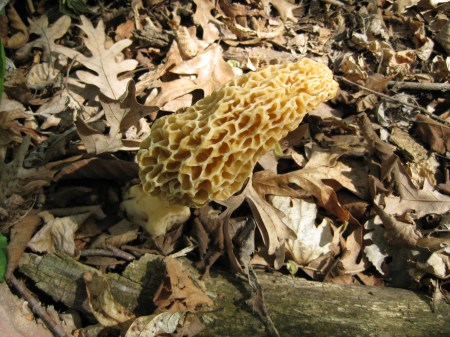
I finished planting corn Monday.  I celebrated by going Morel mushroom hunting with my Dad.  We found some beauties. 

We searched around dead or dying Elm trees.  Our forest has been ravaged by Dutch Elm disease.

Some Morels were boldly out in the open, like the one pictured above.  Most were hidden like the ones pictured below, and would be invisible to an untrained eye.  All were a pleasure to find and eat. 

IMG_0262

Why are Morels so delicious?  Mushrooms, and other protein-rich foods, are full of the fifth taste, Umami.  Umami is a Japanese word meaning, tasty.  Savory, brothy, meaty, are other ways to describe Umami.  Basically, it’s the taste of protein; or the taste as amino acids are broken down.  We all crave Umami and I enjoyed it in spades on the meat diet.

The four other main tastes are:  sweet, sour, salty, and bitter.  I was thinking metaphorically about the five tastes.  If I was to be described by one of the tastes, I would want to be Umami.  Tasty, hearty, interesting, challenging.   And I like to surround myself with Umami people.

Sweet is nice, but kind of uncomfortable for me.  Salty is the way I think of my Grandpa; cussing, telling stories about the old days.  Great quality for a grandpa.  Sour and bitter can describe many people.  I’m sure you will agree these people are simply endured and difficult to enjoy.

I’ll never be sweet or salty.  I could become sour and/or bitter.  I’m striving  to be Umami.  Which taste are you?


Contour Strip Cropping

May 17, 2009

IMG_0258

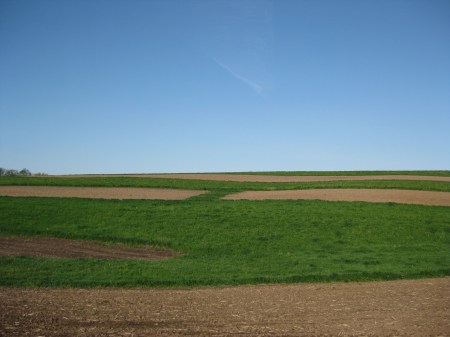
Contour strip cropping is a farming practice designed to minimize soil erosion.  Farming is practiced with the contour of the hillside or across the slope to slow water runoff during a rain.   Fields are arranged in alternating strips of an erodible cropping practice such as corn or soybeans with a soil conserving practice such as hay.

The picture above was taken today.  The tilled fields were planted to corn May 12th.  The green fields are alfalfa/orchardgrass hay fields which will be cut for hay three times in the summer and grazed by cattle once in the fall.

The narrow green strip in the middle of the corn field is a waterway.  It is important to not till in a natural swale or waterway to prevent erosion.  The large green strip across the bottom of the picture is the largest waterway on my farm.  The farmer who owned my farm before me said that when he bought the farm around 1940 there was a ditch big enough to drive a tractor in.  The early farmers didn’t understand some of the conservation practices we use today.  They cleared the land and plowed and planted wheat.


Baby Chicks

May 14, 2009


 IMG_0239

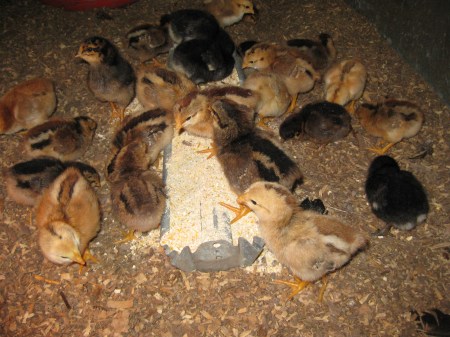
Kenosha elementary incubated 30 fertile eggs from my chickens.  They had 24 hatch; which is an 80% success rate.  Well done, roosters and hens.  Check out my protocol in the post, “Spring is here.”

The teachers said the students were ecstatic to see the chicks hatch after waiting three long weeks.  Other schools could do this project.  Incubators aren’t expensive.  Hook up with a local farmer.


No-till Planting Corn into Sod

May 9, 2009

IMG_0209

I no-till planted 25 acres of corn on Monday, May 4th.  This is our equipment, engaged in planting. 

IMG_0206

There are three wheels in this picture.  The first wheel is the coulter.  The coulter cuts a two-inch deep slot into the soil.  The next wheel is the depth wheel.  Not visible is the corn being deposited into the slot between the depth wheels.  The next wheel is the press wheel.  The press wheels close the seed furrow and press soil around the corn kernel.  All of these wheels are adjustable and we often adjust based on soil conditions.


Pork Carcass Breakdown: What to Expect

May 3, 2009

You want to buy pork, in bulk, direct from a farmer.  What should you expect?  Here is a link to pork carcass cutout charts.

Pork carcasses are usually sold as whole or half carcasses.  Traditionally, there are more cured and smoked products in a pork carcass resulting in a greater butchering cost when compared to beef.  I will detail a hog we butchered recently with butchering costs.

Description Weight Price Amount
Processing 172 lbs. $.45 $77.40
Cooling & Offal Pickup 172 lbs. $.22 $37.84
Hams 44 lbs. $.40 $17.60
Slicing Bacon 16 lbs. $.60 $9.60
Rolled shoulder 25 lbs. $.25 $6.25
Sausage Links 14 lbs. $.85 $11.90
Spare Ribs 10 lbs.    
Pork Chops 30 lbs.    


The total weight of the pork we took home was 139 lbs.  Some of the pork was lost as bones and other waste.  Pork carcasses will vary of course.  The amount of take-home pork will also vary based on the amount of processing, (i.e. deboning, etc.), you choose.

Based on $172 to the farmer and $160.59 to the butcher, the total cost is $332.59.  Divided by a take-home weight of 139 lbs., cost per lb. is $2.39.

Comment or email if you have questions.