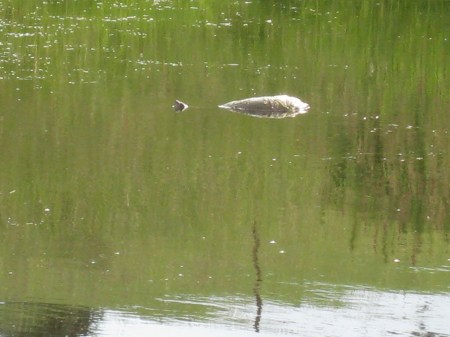
Nessie in Wisconsin?

June 30, 2009

IMG_0399


My childhood career choices vacillated between Sasquatch hunter and Loch Ness monster hunter.  So imagine my surprise when I saw this behemoth surface on a Wisconsin lake.  I snapped a quick picture before it dove.

I wouldn’t want to estimate it’s size because you wouldn’t believe me anyway.  However, I will no longer be enjoying Wisconsin’s waters.  I’m not going to divulge the location of this monster as Wisconsin’s tourism industry is huge and I wouldn’t want to hurt it.  And perhaps this leviathin is a herbivore.

Sightings of this Wisconsin Nessie are not without precedent.  Jay Rath has a chapter in this book, “The W-Files,” devoted exclusively to lake monsters.

“At one time or another, many Wisconsin lakes have boasted their very own saurian monster.  In 1867, for example, Lake Michigan’s sightings were so convincing that the Chicago Tribune announced, ‘that Lake Michigan is inhabited by a vast monster, part fish and part serpent, no longer admits of doubt.’  But despite the publicity lake monster stories once received, today they are largely forgotten.”

I am sharing this information with family and friends only.  I consider you, dear reader, a friend.


The Proof is in the Pudding

June 19, 2009

IMG_0350

Large hogs enjoying their last days on an alfalfa/grass pasture.

 Are you purchasing pastured meats for your health?  Or are you more concerned that the animals are free-range?

Free-range is great fun for livestock.  But without careful management, a pasture can quickly become a dirt lot, and the health benefits that come from eating quality pasture will disappear.

If you are purchasing pastured meats for your health, and want to verify that the animals are getting the majority of their nutrients from pasture, then there is one sure way to know.  Observe the animals’ manure.

 IMG_0327

This is the picture of hog manure from one of the hogs pictured above.  It is almost as green as cattle manure and contains less grain than the hog manure pictured below, which is from a hog receiving no pasture or forage.

IMG_0354

Now that you have this knowledge, I’m sure most of you won’t use it.  And I don’t blame you.  The joke in the movie, “Tommy Boy,” is, “You can stick your head up a steer’s ass to find out how good the steaks are;  but wouldn’t you rather take the butcher’s word for it?” I’m guessing most of you would rather take the farmer’s word for it, too.

I also have two nice pictures of contrasting cattle manure.  If anyone is interested, comment or email.


First Cutting of Hay

June 7, 2009

IMG_0307


June 5, 2009.  Hay fields raked and ready to be baled.  These are the same fields that were pictured May 17 in the post, Contour Strip Cropping. 

I cut the hay fields Tuesday and Wednesday to hopefully be ready to bale on Friday.  Wednesday, Thursday, and Friday were good drying days, (sunny, low humidity), so we baled dry hay Friday.  It is raining now, (Saturday).

Yields are lower than hoped for.  I kept my fields in hay for one year too many and the fields experienced some winter-kill.  Alfalfa is known to winter-kill as it ages depending on winter conditions.  Orchardgrass is also known to winter-kill, but we haven’t had any problems until this winter.  These fields were my first experience with an improved orchardgrass.  The variety is “Extend” from Lacrosse Forage.  It is less clumpy and matures later than the common orchardgrass.  I picked out and planted the seed and it did well for me. I guess I fell in love with it and didn’t feel like rotating into corn.  Curiousfarmer is sentimental.

27 acres yielded 65 big round bales of hay.  Each round bale weighs about 1500 lbs.  So the total yield was 97,500 lbs. of hay.  That is 3,600 lbs. per acre.  We hope to yield 4,000 to 4,500 lbs. per acre for first cutting, which is by far the highest yielding cutting.  I’m interested to see how our other hay fields yield.

We are about 20% done with first cutting.  We will cut again next week when the weather cooperates.


The Law of Supply and Demand in Action

June 4, 2009

The price of soybean meal has gone through the roof.  The last load we purchased was over $.20 per lb. which is 30% greater than  the price we paid in March.  We buy a 3 ton load every ten days to two weeks.  Our cost per load has increased $300.

Farmers gossip more than a murder of crows.  The latest “news” is that we’re going to run out of soybean meal this summer.  I panicked a little.  Our direct-market hogs are on an alfalfa pasture and would be ok if only fed corn.  The logistics of getting all of the rest of our hogs onto pasture scared and excited me.  I love a challenge.  Then I realized that I was reacting to gossip and didn’t need to get crazy just yet.

I did, however, call my feed salesman and determined that it would be cost effective to substitute lysine and threonine, the two most limiting amino acids in a corn/soy diet for hogs, for soybean meal.  So I did.

For hogs weighing 200 lbs. to market, I am substituting 3 lbs. of lysine and 1 lb. of threonine for 50 lbs. of soybean meal in every ton of feed.  3 lbs. of lysine costs $2.85.  1 lb. of threonine costs $1.38.  So the total extra cost is $3.93.  50 lbs. of soybean meal costs roughly $10.  So the savings is roughly $6 per ton of feed.  We use about 6 ton of this feed per week, so the savings is $36 per week.  If soybean meal stays high all summer until harvest, and the relative prices stay similar, we will save $432 over 12 weeks.

I realize this isn’t a huge savings.  But it felt good to take some action.  And the collective action by many soybean meal users will keep us from running out of soybean meal until harvest.  This is the Law of Supply and Demand in action.