Kiva: Microfinance With American Ingenuity

July 27, 2009

Can a loan of $500 dollars change someone’s life?  Microfinance says yes.  Microfinance is the supply of loans and other financial services to the poor. 

Muhammad Yunus is a Bangladeshi banker and economist.  While visiting a poor village near his university in Bangladesh in 1976,  Mr. Yunus was shocked to meet people kept in virtual servitude by usurious loans.  He made a loan of $27 to 42 women out of his own pocket.  This experience caused him to realize that an organization was needed that would provide banking services to the poor.  Grameen bank was born.

In 2006, Muhammed Yunus and Grameen bank were jointly awarded the Nobel Peace Prize “for their efforts to create economic and social development from below.”

Something about microfinance inspired me.  I like the idea of helping someone with their own idea.  After all, I’ve benefited from borrowing. 

I started looking for a way to get involved.  In 2007 I read that Premal Shah, the President of Kiva, was speaking in Madison.  Kiva is microfinance with American ingenuity.  Kiva’s mission is “to connect people through lending for the sake of alleviating poverty.”  “Kiva is the world’s first person-to-person micro-lending website, empowering individuals to lend directly to unique entreprenuers around the globe.”

I attended Mr. Shah’s invigorating talk.  The next day I made a loan of $25 dollars to Guloglan Agakishiev, who was running a butcher shop on what looked to be card tables.  Within a couple of months Guloglan had started repaying his loan of $1000 on schedule.  He finished repaying his loan in the fifteen months that was promised.

Testing Kiva even further, I let my money sit in their account and watched to see if they would sweep it into their coffers.  To their credit, they haven’t, and occasionally remind me that I have money in my account that could be loaned again or taken out.

Hooked, I started to give gift certificates to try to get more people involved.  And so now I am offering a $25 Kiva gift ceritificate to each of the first three people who comment.


A Fertility Mystery

July 23, 2009

IMG_0374


Oat/Barley field with a creek intersecting.  Notice the dark-green line in both fields with plants to the left of the line darker-green than plants to the right of the line.  Why?

I will explain how the field was managed.  Last year was a wet spring and I was unable to plant this field to oats like I had planned in April.  By the time I could work the soil around the first of June I decided to plant corn, instead.

I had read about grazing standing corn in the book, “Grassfed to Finish,” by Allan Nation.  Since I had low expectations about this field’s yield potential due to the late planting date, I decided this was the year to try this radical idea.  Even Citygirlfriend knew this was crazy.

It turned out ok, though.  I grazed eight steers for eight weeks starting in July when the corn was waist high and ending in August with the corn eight feet tall.  The steers gained well, about two lbs. a day, but that was no better than the steers that were grazing permanent pastures and alfalfa/grass hay fields.  So, since the gain was no better and the cost was higher to graze corn, I am not planning on grazing corn anytime in the future. 

The dark-green line is where I chopped down the corn and put up a single-strand electric fence.  I then cross-fenced and gave the steers a half-day to a day allotment at a time.  I also had a round bale of hay available so the steers would never accidentally run out of feed.

After the steers were butchered in August, I took down all the fencing and no-tilled oats into the bare ground.  I didn’t want the soil exposed to rain, sun, and wind.  So are you picturing how it looked?  To the right of the line was a corn field, and to the left of the line was oats.

We harvested the corn in October.  At this point, the oats were about knee-high.  We then grazed the field with the cows.  They ate much of the corn stalks and grazed the oats right down to the ground.

I disced the entire field this spring and then planted oats/barley and didn’t think twice about it.  And then I looked at it one day and noticed the line.  I knew I had to take a picture and present it to you.

The dark-green color indicates higher fertility and that higher fertility is probably more available nitrogen.  Why is there more nitrogen available?  What are the management differences?

The steers grazed and deposited their manure.  However, they wouldn’t have deposited their manure evenly.  You can see where cows deposited their manure on the right side as it shows up in darker-green clumps of forage.

I planted an oat cover crop.  Cover crops are supposed to add nitrogen to the soil.  Would it add nitrogen the next summer even though it was grazed off the previous October?

There was very little carbon on top of the soil this spring.  To the right of the line was corn stalks.  As microorganisms break down corn stalks, (carbon), nitrogen is used.  Maybe more nitrogen was available to the left of the line because of the lack of corn stalks.  This is where I’m placing my bet.

What do you think?  Is it one of these theories, or something else?  Your comments are welcome.


A Visit from Restaurant Magnus

July 12, 2009

IMG_0463

Owners and chefs from Restaurant Magnus visited our farms Sunday morning.  I applaud them for making the effort and taking the time for a farm visit.  It’s fun when someone is interested in what you are doing. 

Check out their menu.  Bold and creative.  Direct-marketing continues to introduce me to interesting people.


Knee-high by the Fourth of July

July 6, 2009

IMG_0458


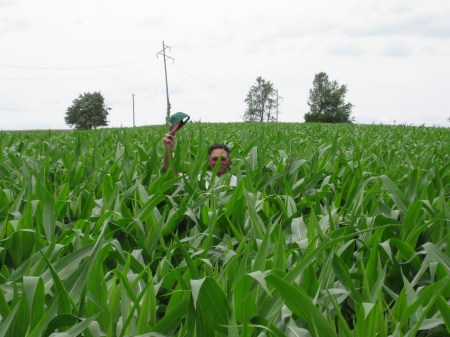
My six-foot-tall father standing in our tallest corn on July 3rd.

Knee-high by the Fourth of July is a common saying in the midwest.  It refers to the height of corn.  I guess that used to be a decent target for corn in the old days.  Corn is planted earlier now.

IMG_0453


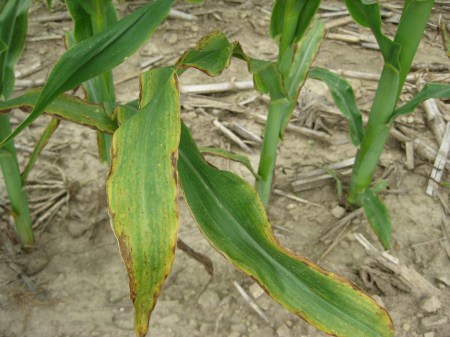
This is a corn plant showing potassium deficiency.  Yellowing on the outside of the lower leaves is the telltale sign.  This plant is alongside a gravel road so it probably has more to do with soil compaction and the inability of the corn roots to search out available potassium than an actual potassium deficiency in the soil.  The corn looks fine a few rows in.

It’s enlightening  that corn shows it’s deficiencies so readily.  What if our personal deficiencies were as visible?