2009 Hay and Forage Summary

September 25, 2009

IMG_7390

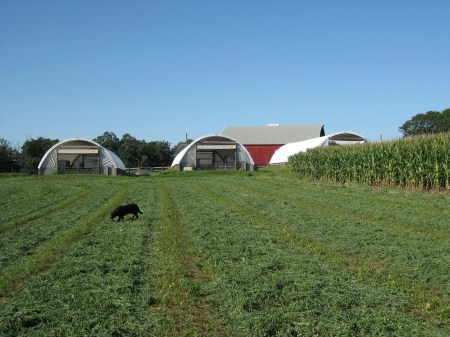
Cattle grazing my best hay field, September 24, 2009.

In my post, “2009 New Hay Seeding,” I promised summer yield statistics.  When the cattle finish grazing the hay field pictured, every hay field will have been harvested or grazed three times.  Here are the statistics.

All the hay was baled in 1500 lb. round bales.  Estimated moisture content is 15%.

1st cutting: 120.4 acres, 341 bales, 511,500 lbs., 4,248 lbs./acre.

2nd cutting: 82.1 acres, 127 bales, 190,500 lbs., 2,320 lbs./acre.

3rd cutting: 61.3 acres, 68 bales, 102,000 lbs., 1,664 lbs./acre.

Total: 88 average acres, 536 bales, 804,000 lbs., 9,136 lbs./acre.

The reason the number of acres declines from one cutting to the next is because I start grazing selected hay fields with the cattle instead of harvesting them by machine.  I do this to help mitigate the summer slump in pasture growth and keep my cattle gaining well.

I graze fields which are self-contained, (no corn strips as cattle are hard to keep out of corn fields).  And prefer fields which are difficult to access with manure.  Without manure, fields decline in fertility.  Grazing, instead of machine harvesting and feeding elsewhere, keeps more of the soil’s fertility in place.

Hay fields were grazed with the mob of 134 cows and 134 calves and 5 herd bulls.  Here are the grazing statistics:

1st grazing: 38.3 acres, 10 days, 3.83 acres/day.

2nd grazing: 59.1 acres, 15 days, 3.94 acres/day.

1st grazing corresponds to 2nd cutting and 2nd grazing corresponds to 3rd cutting.  So if I take the average yield for 2nd and 3rd cutting and multiply by the number of acres grazed/day, I find the equivalent amount of forage the mob was eating.

1st grazing: 3.83 acres x 2,320 lbs. = 8,885 lbs./day.

2nd grazing: 3.94 acres x 1,664 lbs. =6,556 lbs./day.

I’ll have to do more “cipherin” to figure if it’s more economical to hay or graze.  I do most of my heavy thinkin’ in the winter and will have an updated post for you then.  I’ll tell you one thing.  I prefer to graze 2nd and 3rd cutting and oftentimes that is how farmers make decisions.

Below is a close-up picture of the field pictured above.  It is 1st year hay with what I consider  the ideal mix of grass to hay.  My recipe was 10 lbs. alfalfa, 2lbs. Climax Timothy, and 4 lbs. Baraula Orchardgrass from Barenbrug Seeds.  Baraula is the latest maturing Orchardgrass I have ever used and I will be planting more of it next year.   This field yielded tremendously and makes me think about the potential for my farm.  Here are the statistics:

1st cutting: 12.1 acres, 61 bales, 91,500 lbs., 7,500 lbs./acre, 77% better than the average.

2nd cutting: 12.1 acres, 29 bales, 43,500 lbs., 3,595 lbs./acre, 55% better than the average.

As shown, it is being grazed now.  I was late getting the mob to this field so it will not be grazed anymore this year.  Most of the other hay fields will be grazed by the cattle in October/November after a killing frost but before the snow flies.

IMG_7397


Farming Fun With Friends

September 15, 2009

IMG_7363


Posed photo:  manure spreader and rented “bobcat” loader in hoop building after cleaning out and adding two loads of lime.

My father and farming partner had surgery for colon cancer two weeks ago.  He is home and recovering but will not be able to lift anything for a few more weeks.   

It’s been a challenging couple of weeks working without him.  Thank God I have friends and family willing to pitch in and help me out.  Thank you.  Some jobs are almost impossible alone.

I finished baling the 3rd cutting of hay.  We were blessed with dry weather which was necessary to make dry hay this time of year. 

After that I needed to clean out a hoop building and spread the manure on the designated hay strips which will be corn next year.  Two friends each ran a tractor with manure spreader for me.  I loaded the manure with the rented “bobcat.”

The “bobcat” probably costs more than $30,000 new.  But we can rent it for $150-200 dollars and get a hoop building clean.  It has tracks like a bulldozer so it works great on the dirt floor of the hoop building.  In 3-4 hours I can have 20+ loads of manure spread on my fields and a clean hoop building.

After that I put 1-2 loads of lime, (crushed limestone), on the floor of the hoop building to reestablish a base.  Lime is considered a fertilizer for crops and works great in this capacity because it packs kind of like wet sand.

I’ll let the hoop building set empty until I’m ready to put pigs into it and then I will unroll straw or cornstalk bedding and I’m ready to go.  We won’t clean the hoop building out again until the next batch of pigs goes to market.

It’s fun to complete a task with friends.  And it’s fun to run a “bobcat”.  This is farming fun with friends!


Money is the Only Thing That Can Be Insured

September 8, 2009

IMG_7333

Nothing in this picture is insured, not the barn, not the hoop buildings, not the crops, not even the dog.  I only insure that which would be financially devastating to replace.   Am I a reckless wildman of the north woods?  Or am I an astute businessman? 

I go over my farm insurance with my agent nearly every year.  A few years ago he pushed a paper across his desk and asked me to sign it.

“What’s this?” I asked.

“Oh, it’s just a waiver.  The insurance company won’t insure the hoop buildings for wind or hail.”

“Hmmm,” I scratched my head and smiled.  “What else could happen to them?” I asked.

“Oh, someone could take a knife and run along them,” he said, still trying to make the sale.

I thought to myself, “If someone is doing that, then I have bigger problems than hog housing.” 

“I guess I’ll take my chances,” I said and pushed the paper back across his desk.  “Let’s go over the rest of the policy.”  Now I was in a cutting mood and starting to get the high a spendthrift feels upon finding a nickel.

“The barn is insured for $10,000,” he said.

The premium for the barn was $150.  I thought about how little economically I use the barn.  I keep a few square bales of hay and straw in the top and I keep my chickens, (which is a hobby), in the bottom.  But I love that big, old, red barn.  If I were to drop the insurance I would somehow feel like I was neglecting the barn.

“We both know it couldn’t be replaced for $10,000,” he said.

Never talk through the close.

I perked up.  “You’re right, it couldn’t be replaced for $10,000.”

“But you could build something else, like a pole shed,” he stammered as he felt another premium slipping away.

I thought to myself, “If I wanted a pole shed, I would build a pole shed.  What I want is this barn, and the only real insurance is to avoid fires, keep up the roof and structure, and pray.”

What I was in considering in actuality was a $150 lottery ticket which would pay out $10,000 and the only way to win was for my barn to burn down.  I didn’t want any part of it.

So the test I came up with is, Could I afford to lose it?  What I was left with is insurance on my house and garage and personal belongings for $200,000 for a premium of $316 per year.  $500,000 liability for $82.  $36 because I have a 4-wheeler.  And an $18 policy fee which is unexplainable and would drive me crazy if I gave it much thought so I won’t for now.

So what do you think?  Was I raised by wolves?