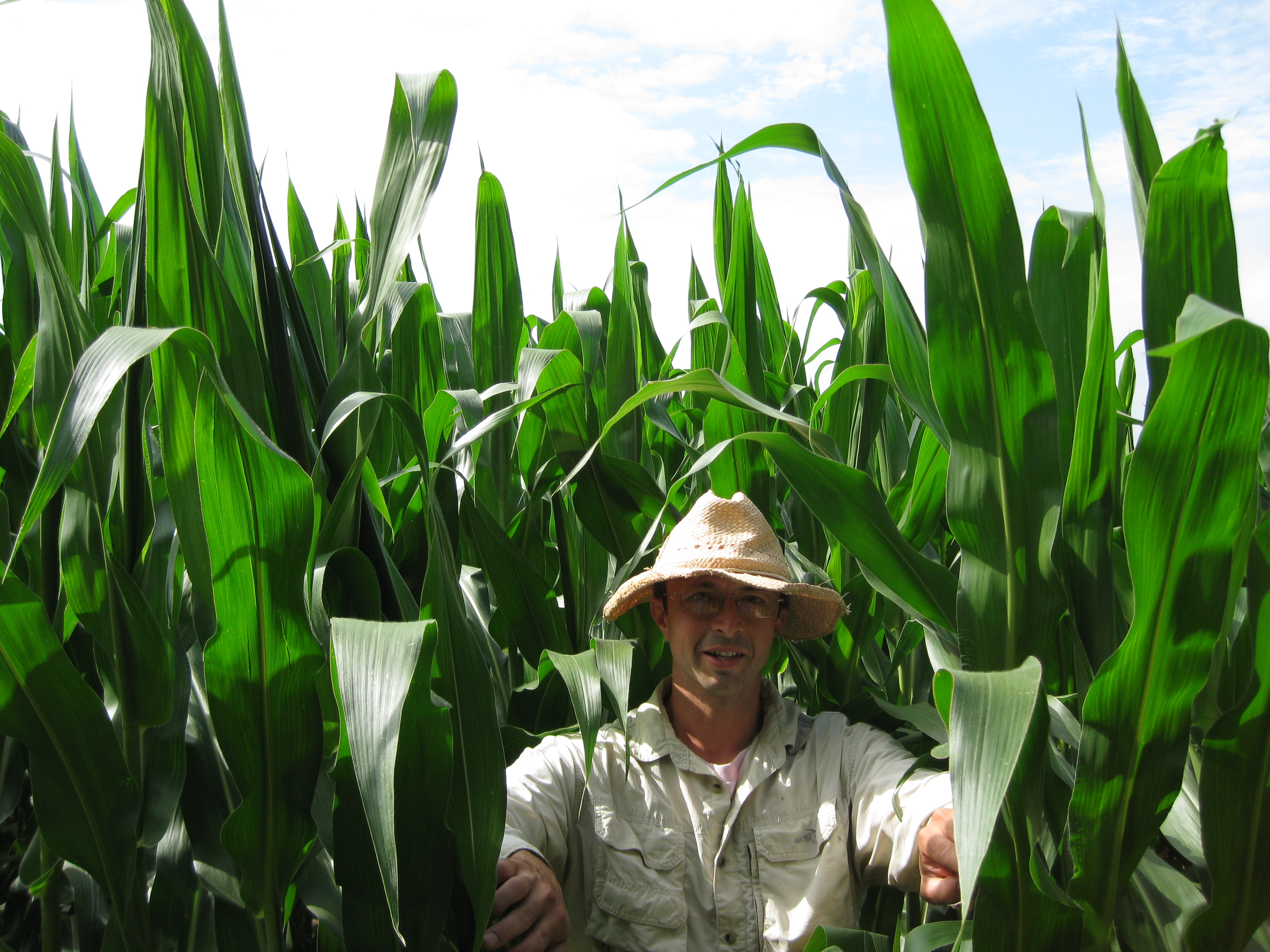
Our tallest corn. We planted all of our corn April 19-23rd. Growing conditions have been ideal, with rain every few days and a hot, very humid June. I don’t know if we have ever had taller corn on the 4th.
Our tallest corn. We planted all of our corn April 19-23rd. Growing conditions have been ideal, with rain every few days and a hot, very humid June. I don’t know if we have ever had taller corn on the 4th.
 1 Comment |
  Curious crops |
  Permalink
 Posted by Curiousfarmer
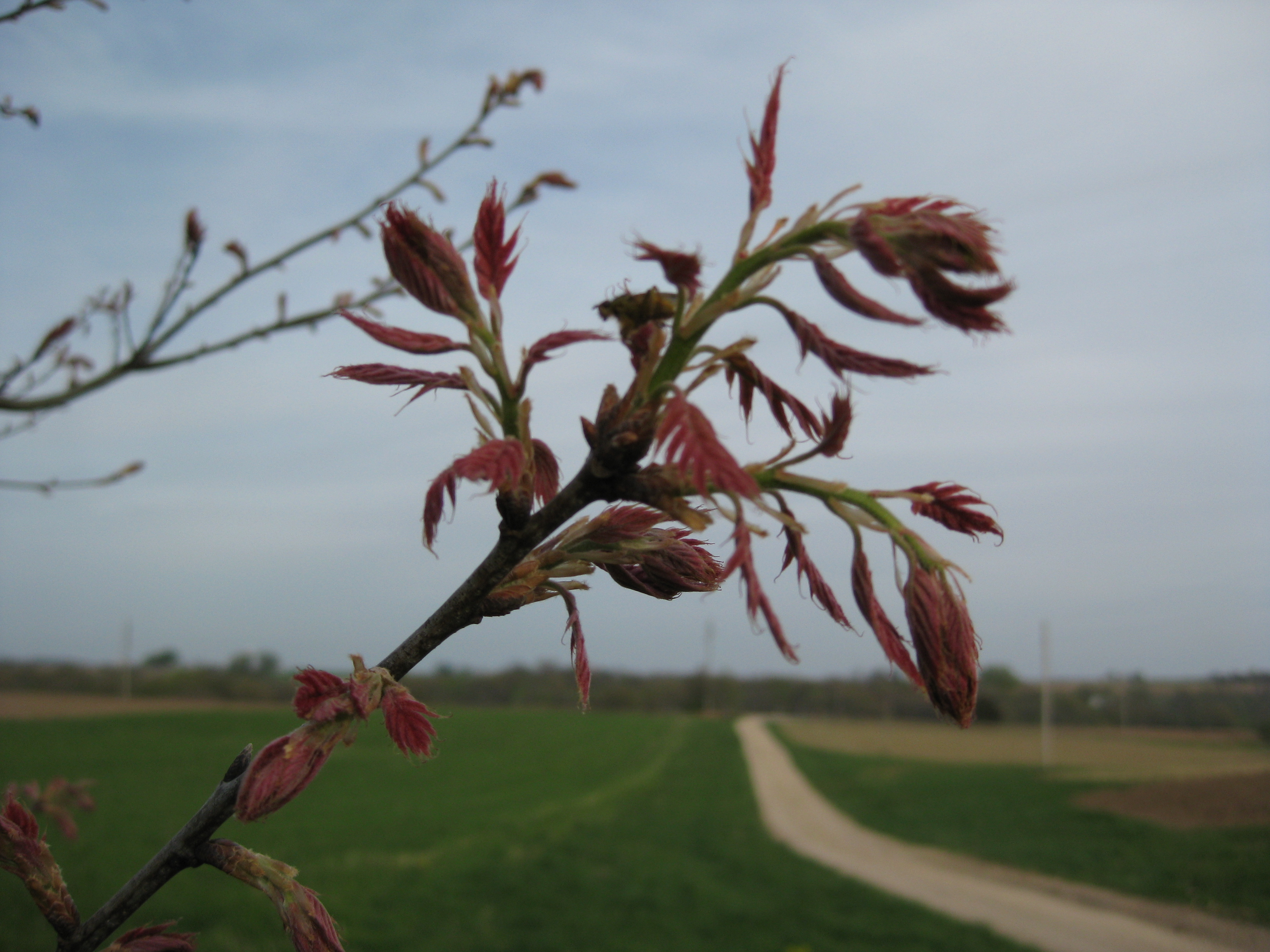
“When the oak leaf is the size of a squirrel’s ear, it’s corn planting time.” Old farmer saying.
I finished planting corn last week. April 23rd is the new record.
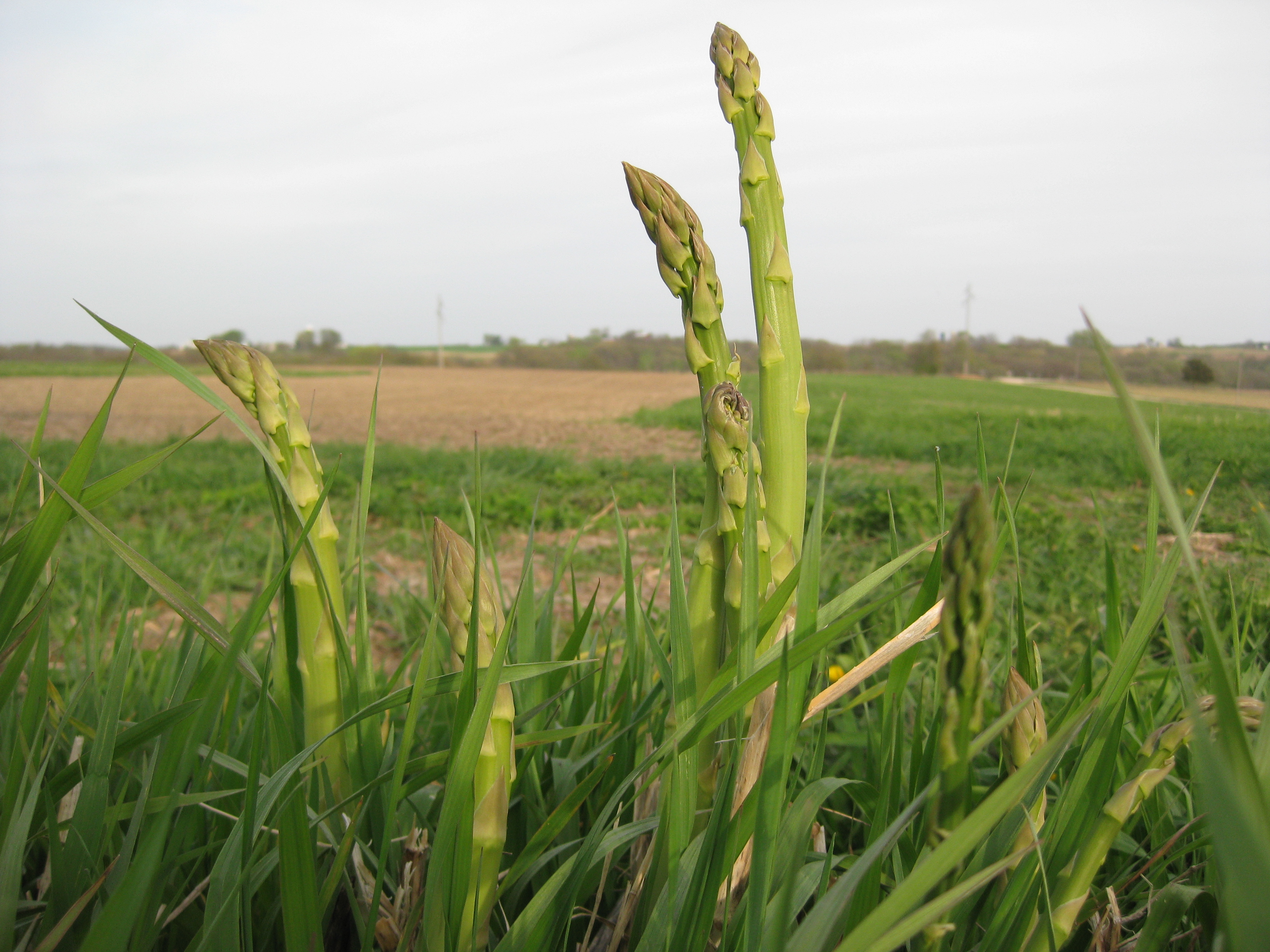
It is an early spring. Look at the asparagus in the old fence row.
Leave a Comment » | Curious crops, Curious food | Permalink
Posted by Curiousfarmer
Do you know how many seeds per square foot you are planting? I didn’t, until I read an interesting article titled, “The Forage Seeding Gamble” by Fae Holin.
It’s interesting that my planned recipe for this year’s seeding, 10 lbs. alfalfa, 5 lbs. orchardgrass, and 2 lbs. Timothy, results in 50 alfalfa seeds per sq. foot, 55 orchardgrass seeds per sq. foot, and 58 timothy seeds per sq. foot, according to the author’s calculations. Very similar number of seeds per sq. foot.
I’m surprised I had never figured this out before as the calculations are not that difficult. First, you need to find the number of seeds per lb. I found several sources on the web, all with different numbers. I guess people get bored counting thousands of seed and just start to estimate. Here is a nice chart with reasonable numbers.
To find the seed per sq. foot with 1 lb. per acre, just divide the number of seeds in a lb. by the number of sq. feet in an acre. We’ll use alfalfa as an example. Alfalfa has 227,000 seeds per. lb. on the previous chart. We know there is 43,560 sq. feet in an acre. So 227,000 divided by 43,560 equals roughly 5 seeds per sq. foot. If we plant 10 lbs. per acre then just multiply 10 by the number of seeds per sq. foot with 1 lb. per acre and you have 50 seeds per sq. foot when planting 10 lbs. per acre.
Another calculation which I had never considered is seeds per dollar. I’m not sure how useful this calculation is, but I find it interesting.
Here are my figures for this year. K500 alfalfa, 227,000 seeds per lb., $2.58 dollars per lb., equals 87,984 seeds per dollar. Climax timothy, 1,152,000 seeds per lb., $1.06 dollars per lb., equals 1,086,792 seeds per dollar. Baraula orchardgrass, 416,000 seeds per lb., $2.44 dollars per lb., equals 170,492 seeds per dollar. Seed seems less expensive now.
Now that I know how many seeds per sq. foot I’m planting, I wonder how many actually grow. It would be interesting to get down on my hands and knees and do some counting this summer. One thing always leads to another in an interested life!
1 Comment | Curious crops, Curious forage | Permalink
Posted by Curiousfarmer
Rejoice! Baraula Orchardgrass seed is a steal this year compared to last year.
In my post, “2009 New Hay Seeding,” I detail how I planted a field to Baraula Orchardgrass and Alfalfa. I didn’t plant any Baraula in 2009 because I was waiting to evaluate the quality and yield. It was outstanding and I wrote about it in my post, “2009 Hay and Forage Summary.”
When I received the 2010 Welter seed catalog I immediately flipped to Baraula Orchardgrass and was happily surprised by the price of $122 for a 50 lb. bag. Last year the price was $200.
I emailed Welter’s and asked why. They said there is a much better supply this year.
The “law of supply and demand” works. But it’s important to remember it may be supply and/or demand affecting the price. I assumed the demand for Baraula must have been through the roof. Looking back now I see all the Orchardgrasses were higher priced. The seed companies must have had a poor yielding year. So the price was affected more by supply than demand.
I realize I need to do what’s right for my farm. I’m glad I tried some other species of grass last year as I look forward to evaluating them.
As for this year’s new seeding I’m going to plant all 59 acres to K500 Alfalfa, Climax Timothy, and Baraula Orchardgrass.
Leave a Comment » | Curious crops, Curious forage | Permalink
Posted by Curiousfarmer

“There’s always something!” common quote by farmers usually said with a shrug and tired smile.
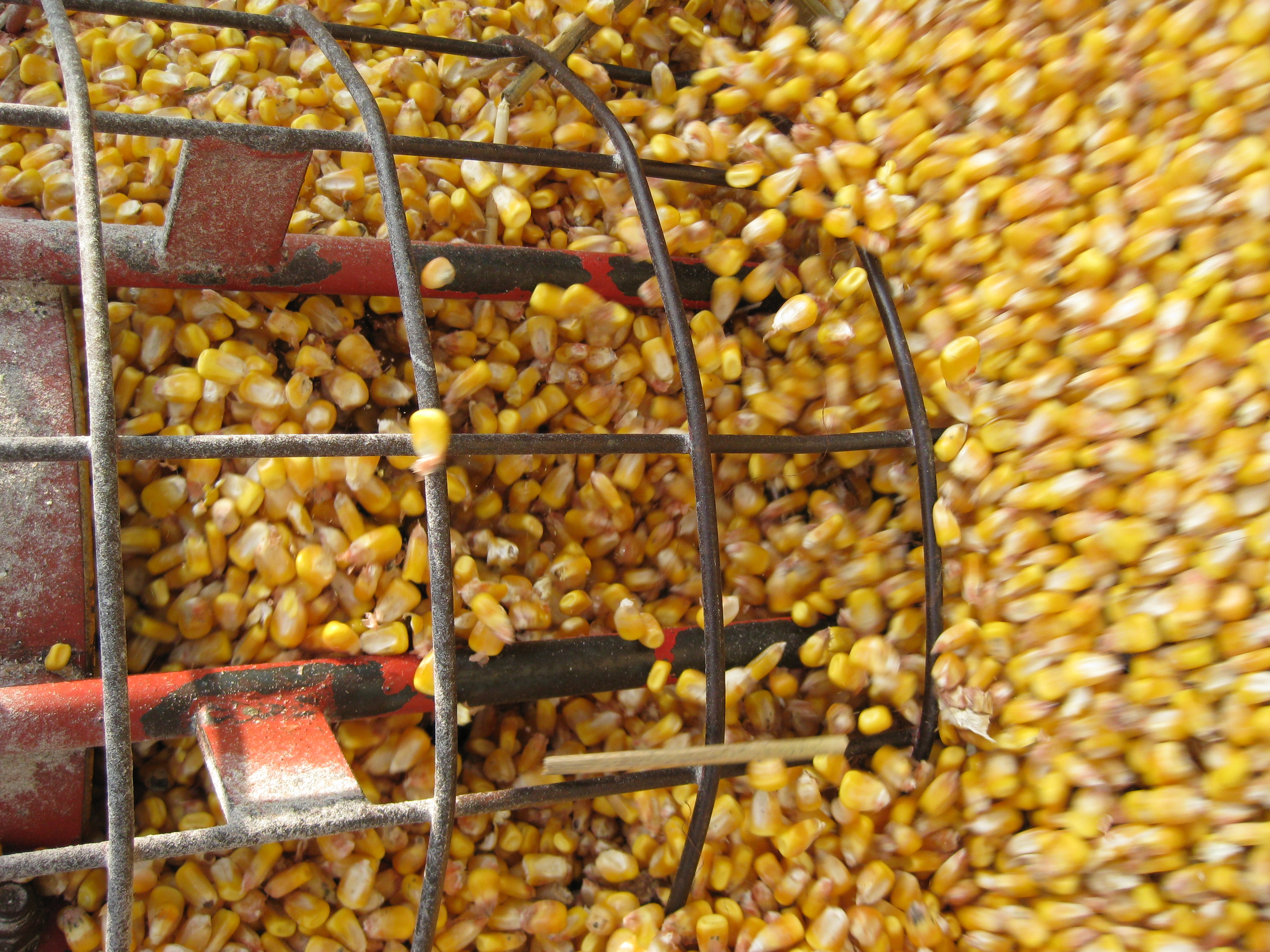
This farming game is tough. The something right now is mycotoxins in the 2009 corn crop.
Mycotoxins are by-products of mold growth. Animals exhibit poor health when fed grains contaminated with mycotoxins.
Our feed salesman took a sample of our corn expecting to find high levels of the three mycotoxins being found in this year’s corn crop. He said that much of the corn crop in Ohio was contaminated and he had already found high levels of mycotoxins in some of his customers’ corn in Wisconsin.
He knew of a farmer who still had much of the 2008 corn crop on hand and counseled us that we should try to sell our 2009 corn and buy his old corn. This would be a logistical headache for us. Thankfully, we didn’t have to consider this.
We sent a sample of our corn to Holmes Laboratory Inc. in Ohio. The test came back with acceptably low levels of Vomitoxin, Zearalenone, and Fumosin. Two months ago I had never heard of these three mycotoxins. Aflatoxin was the only mycotoxin I had ever heard of.
If your corn does have high levels of mycotoxins, you can blend with good corn to reduce the level of mycotoxin in the feed. You can also put additives in the feed that absorb and bind the toxin or deactivate it. JBS United conducts research on the effectiveness of additives.
I have no idea why our corn has low levels of mycotoxins while others find high levels. Sometimes it’s better to be lucky than good.
Leave a Comment » | Curious crops, Curious hogs | Permalink
Posted by Curiousfarmer

Cattle grazing my best hay field, September 24, 2009.
In my post, “2009 New Hay Seeding,” I promised summer yield statistics. When the cattle finish grazing the hay field pictured, every hay field will have been harvested or grazed three times. Here are the statistics.
All the hay was baled in 1500 lb. round bales. Estimated moisture content is 15%.
1st cutting: 120.4 acres, 341 bales, 511,500 lbs., 4,248 lbs./acre.
2nd cutting: 82.1 acres, 127 bales, 190,500 lbs., 2,320 lbs./acre.
3rd cutting: 61.3 acres, 68 bales, 102,000 lbs., 1,664 lbs./acre.
Total: 88 average acres, 536 bales, 804,000 lbs., 9,136 lbs./acre.
The reason the number of acres declines from one cutting to the next is because I start grazing selected hay fields with the cattle instead of harvesting them by machine. I do this to help mitigate the summer slump in pasture growth and keep my cattle gaining well.
I graze fields which are self-contained, (no corn strips as cattle are hard to keep out of corn fields). And prefer fields which are difficult to access with manure. Without manure, fields decline in fertility. Grazing, instead of machine harvesting and feeding elsewhere, keeps more of the soil’s fertility in place.
Hay fields were grazed with the mob of 134 cows and 134 calves and 5 herd bulls. Here are the grazing statistics:
1st grazing: 38.3 acres, 10 days, 3.83 acres/day.
2nd grazing: 59.1 acres, 15 days, 3.94 acres/day.
1st grazing corresponds to 2nd cutting and 2nd grazing corresponds to 3rd cutting. So if I take the average yield for 2nd and 3rd cutting and multiply by the number of acres grazed/day, I find the equivalent amount of forage the mob was eating.
1st grazing: 3.83 acres x 2,320 lbs. = 8,885 lbs./day.
2nd grazing: 3.94 acres x 1,664 lbs. =6,556 lbs./day.
I’ll have to do more “cipherin” to figure if it’s more economical to hay or graze. I do most of my heavy thinkin’ in the winter and will have an updated post for you then. I’ll tell you one thing. I prefer to graze 2nd and 3rd cutting and oftentimes that is how farmers make decisions.
Below is a close-up picture of the field pictured above. It is 1st year hay with what I consider the ideal mix of grass to hay. My recipe was 10 lbs. alfalfa, 2lbs. Climax Timothy, and 4 lbs. Baraula Orchardgrass from Barenbrug Seeds. Baraula is the latest maturing Orchardgrass I have ever used and I will be planting more of it next year. This field yielded tremendously and makes me think about the potential for my farm. Here are the statistics:
1st cutting: 12.1 acres, 61 bales, 91,500 lbs., 7,500 lbs./acre, 77% better than the average.
2nd cutting: 12.1 acres, 29 bales, 43,500 lbs., 3,595 lbs./acre, 55% better than the average.
As shown, it is being grazed now. I was late getting the mob to this field so it will not be grazed anymore this year. Most of the other hay fields will be grazed by the cattle in October/November after a killing frost but before the snow flies.

Leave a Comment » | Curious cattle, Curious crops, Curious forage | Permalink
Posted by Curiousfarmer

Harvesting oats/barley with our 1970’s era Massey Ferguson combine. I won’t know an exact yield until I have fed all of it to our hogs over the next year. We finished baling the straw on Friday.
Oats/barley is higher in protein and fiber than corn, but lower in energy. I use oats/barley in the hog rations at a rate of 20% of the ration when it’s available. So that’s 400 lbs. per ton. I reduce the soybean meal by 50 lbs. per ton when I include oats/barley in the ration. I see no noticeable difference in hog performance at this inclusion rate.
1 Comment | Curious crops, Curious hogs | Permalink
Posted by Curiousfarmer

Oat/Barley field with a creek intersecting. Notice the dark-green line in both fields with plants to the left of the line darker-green than plants to the right of the line. Why?
I will explain how the field was managed. Last year was a wet spring and I was unable to plant this field to oats like I had planned in April. By the time I could work the soil around the first of June I decided to plant corn, instead.
I had read about grazing standing corn in the book, “Grassfed to Finish,” by Allan Nation. Since I had low expectations about this field’s yield potential due to the late planting date, I decided this was the year to try this radical idea. Even Citygirlfriend knew this was crazy.
It turned out ok, though. I grazed eight steers for eight weeks starting in July when the corn was waist high and ending in August with the corn eight feet tall. The steers gained well, about two lbs. a day, but that was no better than the steers that were grazing permanent pastures and alfalfa/grass hay fields. So, since the gain was no better and the cost was higher to graze corn, I am not planning on grazing corn anytime in the future.
The dark-green line is where I chopped down the corn and put up a single-strand electric fence. I then cross-fenced and gave the steers a half-day to a day allotment at a time. I also had a round bale of hay available so the steers would never accidentally run out of feed.
After the steers were butchered in August, I took down all the fencing and no-tilled oats into the bare ground. I didn’t want the soil exposed to rain, sun, and wind. So are you picturing how it looked? To the right of the line was a corn field, and to the left of the line was oats.
We harvested the corn in October. At this point, the oats were about knee-high. We then grazed the field with the cows. They ate much of the corn stalks and grazed the oats right down to the ground.
I disced the entire field this spring and then planted oats/barley and didn’t think twice about it. And then I looked at it one day and noticed the line. I knew I had to take a picture and present it to you.
The dark-green color indicates higher fertility and that higher fertility is probably more available nitrogen. Why is there more nitrogen available? What are the management differences?
The steers grazed and deposited their manure. However, they wouldn’t have deposited their manure evenly. You can see where cows deposited their manure on the right side as it shows up in darker-green clumps of forage.
I planted an oat cover crop. Cover crops are supposed to add nitrogen to the soil. Would it add nitrogen the next summer even though it was grazed off the previous October?
There was very little carbon on top of the soil this spring. To the right of the line was corn stalks. As microorganisms break down corn stalks, (carbon), nitrogen is used. Maybe more nitrogen was available to the left of the line because of the lack of corn stalks. This is where I’m placing my bet.
What do you think? Is it one of these theories, or something else? Your comments are welcome.
1 Comment | Curious crops | Tagged: crops, fertility, oats | Permalink
Posted by Curiousfarmer
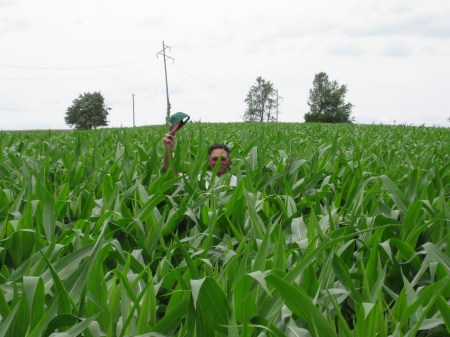
My six-foot-tall father standing in our tallest corn on July 3rd.
Knee-high by the Fourth of July is a common saying in the midwest. It refers to the height of corn. I guess that used to be a decent target for corn in the old days. Corn is planted earlier now.
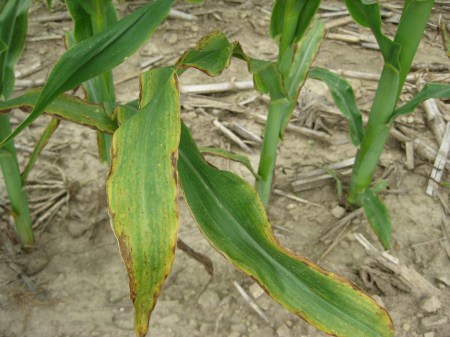
This is a corn plant showing potassium deficiency. Yellowing on the outside of the lower leaves is the telltale sign. This plant is alongside a gravel road so it probably has more to do with soil compaction and the inability of the corn roots to search out available potassium than an actual potassium deficiency in the soil. The corn looks fine a few rows in.
It’s enlightening that corn shows it’s deficiencies so readily. What if our personal deficiencies were as visible?
2 Comments | Curious crops | Tagged: crops, deficiencies | Permalink
Posted by Curiousfarmer

June 5, 2009. Hay fields raked and ready to be baled. These are the same fields that were pictured May 17 in the post, Contour Strip Cropping.
I cut the hay fields Tuesday and Wednesday to hopefully be ready to bale on Friday. Wednesday, Thursday, and Friday were good drying days, (sunny, low humidity), so we baled dry hay Friday. It is raining now, (Saturday).
Yields are lower than hoped for. I kept my fields in hay for one year too many and the fields experienced some winter-kill. Alfalfa is known to winter-kill as it ages depending on winter conditions. Orchardgrass is also known to winter-kill, but we haven’t had any problems until this winter. These fields were my first experience with an improved orchardgrass. The variety is “Extend” from Lacrosse Forage. It is less clumpy and matures later than the common orchardgrass. I picked out and planted the seed and it did well for me. I guess I fell in love with it and didn’t feel like rotating into corn. Curiousfarmer is sentimental.
27 acres yielded 65 big round bales of hay. Each round bale weighs about 1500 lbs. So the total yield was 97,500 lbs. of hay. That is 3,600 lbs. per acre. We hope to yield 4,000 to 4,500 lbs. per acre for first cutting, which is by far the highest yielding cutting. I’m interested to see how our other hay fields yield.
We are about 20% done with first cutting. We will cut again next week when the weather cooperates.
Leave a Comment » | Curious crops | Tagged: crops, hay | Permalink
Posted by Curiousfarmer
 Curiousfarmer