2017 Spring Calving, Fatty Udder Syndrome

May 21, 2017


Some years we can’t remember helping a single calf nurse.  This calving season has been difficult, with one problem after another.  Sometimes we have had more than one problem pair in our corral, which is where we keep the pairs separated if they are having problems until they can be on their own.

Admittedly, a big source of our problems this year has been our decision to keep and calve very old cows.  Cows that are productive into old age is a nice problem to have, and one that I largely attribute to a better nutrition and feeding strategy.  Better rotational grazing has improved the green season nutrition, and unrolling round bales of hay has improved the winter nutrition.  Unrolling the hay instead of feeding in feeders reduces the competition with younger, stronger, cows, and it is also easier to chew as the hay is loose after unrolling instead of packed densely.  Older cows teeth wear down, resulting in more difficulty chewing which can become a nutrition issue.

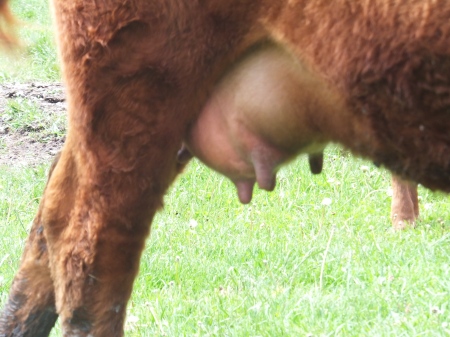
Unfortunately, older cows udders break down over age and the teats become larger, sometimes resulting in teats so large a newborn calf fails to get started nursing.  We get the pair into the corral and the cow in the catch chute and help the newborn calf nurse.  Usually one or two nursings will be enough for the calf to get the idea and start nursing on its own.  When we see the calf nursing on its own, we turn the pair back out to pasture with the herd.  Annoying, but doable.

But the problem which has baffled us this spring and a couple of times in the past few years, is when a heifer calved without problem, but failed to produce any or enough milk for her newborn calf.  Until a few years ago, we had never seen this problem.  But it has happened again, and this time with this beautiful heifer, 527, pictured above.  We called our local vet and she took the heifer’s temperature and palpated her udder, assuring us there was no discernible health issue.  The udder is soft, not hard as if it had mastitis.  And there is no pussy discharge, just nothing.  The vet didn’t have a theory, which is frustrating, but also a relief that the heifer wasn’t sick and we weren’t having a disease problem.

So we started brainstorming.   What is different about our herd?

Genetically, the base breed going back to my Grandfather’s cattle was Shorthorn.  We used some Lincoln Red genetics in the 80s and 90s, an ill-advised foray into Maine Anjou genetics in the 90s, and finally, when we could no longer find good Shorthorn bulls, we started using Red Angus genetics around the year 2000 and have been very pleased with the results.  Our cattle are moderate- framed, thick-made, and able to finish on grass, which worked great when I began to direct-market grass-finished cattle around 2008.

Red Angus genetics didn’t seem to change the udders of our cattle very much.  I would say the conformation of the udders would be a little better and they give a little less milk.  Shorthorns are known for producing a lot of milk for a beef breed, so it makes sense that Red Angus would decrease the amount of milk, but not by much. I don’t think the problem is genetics.

We have improved our pastures and especially the rotation and resting of the pastures as we’ve implemented our own version of mob-grazing.  And we’ve started grazing some hay pastures during the summer slump when some of the cool season grasses are growing very slowly.  The end result is our cattle are gaining better than they ever have, with some of the fastest-gaining calves gaining close to 3 lbs per day from birth to weaning.  We recently viewed an old vhs tape of our cattle in the 80s, and the difference was remarkable.  Without video evidence, we never would have believed how much better the pastures and how much thicker our cattle are now.

Why am I writing about how fast the cattle are gaining?  Sometimes I have an insight or notion which I’m not sure where it comes from.  Maybe I read something sometime.  I don’t know.  But I woke up one morning with a theory that the reason these heifers have no milk is that during a critical stage in their mammary development, they were gaining weight so rapidly, instead of normal mammary development, their udder became fatty.

I asked the vet and she didn’t think it made much sense.  We even stopped in one day and visited our old retired vet from Mineral Point, and he didn’t think this theory made much sense.  Undaunted, I was going to put this theory onto the internet and see if any of you concurred.  But a little research, and a few key articles later, of which I will link to, I’m 99% sure this is what is happening to these heifers.

The reason we need to decide on a theory is because it will affect our decision making.  If for some reason these heifers are genetically deficient in milk, we would want to purchase bulls with higher milk epds, (expected progeny difference).  But if my theory is correct, and these heifers are actually receiving too much nutrition, then we would want to select bulls with lower milk epds.

The first article I found that pertained was written by University of Illinois extension in 1999.  They talked about the five different stages of mammary development and how sometimes mammary development is isometric, (growing at similar rates as the rest of the body), and other times mammary development is allometric, (growing at two to four times the rest of the body). A key allometric stage is prepuberty, 3 to 9 months of age.  This paragraph was particularly illuminating:

“Prepubertal nutrition can have a significant effect on future milk yield. Raising heifers on high planes of nutrition during prebubertal mammary growth has been shown to have a negative effect on milk yield. Feed restricted heifers can have up to 30 percent larger mammary glands at puberty. Furthermore, mammary tissue on heifers fed ad libitum was over 80 percent fat, while heifers fed a restricted diet have around 65 percent fat, and 13 percent more parenchymal tissue (tissue that will eventually become milk producing tissue) compared with heifers fed ad libitum. It should be noted that mammary parenchymal tissue grows into a layer of fat referred to as the fat pad.”

Ok, are you convinced yet?  I also found this article published in Asian-Australasian Journal of Animal Science.  Both articles are written pertaining to the dairy industry, as most dairy heifers are raised in confinement on a diet that can be regulated.  They suggest a feeding strategy which restricts the diet at critical times during mammary development, and then more feed at other times so as to not waste time and money as the sooner a heifer is producing milk, the more profitable the industry feels the dairy producer will be.

However, I’m wondering if the dairy industry is thinking about this wrongheaded?  A big problem in the confinement dairy industry is how quickly cows are “burnt up”, (culled for one reason or another).  I used to think the reason that cows fell out of production so fast was because of the way they are managed as cows.  But actually, dairy cattle are on a fasttrack from birth.

Maybe the dairy industry should go to a policy of raising their replacement heifers slowly on a high forage diet.  Maybe they shouldn’t worry so much about rushing a heifer into production by age two, and instead should be satisfied with a heifer calving at two and a half or three years of age?  Most of the big dairy farmers in my area are outsourcing the raising of their dairy heifers.  There may be an opportunity for farmers to do a better job with this?  I don’t know.

As far as our problem, so far we have had a very few that exhibited this problem.  I would hate to change the way we are managing our cattle and pastures as the whole herd is doing so well with our rotational grazing.  I’m thinking our problem is rare and only affecting a very few heifers that may be very early maturing, thereby coinciding the allometric mammary growth phase at just the wrong time when they are gaining 3 lbs per day.  Not sure, but I will continue to monitor.


Pick the Best Sow Contest: Conclusion

May 4, 2016

DSCF2373


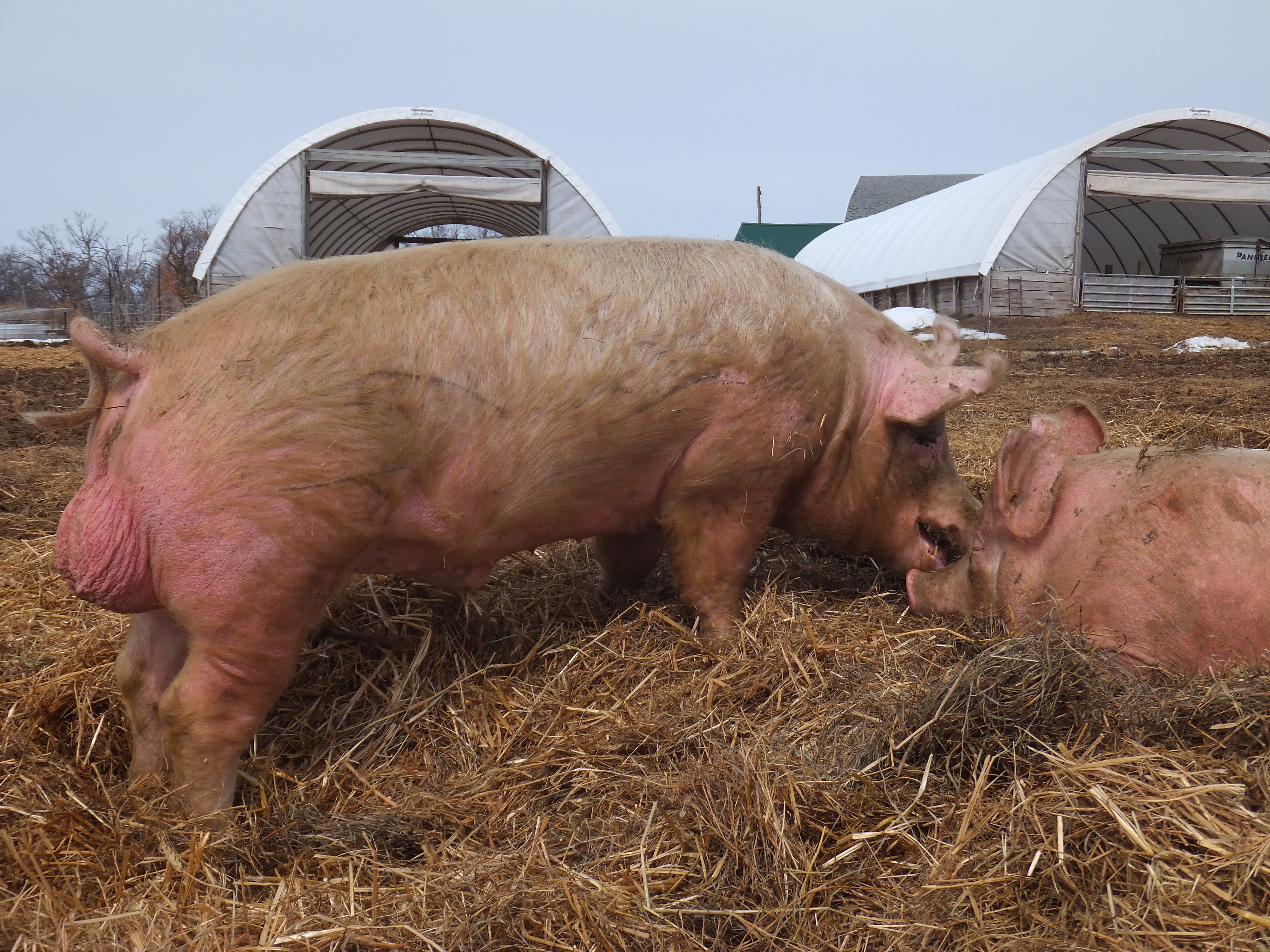
This is the conclusion of a contest to pick the best of four sows.  The best defined as the sow with the most live piglets at one week of age.  The previous two posts give you more background in case you missed them.

Previously I wrote that sow #3 had 13 live piglets and sow #1 had 10 live piglets.  At a week of age, sow #3 still had 13 piglets and sow #1 lost one and had 9 piglets.

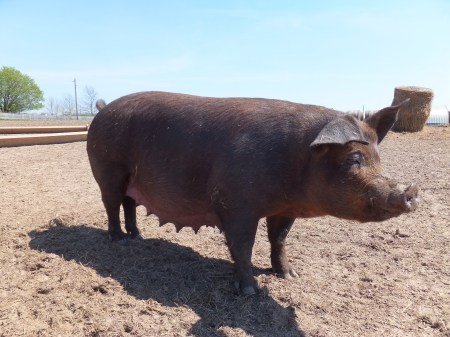
Since then, Sow #2 farrowed 11 piglets of which she has 9 left.  The third photo is of her red piglets.

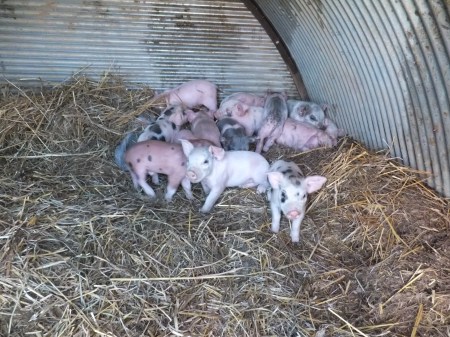
Sow #4 farrowed 17 beautiful, live, piglets, top photo.  At 24 hours, she still had 15 live piglets and I was counting chickens and thinking about setting a new farm record and awarding the prize to Valerie who guessed sow #4 with 13 piglets.  Sow #4 was also my guess so I was feeling a little smug.

But as is so often the case in farming, my celebration was short-lived.  It rained all day and in another 24 hours, 13 of sow #4’s piglets had died from diarrhea.  The next photo shows two live piglets and one dead.

DSCF2384


Sow #3’s litter of 9 piglets.

DSCF2376


The two remaining piglets of sow #4 are doing fine.  She has joined her litter with the other white sow #3’s litter.  The photo below is of those 15 piglets.

The red sows are choosing to keep their piglets segregated as of now.  Probably the longer they can stay apart from the herd, more of their piglets will live as some may be crushed or starve if competition is too great.

I really appreciate the pasture mothering ability of the red sows.  The white sows are more unpredictable, but I like the extra numbers they produce, so I’ll probably keep some daughters and incorporate their genetics into my herd.

Thank you to everyone who participated in the contest.  Congratulations to Gordon who picked sow #3 with 12 piglets.  Gordon is a new farmer in Iowa.  Edmund came in a close second, picking sow #3 with 11 piglets.

I decided to give a $25 Kiva gift card to each of them.  Let me know guys if you don’t receive an email from Kiva or have trouble redeeming your card.


DSCF2394


Pick the Best Sow Contest: Update1

April 28, 2016

DSCF2360


Two sows have farrowed and contest entry is closed.  Remember, the contest is which sow has the most piglets alive after one week.  So here is the update:

Sow #3 farrowed 4/27, 17 piglets, 13 alive after 24 hours.

Sow #1 farrowed 4/27, 11 piglets, 10 alive after 24 hours.

Guesses:

Dave Perozzi, #1-14 piglets

Cathylee, #2-11 piglets

Ellie K, #2-9 piglets

Gordon Milligan, #3-12 piglets

Edmund, #3-11 piglets

Valerie, #4-13 piglets

My guess is Valerie will win, but all the guesses are reasonable.  I really like my red sows, #1 is my favorite phenotypically, (how she looks), but it is hard to bet against the white sows because they are half Landrace and the Landrace breed is know to crank out the piglets.

Both of these sows are good mothers and made nests, the #3 sow worked all morning carrying hay to make her nest.  Its cold here today, in the 40s F, but that doesn’t seem to be a problem.

DSCF2362


Contest: Pick the Best Sow

April 25, 2016

Dave Perozzi commented on my last post about valuable pasture swine genetics and asked me to show pictures of “good” vs. “bad” sows.  You can read my reply here.  I told Dave that is a great idea for a blog post, so I came up with this idea for a contest.

Out of the four sows pictured below, pick the sow who will have the most live piglets at one week after farrowing.  I’m using one week as a stand-in for weaning because any death loss after the piglets start leaving their hut is minimal and difficult to measure.  As a tiebreaker, guess the number of piglets the winning sow will have at one week.

Contest entry will close Thursday,  April 28th at 7 am.

The winner of the contest will receive a $25 gift certificate at Kiva.  Kiva is micro finance, an idea I love that helps connect lenders to borrowers, often in developing countries which may have limited access to capital.

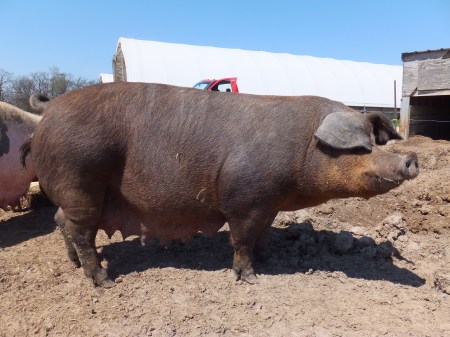
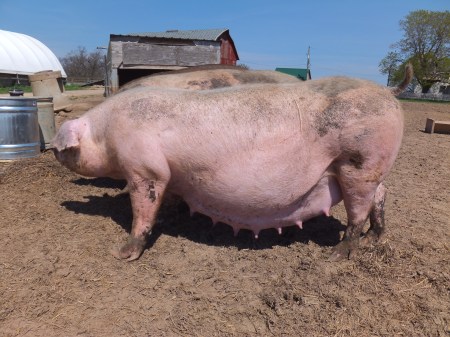
A description of each sow is below each photo.  The red sows will be having their fourth litter.  The white sows will be having their second litter.  I’ll talk more about each sow in my comments and in a future post.

Good luck!


DSCF2347

#1: Slightly erect-eared red sow

DSCF2357

#2: Drooping ear red sow


DSCF2349#3: Drooping ear blue-butt

DSCF2354#4: Drooping ear white sow


Valuable Pasture Swine Genetics

March 31, 2016

DSCF2342


This is not valuable pasture swine genetics.  This is the sow who helped me realize how valuable pasture swine genetics are.

Sows that are able to build a nest and farrow unassisted in a hut and nurse and wean a large litter are amazing.  I didn’t fully appreciate them until I brought in some new genetics via AI and farrowed the resulting offspring.

I’ve always liked the Landrace breed and have used Landrace semen in the past with good results.  Landrace are known as a maternal breed, but I also know there is tremendous variability within the breed.  Back when I was a student at Iowa State using ultrasound to evaluate thousands of hogs, some of the craziest hogs that came through my chute were Landrace.  And out of all the hogs I evaluated, I found three with loin measurements of over 9 square inches, (very muscular), and all three were Landrace gilts.

So I used semen from two different Landrace boars resulting in four litters.  The Landrace boars were from two different, but well-respected Landrace breeders.  Right away I could see a difference in the piglets. Two of the litters had the more traditional Landrace look with larger ears and deep bodies.  The other two litters looked more thin-skinned with smaller ears.

I kept sixteen gilts as breeders, roughly four per litter.  Eight are farrowing their second litter now.  I couldn’t tell much difference last summer because of the problem I was having with piglet scours.  The diarrhea was much more of a problem than sow behavior, sometimes affecting a whole litter, other times leaving a litter untouched.  Many piglets died, as I wrote last fall, but as I hoped, the disease worked though the herd and I’m seeing no evidence of it now.  Patience and experience helped me have faith, as it is always very difficult for me when my animals are not healthy.

Now with their second litter I can see a difference.  The larger-eared, deep-sided sows calmly picked a hut and made a nest and are raising nearly all of the piglets they farrowed. The leaner, thin-skinned sows were agitated before farrowing and it continued for the first few days after farrowing.

The worst sow farrowed twelve nice piglets and crushed five.  This is the sow in the photo.  Possibly she would have done better in confinement?

So I continue to learn.  I will cull the sows that do poorly, and incorporate the genetics of the good ones, joining my herd of excellent red sows and boars, which I appreciate now more than ever.


Herd Boars

August 16, 2014

DSCF1618

Tater, the best boar I’ve ever raised, and the pinnacle of my attempts to create an Oxford Sandy and Black for the midwest.  Alas, Tater had one crucial problem.  He was sterile.  Or at least he was functionally sterile.  He would make a few feeble attempts, but quit before achieving the proper insertion.

When I told me son about Tater, he said, “If he’s so good, couldn’t you collect his semen and use it to artificially inseminate.”

“I think that’s what has contributed to this problem.  Twenty-plus years of artificial insemination has led to the rise of problem breeders,” I said.

My memory may be fooling me, but it seems like boars used to do a better job with natural service.  Part of the problem may be I don’t keep enough boars around.  You would think I would be smarter than this with close to forty years of experience.  We always said it starts with the boars.  If you don’t get the sows bred, you are out of the livestock business.

Fortuitously I had kept a backup boar, just in case Tater didn’t work.  Chris is pictured below, half Yorkshire, half Landrace.  He sired all the winter/spring litters.

DSCF1625

And then we come to Taiphan, pictured below.  Mean, ugly, difficult to be around, and he gets the job done.  I forgot what a truly aggressive breeding boar is like.

When a boar is sexually aggressive, you have to worry that he gets enough to eat.  I remember boars from years ago that we had to remove from the breeding herd to let them gain some weight.

Taiphan was in the first litter born in 2013 in a snowstorm.  Most of his littermates froze, so we know he’s tough as well as aggressive.  His dam was a Duroc sow and his sire was DRU semen from SGI.  So he’s 3/4 Duroc and 1/4 French Muscolor.  He sired the early summer litters.

DSCF1663I have some new litters out of Duroc and Landrace semen.  They look ok so far.  I kept quite a few boars, hoping I can keep from running short in the future.

It’s not easy.  You have to have some redundancy in case something goes wrong.  And if everything happens to be perfect, pour yourself a glass of lemonade and enjoy the two or three minutes while they last.


Duroc Gilt, Nursing Piglets

January 24, 2012

This is a picture of one of the most recent litters.  I’ve had three littermate Duroc gilts farrow.  Each is an excellent mother.

The Duroc breed is not considered good for mothering ability.  There are some genetic lines within the breed, however, which have been selected for mothering ability.  I’ve been selecting from within these genetic lines for a while.

Farrowing crates can mask poor mothering ability, and bring the worst performers closer to the mean.  Farrowing without crates allows a fuller expression of a sow’s maternal instincts.  I’m happy to see positive results from my years of selection.


Robert Frost: A Blue Ribbon at Amesbury

March 6, 2011

How can a poem, written years before, capture the way I feel?  In “A Blue Ribbon at Amesbury,” Robert Frost writes my thoughts, my feelings.

“A Blue Ribbon at Amesbury” describes a young man’s mind, as he observes his blue-ribbon winning hen.

Excerpt:

The one who gave her ankle-band,
Her keeper, empty pail in hand,
He lingers too, averse to slight
His chores for all the wintry night.

He leans against the dusty wall,
Immured almost beyond recall,
A depth past many swinging doors
And many litter-muffled floors.

He meditates the breeder’s art.
He has a half a mind to start,
With her for Mother Eve, a race
That shall all living things displace.

The cattle on my farm can be traced back over fifty years, the hogs over thirty, the chickens over ten.  We are always selecting, always monitoring, always striving.

Thank you Quantum Devices, Inc. for your guess. Since you were the only one to guess which Frost poem is my favorite, you win the $25 gift certificate to Kiva.


Inbreeding

February 16, 2010

My  post, “How We Decide: Listen To Your Gut,” explained how we had three littermate boars who all had the same abnormality in which they couldn’t extend their penis to breed.

Dad and I discussed possible causes for this condition.  He thought it may be an inbreeding problem.  I thought it had something to do with the increased use of artificial insemination, (AI), in swine.

When we started using AI fifteen years ago, maybe only 10% of the nation’s hogs were produced with AI.  Now, probably over 90% of the nation’s hogs are produced using AI.

Boars which would have been culled because of poor natural breeding ability are now being artificially collected and their genes are spread throughout the population.  I detailed the steps I am taking to combat this problem in my last post.

Dad recently read an article about inbreeding which discussed the deleterious effect it has on reproduction.  And he rightly assumed that the dam of the three boars may have been slightly inbred.  So, combining these two facts caused him to theorize the problem was inbreeding.

Good thinking.  Except I told him I knew the sire of the boars was completely unrelated to the dam.  So there is no chance of inbreeding.

But Dad thought if one of the parents is inbred, then inbreeding may be a problem in the offspring.  And that brings me to my point.

It doesn’t matter how inbred one or both parents are. As long as the parents are not related, the offspring will not be inbred.

Let me explain.  But first let me define two terms, homozygous and heterozygous.  Homozygous is when a pair of genes at any location, (locus), is identical.  Heterozygous is when a pair of genes at any locus is different.

Let’s use coat color in cattle as an example.  One parent is an inbred Black Angus and one parent is an inbred Red Angus.  The Black Angus is black and its pair of genes is represented by BB.  The Red Angus is red and its pair of genes is represented by bb.

Because we know one gene is inherited from each parent, the offspring will get one black, B, gene and one red, b, gene.  The offspring’s genes are heterozygous, Bb, even though its parents were inbred and homozygous.  A single mating between unrelated, inbred individuals wiped out all inbreeding in the offspring.

This example also illustrates how inbreeding and homozygosity is not necessarily a bad thing.  Just ask any Black Angus breeder if she is concerned that her cattle are homozygous black!


How We Decide: Listen To Your Gut!

February 9, 2010

As I struggled with my personal life last fall, our farm struggled.  We have only four new litters of pigs when we normally would have twenty.  The reason?  I failed to listen to my gut!

I’m reading an excellent book by Jonah Lehrer titled, “How We Decide.”  It’s about what’s going on in our heads when we make a decision.  In the second chapter, Jonah talks about how experts typically make a decision.

“Although we tend to think of experts as being weighed down by information, their intelligence dependent on a vast amount of explicit knowledge, experts are actually profoundly intuitive.  When an expert evaluates a situation, he doesn’t systematically compare all the available options or consciously analyze the relevant information.  He doesn’t rely on elaborate spreadsheets or long lists of pros and cons.  Instead, the expert naturally depends on the emotions generated by his dopamine neurons.  His prediction errors have been translated into useful knowledge, which allows him to tap into a set of accurate feelings he can’t begin to explain.”

I used three littermate boars for breeding this past fall and they failed to successfully conceive a single litter.  I had a bad feeling about these boars from their birth, probably before their birth.  But I failed to listen to my intuition.

These boars were sired by artificial insemination, (AI), using semen from a boar housed in Iowa at a company called Swine Genetics International, (SGI).  I like SGI and have had a lot of good luck working with them.  We have had a closed swine herd for fifteen years.  This means we haven’t brought any new swine onto the farm.  We introduce new genetics using artificial insemination.  I joke that the only swine we buy is delivered by UPS.

SGI helpfully separates their boars by breed, and further separates by type and expected function.  For example, boars may be classified as maternal, meaning they will sire excellent mothers, or terminal, meaning they will sire excellent market hogs.  They also have high marbling lines, high growth, high lean, and other types.

The type that gets us in trouble is the Showpig line.  These boars are always very attractive to look at, but usually end up disappointing us in the end.

The sire of our three boars which couldn’t breed was a Yorkshire from the Showpig line and his name is “Be Bold.”  That is a fitting name, because we were, even though we knew better.  But look at his video, isn’t he awesome?  Can you see why we were tempted?

The three boars we kept out of him looked awesome as well.  Dad even said they were the best-looking boars we’ve ever had on the farm.  So we turned them in with the gilts and proceeded to work on corn harvest and didn’t pay much attention to them other than at morning feeding or a casual glance walking by their pen.

The problem was they couldn’t extend their penis out of the sheath.  Boars have a long, pink, corkscrew-shaped penis.   Here is a link to a diagram of a boar’s penis.

 They would mount the right end and get all tight in there and get that orgasmic look in their eyes. But their penis was not going into the gilt.  They ejaculated inside the sheath.  That’s why I even saw the cervical jelly the boars produce which is usually a sure sign something is getting bred.

Now I probably could have pulled the penis out of the sheath and helped them get started breeding.  Some farmers would do that.  But by the time I figured out the problem, I was so frustrated I was looking forward to letting Johnsonville make bratwurst out of them.  And I had other boars which had grown large enough to breed.   

This isn’t the first time we’ve been disappointed.  In fact, it happens so often, I’ve been toying with an idea that would be a safeguard.  The problem is this idea also slows genetic progress. 

Here’s the idea.  Only keep gilts out of AI litters, no boars.  You see, on our farm, a boar can produce 200 offspring in a year while a gilt can only produce 20.  If I end up liking the gilt, then I can keep gilts or boars out of her later.  That way I  introduce the new genetics into my herd, but at a slower, safer rate.

I’ve already implemented this idea in some fashion.  If a gilt or sow has a litter and is a poor mother, or there is a genetic defect in the litter, or any other reason for not liking the litter, I don’t ear notch the piglets in the litter.  That way, five months later, when I am selecting replacement gilts, I’m not tempted to choose a gilt from that litter. 

I keep detailed records and write down any problems that may have occurred.  But I have been known to justify keeping a gilt from a problem litter because she looked so good.  If she is not ear notched however, I have no records on her, and the cautious curiousfarmer of five months ago, trumps the reckless curiousfarmer of today.