Health Savings Account

August 27, 2009

J9 recently commented and ask that I explain my healthcare.  Thank you for this suggestion.  This topic is timely as the country debates health reform. 

So I’m writing this on a rainy Thursday morning, trying to decide whether to eat eggs or hamburgers for breakfast.  Yes, my diet is still meat heavy.  I’m conducting a lifelong test on the question, “Does saturated fat clog arteries?”

I have a Health Savings Account combined with High Deductible Health Insurance through Golden Rule Insurance.  My insurance premiums and the money I contribute to the savings account are tax-deductible. 

Congress created this program in 2003.  I jumped on it quickly because I already had high-deductible health insurance.  It’s a burden to pay the premiums and to contribute to the savings account, but it’s nice to have money I can use for medical expenses.  And any money I don’t use for medical expenses can be used tax-free for any purpose once I reach retirement age. 

So what does this look like in practice?  I have a $3000 deductible policy.  For this insurance I pay $2223 annually.  I contribute $2850 annually to my savings account.  So my total health cost for the year is $5073.

I am in favor of healthcare reform.  However, I reluctantly admit, I am not writing letters or attending listening  sessions.  I do little more than vote.  I am waiting to see what congress comes up with and will choose the best option for me.


Hog Market is Crashing

August 24, 2009

The hog market is crashing.  Hog farmers are going out of business.  Our hog buyer has been laid off. 

According to NPPC President, Don Butler, the U.S. hog industry has lost nearly $4.5 billion since September, 2007.  Producers have lost an average of $21.37 per hog.  Losses per hog may be over $50 per head this fall.

We sold a load of commodity hogs August 4th.  The price per 100 lbs. of hog was $43.48.  Just ten days later on August 14th we sold another load and the price per 100 lbs. of hog was $37.60.  That’s a difference of nearly $15 per 250 lb. hog.

Direct-marketing pork has helped us stay optimistic about raising hogs.  Unfortunately, many producers are finding nothing to be optimistic about and are exiting the hog industry.  How low will these markets go until reaching seasonal lows in December?  I will keep you posted.

Here is a conversation I had at the hog market, recently.


I waited at the hog market with my old herdboars.

“They can’t be together,” I said to the old man waiting to unload his hogs. 

“This one will tear the other one up.  He already did a month ago, jumped over a gate four feet high.”

“Looks like he could do it now,” the old man said as the boar measured the gate with his snout.

“He’s a good-looking boar.”

“Thanks,” I said.

“Where’d you get him from?” the old man asked.

“I raise boars,” I said.  “I use AI to bring in new genetics.”

“Oh, you use AI?”

“Yes.  Where do you get your boars?” I asked.

“Ohio.  Durocs one year, Yorkshires the next.”

“That’s a good cross,” I said.

The old man looked up towards the scale and asked, “Where’s Scott?”

“He’s on vacation,” I said.  “But next week’s his last week.”

“What, why?” the old man asked.

“He got laid off.  They’re closing down German Valley and Rory is going to drive from Lancaster to fill in here.”

“The hell you say.”


Combining Oats/Barley

August 16, 2009

IMG_7320


Harvesting oats/barley with our 1970’s era Massey Ferguson combine.  I won’t know an exact yield until I have fed all of it to our hogs over the next year.  We finished baling the straw on Friday.

Oats/barley is higher in protein and fiber than corn, but lower in energy.  I use oats/barley in the hog rations at a rate of 20% of the ration when it’s available.  So that’s 400 lbs. per ton.  I reduce the soybean meal by 50 lbs. per ton when I include oats/barley in the ration.  I see no noticeable difference in hog performance at this inclusion rate.


Sweet Corn for Tacos

August 10, 2009

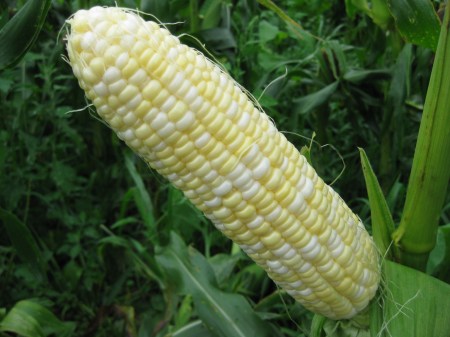
IMG_7307

I picked 3 dozen ears of sweet corn to give to friends.  Two friends were home and gladly accepted the gift.  I drove around town wondering what to do with the remaining dozen.

A temporary taco stand was set up in the park by main street.

“Maybe they would be up for a trade,” I thought as I parked my car.

“How many tacos you want?” a woman asked me.

“Uuuuh,” I said and walked over to where a man was cooking meat on a large, flat grill.

“How many tacos you want?” he asked me.

“What kind of meat?” I asked him.

“Pork.”

“Oh.  Do you like corn?”

I realized I was acting quite weird.

“Sweet corn.  I’m a farmer.  I have a dozen ears in my car.  Would you like to trade?”

The cook looked confused and uncomfortable.  The woman sidled over to help translate.

“I’ll show you,” I said, and walked back to my car.

I set the bag of sweet corn on a cooler.  When the cook stopped turning the meat, I took out an ear and pulled the husk back to show the plump, yellow and white kernels.

The cook said something excitedly in Spanish to the woman.

“How much?” he asked.

“It’s worth 4 dollars a dozen,” I said.

“4 tacos are 6 dollars,” he said.

I wasn’t sure what he was driving at.

“Ok, how about 3 tacos?” I countered.

He nodded and went back to cooking.

My friend from Honduras tells me most of the Hispanic immigrants in Lafayette county are from small towns and rural areas of Mexico.  They came to the US for work, of course.  But they enjoy the bucolic atmosphere of Lafayette county. 

They began wrapping up the tacos and the woman said, “He’s giving you four.”

We country folk sure know how to drive a hard bargain.