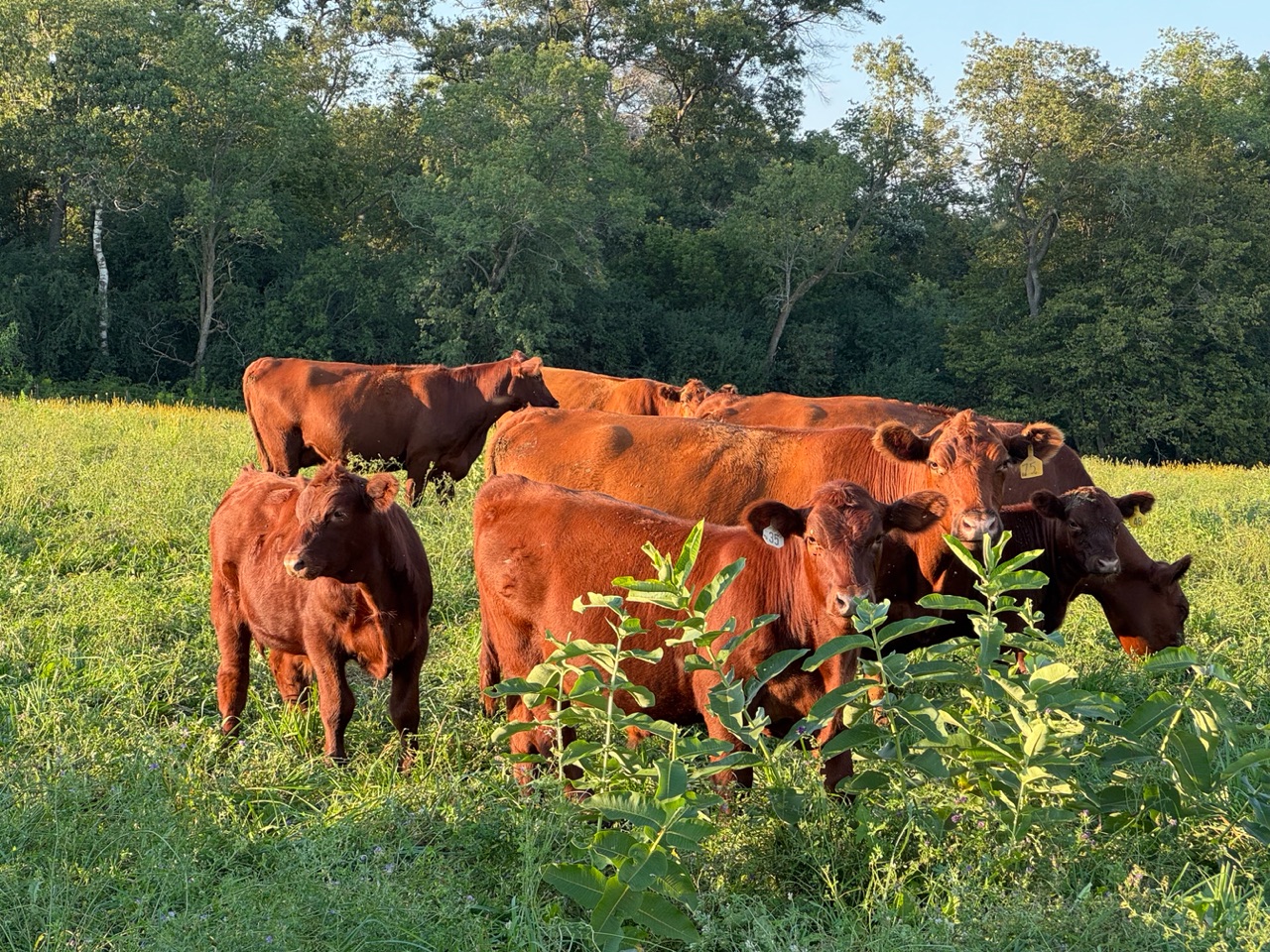
Above is the #75 cow who we’ve been following in this blog since she was a calf. She’s always photogenic.
Below is a well put together 1st calf heifer. I love her small udder. You need small udders that will outlast the cow.
The calves continue to grow, but I’m not sure they will be bigger than last year’s calves, which is counterintuitive, as last year was dry and this year was wet. On a farm with adequate forage, cattle will do better on a dry year, as every bite of forage contains more nutrients compared to forage on a wet year. When you’re consuming dozens of pounds of forage per day, the amount of moisture in the forage makes a big difference.
We’re having a wet, hot, Wisconsin summer. With several multi-inch rain events and less pigs this year, my pig pasture is getting away on me. So I gave it a quick rotation with the cattle.
I’m super happy with Teddy, my South Poll bull. He’s in the photo below, after six weeks of breeding. He gained weight during the breeding season.
Teddy’s super chill, yet attentive to his heifers. Look at how much slicker his hair coat is compared to the heifers in the top photo. I’m planning to keep daughters out of Teddy and hoping they have his good attributes.
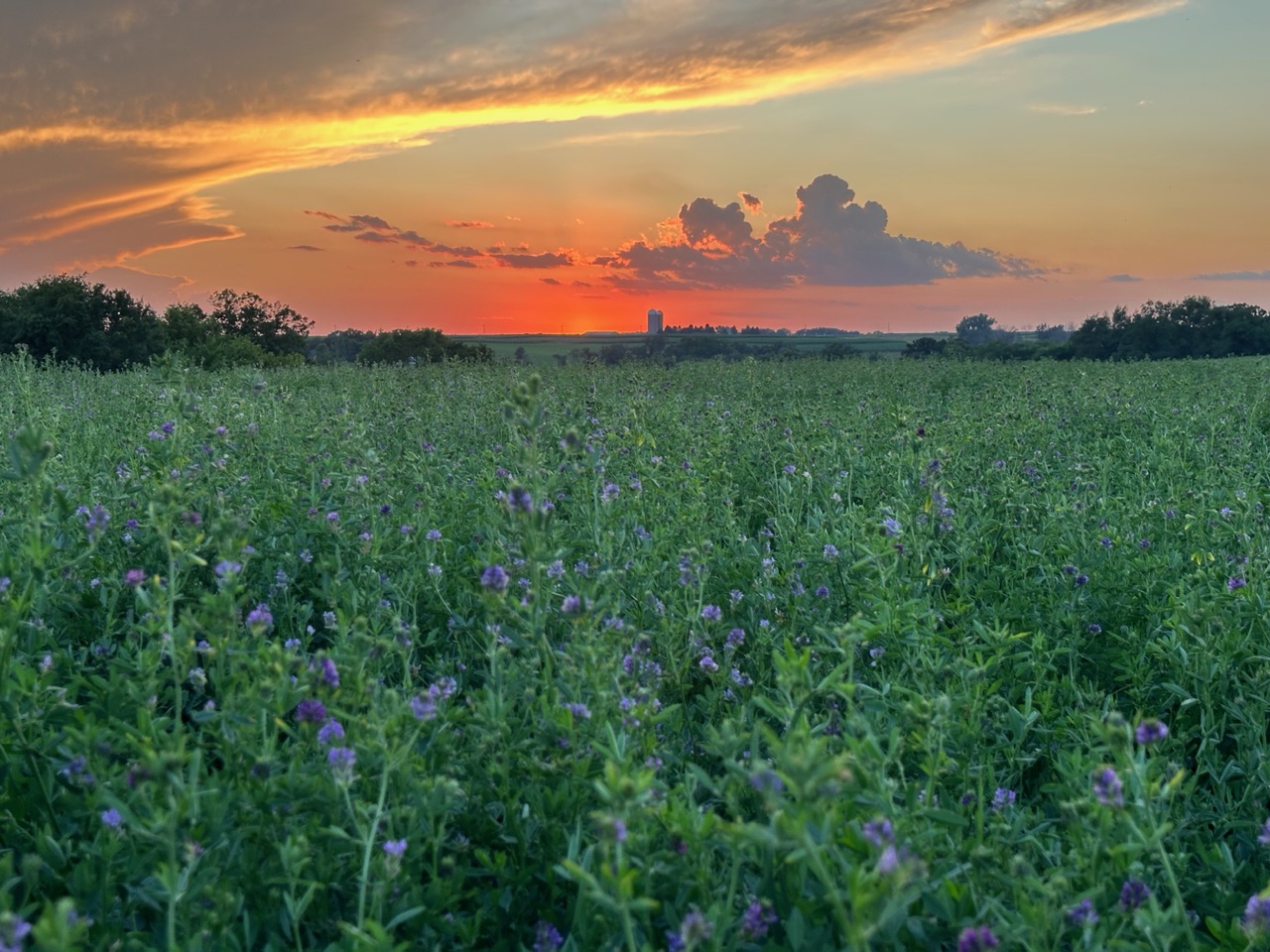
My youngest sister caught this photo of sunset overlooking our hay field. All three sisters and most of their kids made it home for the fourth and we had a nice family gathering. Below is some of the family in front of Vicente’s corn for our traditional fourth of July corn photo.
After a dry winter/spring, the sky spigot turned on and we are green! Nothing ruins a drought like rain.
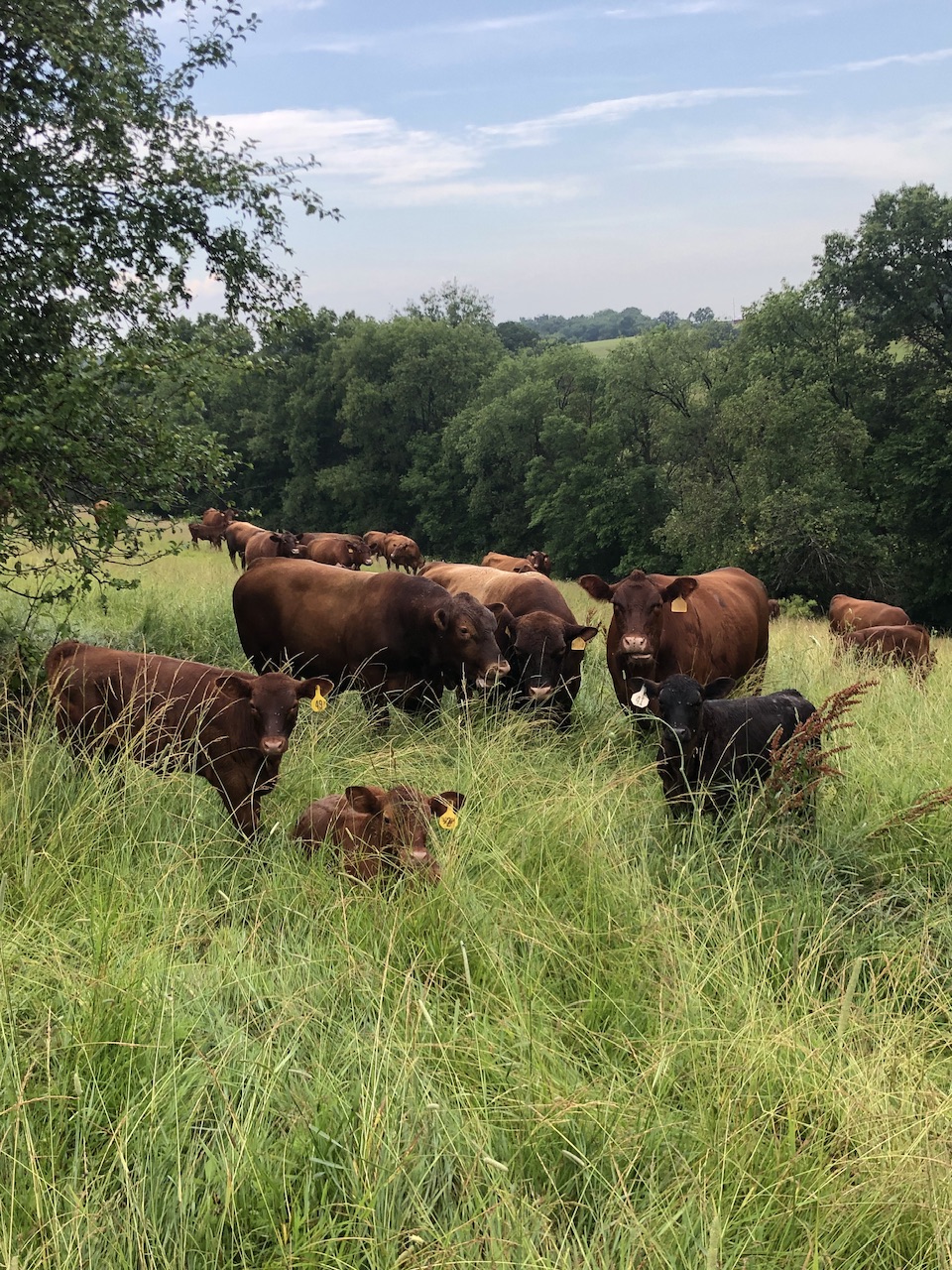
We turned out the big bulls June 27th and the yearling bulls July 3rd. Below is a photo of two of the big bulls following a cow and a few calves. This pasture was rested eight weeks and rebounded nicely after spring grazing.
She’s a great example of the logic only humans bring to the table, as out of our herd of over 100 Red Angus cows, she’s the only one who’s registered Red Angus.
We continue to open up a little space on our farm for interesting persons to garden. Besides Isabel, three other families are gardening in our good soil.
Malcom Gladwell says, “If you find an interesting person, it means they are part of an interesting group.”
It’s been a dry spring and unseasonably warm. We welcomed over an inch of rain last night though, and cooler temperatures.
We’re wrapping up calving, which has gone well, and planning to make some 1st cutting hay on acres we didn’t graze.
I don’t know that “hindsight is 20/20,” but I do think we work hard to understand our life. The past is neat, because we’ve reduced it to a story. What often isn’t talked about and largely forgotten after the fact, is the unsettled feeling we have when trying to make a decision in the present.
You look at anyone who’s been doing something for awhile and its easy to think that he or she has it all figured out, but if we’re being honest, I don’t think we ever have it all figured out. Whatever we’re doing in life, there’s going to be some level of uncertainty.
I think the important thing is to continue to make decisions, implement, observe and evaluate results, then reconfigure and make more decisions. Try not to beat yourself up about the decisions that didn’t work well. Did you learn something?
I was faced with making bull buying decisions after we got rid of half our herd bulls last fall. I knew I had time, we don’t turn our bulls out until the fourth of July, but I also knew I needed to work on this when I had more time during our slower winter season.
We had used four older bulls on our cows and two yearling bulls on our heifers. After culling, we were left with one older bull and the two yearlings. So I could add bulls to breed my cows or I could move my yearlings up to breed the cows as two year olds and buy younger bulls for my heifers. I figured I only needed to purchase two.
I got a line on a couple coming two year old Black Angus bulls from a local breeder friend of mine. They were priced right and big enough to use on cows. I drove south of town and took a Ranger ride with Matt and checked them out.
They were good bulls and would make good calves for me. I planned to use them as a terminal cross, selling all their offspring as feeders. But I wasn’t 100% sure of their disposition.
I asked Matt if I could show them to Isabel, that’s one of the benefits of buying bulls close to home, easier to observe, and we went back to the pasture they were in and looked at them again. Without Matt and the Ranger, their disposition was a little worse, so we decided we would keep looking. This was October, so we had time to be choosy. If it had been June, we would have purchased them and probably been happy.
I visited a Red Angus herd in southern Iowa and determined most of his cattle were too related to my own. I’m still glad I took the time to see his cattle as you always learn something when visiting with other farmers and ranchers. His bulls were my last best shot for bigger bulls to breed my cows.
I shifted my focus to look for bull calves to breed to my heifers, planning to use last year’s yearling bulls to breed my cows. I planned a trip to Missouri to visit a couple South Poll herds, but couldn’t make our schedule work. I watched a couple of Pharo Cattle Company bull sales online. I was interested in PCC’s Nebraska sale, but again couldn’t make our schedule work to visit the sale in person. I really didn’t want to buy a bull sight unseen.
But then I got an email from Kit Pharo saying they were waiving the delivery fee for the Red Angus bulls. I could buy a Red Angus bull online and have it delivered to Monticello Iowa, only an hour and a half from my farm. This was too good of a deal to pass up. I marked up my catalog and prepared to bid.
The day of the sale came and I bid on 26 bulls, but stuck to my budget of $5000. I guess I’m too cheap, as I didn’t get one. I was disappointed, but I knew I still had time, so I wasn’t panicking yet.
I visited Matt’s herd again to look at his weaned calves. Matt pointed out a bull calf whose birthweight was in the 50s and whose EPDs for calving ease and birthweight were in the top 1% of the Angus breed. Furthermore, the calf and his dam both had a gentle disposition. Disposition and Calving Ease are my top two traits, so I only needed a day to think about it and pulled the trigger and picked him up so I could grow him slowly.
Now I relaxed, as I had just enough bulls if I didn’t find another one, but I kept looking. The Missouri South Poll Association had a sale. I watched it online. The best cattle in the sale in my opinion came from Sassafras Valley Ranch. This was one of the farms I wanted to visit in Missouri.
I contacted Bruce Shanks, the owner of Sassafras Valley Ranch in February and he told me he had a South Poll bull calf which fit my criteria. I decided to take a flier on a South Poll bull, sight unseen, and met Bruce with my truck and trailer in Southern Iowa, saving me about six hours of driving. I’m super happy with this bull’s disposition and look forward to witnessing his progeny’s calving ease next spring.
And now we are nearly three weeks into our calving season. The yearling bulls I used last year did an excellent job breeding the heifers. Fifteen out of 23 heifers have calved, with four of them looking close. It looks like four heifers didn’t breed, as I experimented with a shorter 45 day breeding season. This is perfect for my grass-fed beef needs, so I’m super happy with that decision.
And I’m happy we are moving these bulls to breed cows this year, as their calves have been too large for my liking to breed again to heifers. I guess I would still call them calving ease though, as we haven’t had to pull any calves.
So we’re all squared away for this coming breeding season and excited to see the results in a year or so, but if you had told me a year ago that I would be breeding my heifers to a Black Angus and a South Poll I would have been surprised. Farming, just like life, is a journey.
2025’s heifers and calves are pictured in these two photos.
For the past 25 years we have been using Red Angus bulls exclusively. This year we still have 3 Red Angus bulls for our cows, but will be crossbreeding our heifers with two new bulls. The red bull with two white tags is a South Poll from Sassafras Valley Ranch in Missouri. The Black Angus behind him is from Rocky Road Farms Angus, right here in Darlington.
I’ve never been opposed to crossbreeding, but I needed to find the right bulls. These bulls are excellent for our top two traits, disposition and calving ease. I’m excited to get some hybrid vigor back into our cattle.
I plan to use them together to breed about 30 of our Red Angus heifers. I’ll have to wait until April of 2026 to get calves on the ground, but I plan to get birthweights on all the calves to compare South Poll to Black Angus. It won’t be scientifically significant, but it will be anecdotally interesting. It will be easy to determine parentage as black is a dominant color in cattle and since the Black Angus bull is homozygous black, any black calves will be sired by him. All the red calves will be sired by the South Poll bull.
Check back for results of this experiment in June or July, 2026.
Happy spring everyone. I have one black calf this year. Calving is going well. We’ve lost two, but with two sets of twins saved we’re still at 100%.
I wanted to ask the farmers where they keep their cows in the winter time. The last two winters have been the warmest ever for Wisconsin.
We dealt with a lot of mud and compacted the soil where we had the cows. In the background of the top photo, you can see where I replanted part of the pasture and the field above it.
We are used to dealing with frozen ground, which kept the cows from doing much damage, but it appears I can’t count on that anymore. So if you have some thoughts about winter and mud and cows I’d appreciate if you left a comment. Thank you.
The photo below shows where I frost seeded red clover in a pasture damaged last winter, so perhaps there’s a way to turn a negative situation into a positive.
We’ve probably had over 10 inches of rain in September and October. It’s a little late after a dry summer, but it’s nice to remember how productive our pastures can be with the best fertilizer, which is rain.
We plan to wean our spring calves next week and then we’ll be able to graze everything one more time before winter. The cows, free from the burden of nursing a calf, will put on weight before winter.
Welcome visitors! Check out our pages for more information about our meat or buying a quarter cow or half hog.
We live and Farm in the driftless region of Southwest Wisconsin, which means in the last Ice Age the glaciers split and went around us, resulting in a geologically different area than the surrounding land.
Underlying the relatively shallow soils is limestone and is referred to as Karst geology. I don’t fully understand the reason why, but the resulting grass which grows here is incredibly rich and perfect for grass fed cattle. There are a few other areas in the world similar to here, Kentucky , an area in France, probably others I’m not aware of.
Anyway, we feel blessed to live and farm here and hope you enjoy our meat!


 Posted by Curiousfarmer




 Curiousfarmer