Lamb’s Quarters? Pigweed? Scientific Names, Please!

July 11, 2010

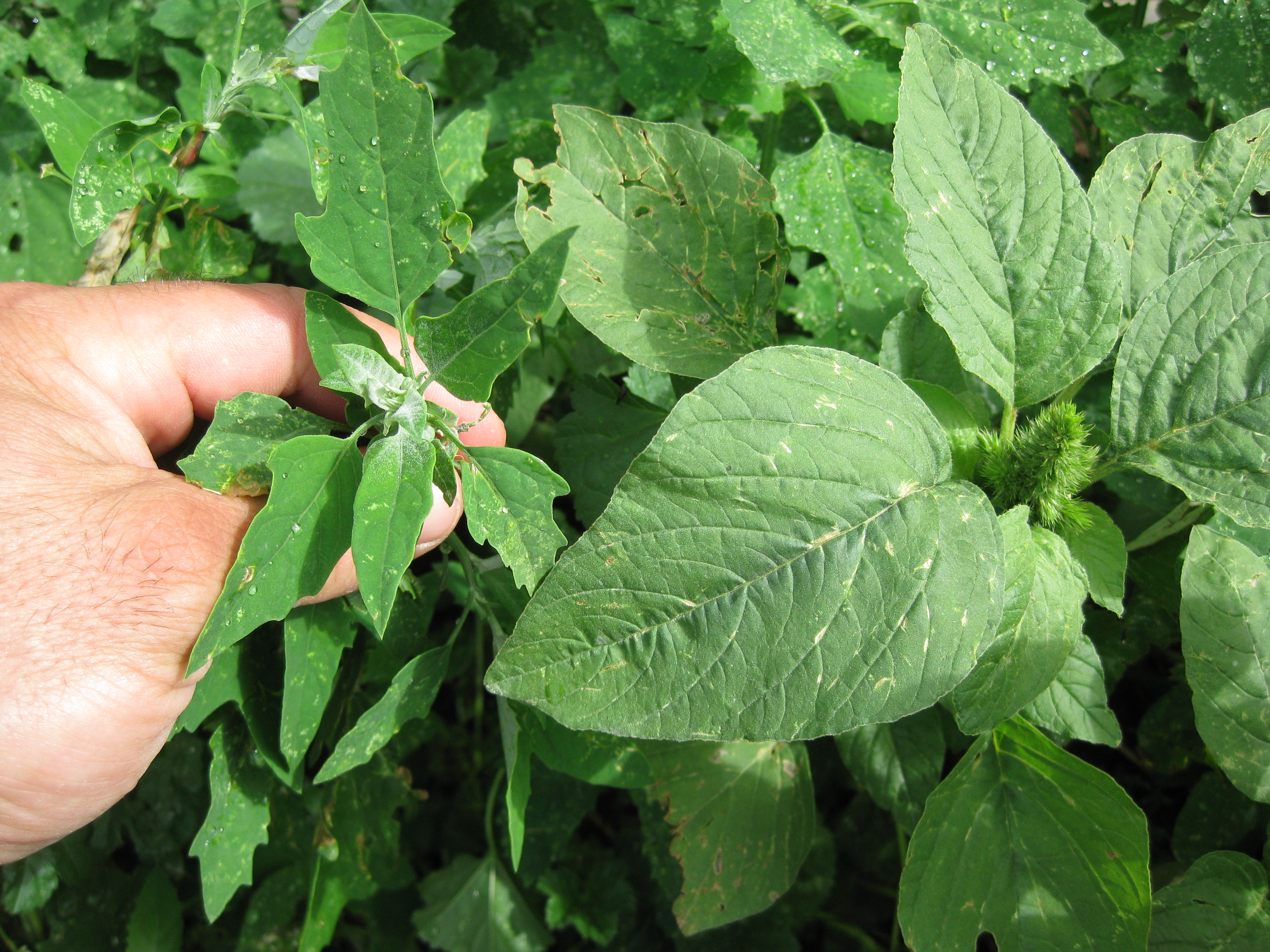
Lamb’s Quarters in hand, Pigweed on right.  Or is it the other way around?  It may be, depending on where you live.

I took Shepherd and Gameboy to the Johnson Public Library and signed them up for library cards.  Serendipity helped me find “Stalking the Wild Asparagus” by Euell Gibbons, in the used book pile.  I quickly gave the librarian a dollar for this wild food foraging classic from the 1960’s.

I turned to the chapter on Pigweed, because Citygirlfriend has been sautéing Pigweed, lately.  But I was confused because the picture looked like the plant I call Lamb’s Quarters.  As I read further, I realized I need to start using scientific names.  Euell explains why, with reasoning that resonates.

“Years ago, I was very impatient with anyone using a long Latin name to designate a common, ordinary plant.  I considered the use of these tongue-twisting titles to be an affectation, designed to show off the knowledge of the user.  Why couldn’t these high-brows use the common name, which everyone understood?

I think it was the Pigweed, more than anything else, that cured me of this attitude.  Pigweeds are among the commonest of the unwanted plants in fields, gardens and barnyards in Pennsylvania.  Therefore, I was not surprised to find that pigweeds were also common in Indiana, when I traveled there.  I learned that farmers in Tennessee, Texas, New Mexico, California and even Hawaii were troubled with pigweeds.  Obviously these farmers should get together and learn some way of controlling this troublesome weed.  The only difficulty with this procedure was that, in each of these localities, the “pigweed” was a different kind of plant.  To complicate matters even more, ‘Chenopodium album’, the pigweed of Pennsylvania, also grew in all these other places.  In some sections it was called Lamb’s Quarters, in some Goosefoot and in still other it was referred to as Wild Spinach.

I began to see why the botanical classification was necessary.  Many totally different plants are called pigweed in some parts of the world.  The plant I call pigweed is known by dozens of other common or folk names in different places.  Therefore any attempt to use the common name in distant places would only lead to confusion.  But I can say ‘Chenopodium album’ and a trained botanist from any part of the world would instantly know the precise plant meant.  Far from confounding the confusion, these Latin names greatly simplify the task of communication in this area.

More than that, the botanical name can tell me more about the plant in question than even the most descriptive common name ever could.  If I had never seen this particular plant, the name ‘Chenopodium’ should tell me that this weed is a member of the same family to which garden beets and spinach belong.  If I don’t have this knowledge at my fingertips, I can easily look it up in any botanical manual.  About this time I’ll begin to suspect this plant might be good to eat.”

Well said, Euell!  So I’m using scientific names now.  The plant in my hand  is Chenopodium album, and the plant on the right is Amaranthus retroflexus.  Both are wild edibles enjoyed at our table.


Brown Thrasher Eggs

June 14, 2010

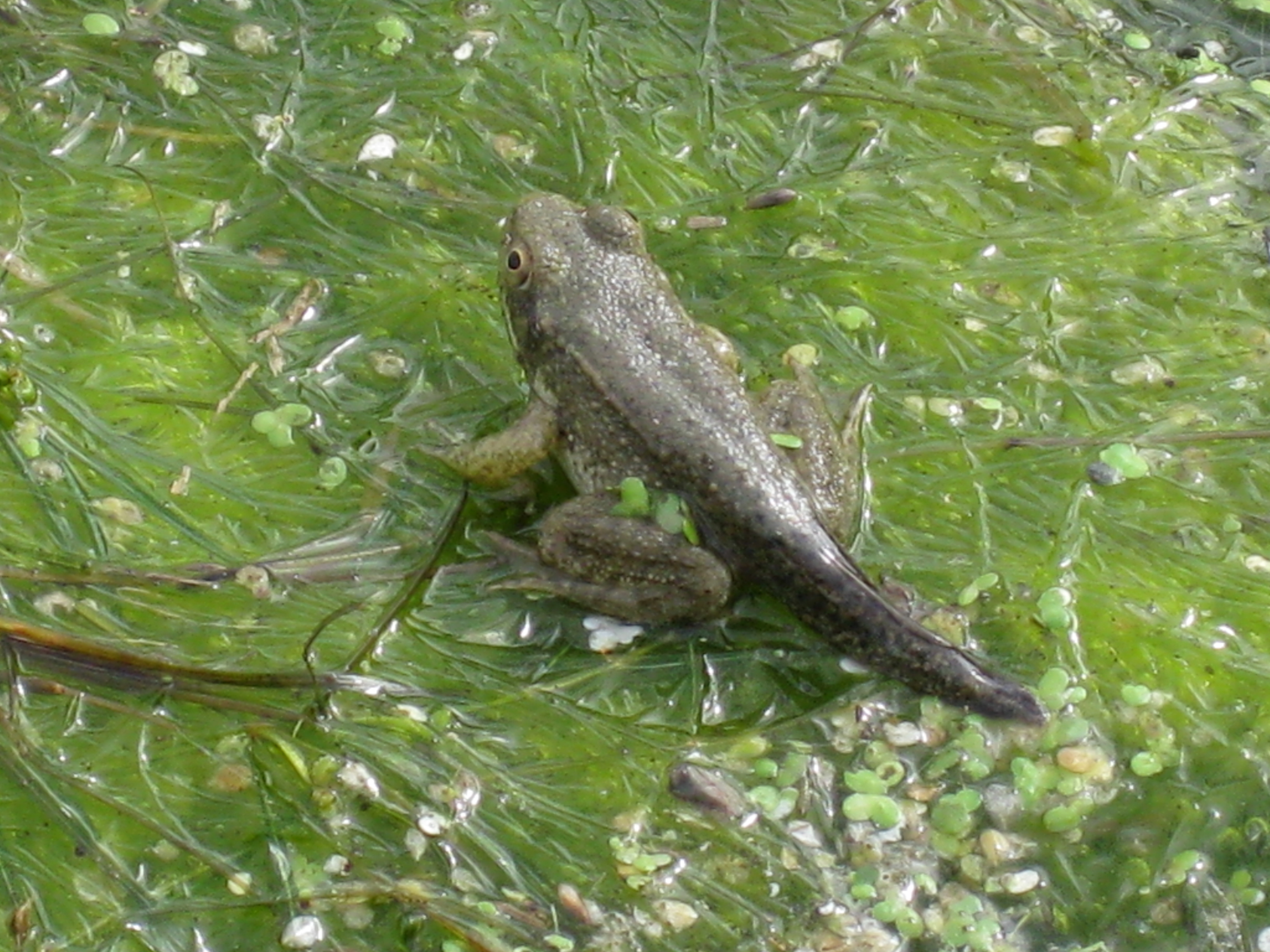
Bullfrog tadpole checking out the scenery above the water.  Look at how fast it has developed legs compared with the picture in the May 6th post, “Toads and Frogs, Living and Loving.”

Curiousfarmer started with an emphasis on Farmer, but over the first 100 posts, has evolved into an emphasis on Curious.  That’s good.  I can always be curious.

I started this blog to share what I know about farming.  I quickly realized how little I know, and how boring it is to only write what I know.  It’s way more fun and interesting to write what I am learning.

I made a mistake on the post, “Fragile Beginnings.” The eggs pictured were not from a Brown Thrasher.  The eggs pictured below are from a Brown Thrasher.

Because I wanted to write about the eggs pictured in “Fragile Beginnings,” I had to organize my thoughts.  I found out how little I knew, and what I did know was wrong.

I saw a Thrush fly out of the tall grass by the pond.  Then I saw the nest and assumed it belonged to the Thrush.  I snapped a picture and began to research Thrush on the internet.

Unfortunately, I couldn’t find any type of Thrush that resembled the bird I saw.  So I did some more research and came up with some suspects.  After a few more sightings, I knew the bird was a Brown Thrasher.  So I wrote the post.  There were no pictures I could find of Brown Thrasher eggs.

Today I was driving the ATV past a Gooseberry bush and a Brown Thrasher flew out of the middle of it.  I realized she may have a nest, so I checked it out.

“Crap!  This is what Brown Thrasher eggs look like.”

I returned and bothered the Brown Thrasher again and snapped a picture.  Now I know that there are Brown Thrasher eggs on the internet.


Farmer Genius

April 12, 2010

This is a guest post from my good friend, James Miller.  James grew up on a hog and dairy farm near Wiota, Wisconsin.

James authors the blog Quantum Devices Inc.

Comment and let James know what you think of his Dad’s ingenuity.

“How much do you want for the radiator out of the old Chevelle?”

This was my Dad, so I’d like to be able to say that I told him he could just have it.  After all, he was the man who milked cows twice a day, every day, to feed and raise us. He was also the man who paid the $326 for the speeding ticket when I was pulled over for doing 96 miles and hour in the family Bonneville.

I’d like to tell you that I just gave it to him, but I was a kid and went more like:

“How’s twenty bucks sound?”

I never even bothered to ask why he wanted it.

The next day I noticed that there was a section of garden hose strung from the old well to somewhere down in the basement of the house.  Another long section of hose ran back out of the basement into a dry dusty field.

I walked out into the field and saw the hose had been punctured so that, instead of water gushing out the threaded brass end of the hose, it trickled out evenly all along it’s length.

Dad was using the water from the old well to irrigate the field.

I walked back to where the hoses entered the basement and flipped on the cobweb covered ceramic light switch.  I followed the two hoses down the steep and narrow concrete steps. They led to the furnace where they both connected to the old radiator.  The radiator was temporarily fastened to the air intake of the furnace.  The furnace’s blower was running, drawing air in past the fins of the radiator and distributing the cold air though the house.

Dad had made a poor man’s version of air conditioning.

Here were the problems Dad had faced:

It was a particularly hot, dry summer, and it was difficult for mom to cook large “meat and potatoes” meals for the field help in the sweltering kitchen.

There was the even larger problem of no rain, which besides making it difficult to grow the crops, could also lead to wind erosion of the top soil.

Some people may have spent some money on a window air conditioner, or even converted the furnace over to central air.  Some may have even paid someone to come in and irrigate the field.

But Dad, like most good farmers, was both thrifty and clever.  I think that all those who tend to land and cattle have to have a certain level of farmer ingenuity that, in its higher moments, borders on genius.

So what is Farmer Genius?

Farmer Genius doesn’t check out a library book, know how to play an instrument, or the difference between Shakespeare and Voltaire. Since animals can’t read, Farmer Genius doesn’t really concern itself with spelling. I remember mom pointing out an ice cream bucket in the machine shed, saying “Look at that bucket of ‘NIALS’” over there.

Farmer Genius doesn’t know what happens when two vowels go walking.

Instead, Farmer Genius tends to be one of physicality and inherent understanding of math and physics, where one can mentally work out the right answer but not be able to prove with paper and pencil. Farmer Genius understands how a discarded shopping bag blowing across a field can frighten cattle into running through fences.  Farmer genius knows whether an engine is running rich or lean by the smell of the exhaust.  Farmer Genius doesn’t pay too much attention to the labels given to “screwdriver” and “hammer”; but instead sees everything and anything can be part of his toolbox.

During calving, Farmer Genius knows the moment when you need to tie the twine to the calf’s front legs to assist in pulling it from the mother; and do it in a manner that causes no harm to the calf or the cow.

The Farmer has a strict sense of right and wrong, but Genius is the part that always chooses to do right.

Dad’s Farmer Genius solved the problems a hot summer presented by using only what was on hand; an old well, some garden hoses, and a kid who would give up a radiator for twenty bucks.