Reputation Selling Heifers

March 26, 2010

“Would you take 650 a head for the entire group?” Greg said.

“We would,” Dad said.  “But we’ve got guys coming to the sale. And I told Kevin I’m bringing them.  And Bloomington advertised already.”

“Yeah,” I said.  “I wished we could have talked a week ago.  We’ll definitely call you next year.  I didn’t realize you bought cattle in the spring.”

“Whenever.  Whenever there are good cattle to be bought,” John said.

“Do you think we made the right decision,” Dad said.

“Yeah, it’s our reputation,” I said.  “It’s probably going to cost us about 2,000 dollars, though.”

“How do you figure?”

“I figure they’ll bring about 600 dollars net at the sale barn.  So 50 dollars a head times 40 head equals 2,000 dollars.”

“I guess that sounds about right,” Dad said.  “Would could we do?  We’ve made a commitment.”

“And we’re in this business for the long haul.  So even if it costs us a couple thousand short-term, we can make it up long-term by having consistently good cattle that people want to buy.  Let’s call it an investment in our future.”

As our hay supply dwindled and the groundhog didn’t see his shadow, we thought about selling our yearling heifers.  We planned to select the heifers we wanted to breed and keep for cows and then offer the rest privately for farmers to add to their cowherd.  Whatever was left would be sold at the local livestock auction.  We have been doing this ever since we improved our genetics using Red Angus bulls and have always had a positive response from farmers.

We placed an ad in the local Shopping News.  It read, “Yearling Red Angus replacement heifers for sale.  Matthew Walter, phone number.”

We ran the ad for three weeks and I received no calls the first week, two calls the second week, and four calls the third week.  Nibbles, but no bites.

It appeared that our price was a little high.  We were asking $700 a head.  The feeder calf market was soft in January and the first half of February.  Our best estimate was that we would get $500 to $550 a head at the sale barn.

One guy stopped in a couple of times and told us we were $100 too high.  We thanked him for his interest and told him we would tell him when we took them to the sale barn.

Dale stopped in and walked through them.  We could tell he was impressed when 978 walked up and licked his arm.  People are impressed by quiet cattle.

Dale was interested, but in the whole group.  He wanted us to call him when we took them to the sale barn.

We called Kevin at Bloomington a week in advance of the sale so he could advertise them.  We contacted a trucker to help us haul them.  Everything was lined up for the March 12th sale.  And then John and Greg stopped in and made us a great offer.

The very night after we declined Greg’s offer, Kevin called us to make sure we were bringing our heifers.  He said they had received calls and there was definitely some interest in them.  Dad and I were glad we weren’t going back on our word.

We sat and watched cattle sell.  There is always tremendous variation in the prices.  Four red heifers averaging 666 lbs., brought 95 cents per lb.  Five black heifers averaging 632 lbs., brought only 88 cents per lb.

Thirteen red heifers averaging 656 lbs., brought 99.5 cents per lb.  I hoped ours would bring that much.

Our heifers came in the ring.  They looked good.  Thirty-eight heifers averaging 666 lbs., brought 102.5 cents per lb.  Two small heifers averaging 420 lbs. , brought 112.5 cents per lb.  Dale was the winning bidder for all of them.

They averaged $672 each.  Even after commission and trucking was paid, we still made well over $650 each.

We were happy.  We made some money.  And more importantly, we stuck to our word and kept our reputation intact.


Tearing Out Fence

March 20, 2010

Dad is ok.  But we had an emotional St. Patrick’s Day.

Dad sat down on a pail to take a break while I used my chainsaw to cut some shrubs in the fence row  about ten feet away.  I was trying to avoid the barb wire, of course, but hit a wire that was embedded in the tall grass.  It broke and went flying into his face.

I gave him a ride home on the ATV and Mom took him to the local clinic where he received three stitches in his lip and a tetanus shot.  Mom took him to McDonald’s after that. He had a shamrock shake.

Dad was hurt at 2:30 and was back helping me clear out the fence row by 4.  We finished clearing the fence row by 6.  A quarter mile of fence cleared in a day and a half, even with an injury timeout.

Pictured below are the brace posts.  The brace posts are tied together with wire, with a brace between them.  This gives you something to pull against when stretching the barb wire.

The brace was traditionally placed at an angle.  But this results in one post being pushed out of the ground over time.   We place our brace  level and I will picture this when we make this fence new.

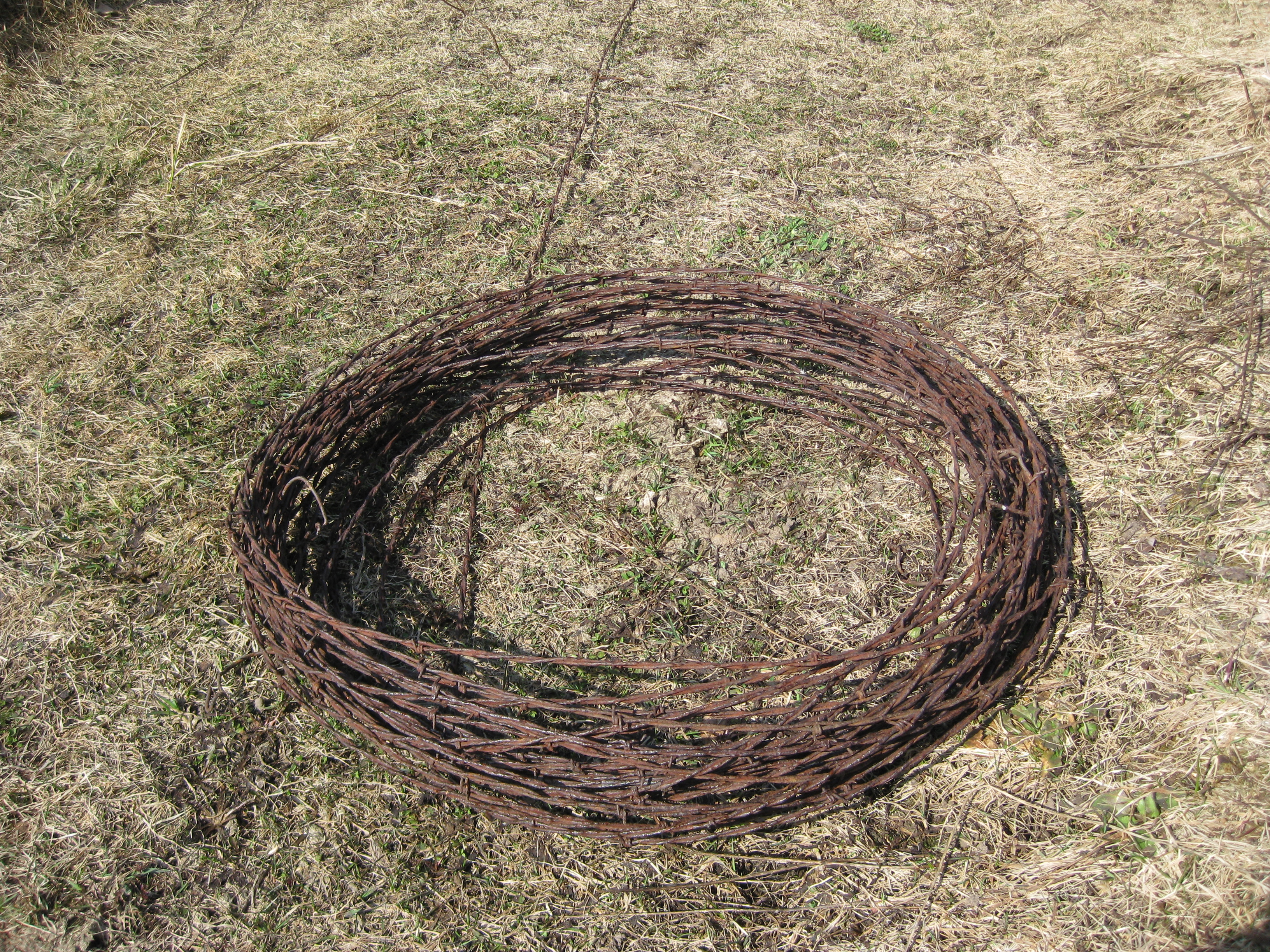
This is the old barb wire being rolled up.  Our neighbor was rolling up his barb wire on a barrel.  Dad said not many people know how to roll up barb wire.

The wire is on the ground and a hoop is formed and rolled along the ground crisscrossing the wire as you roll.  It doesn’t seem like rocket science to me; but I benefited from Dad’s teaching.

This is the worst stretch of fence because of all the brush that has grown up in it.  Dad wasn’t the only one to get hurt.  I sprained a tendon in my forearm trying to do too much, too fast.

We have been talking about replacing this fence for at least the last three years.  It was great to find some beautiful March weather to get after it.

Now it’s the first day of spring and it snowed.  This will give us a few days to heal until the ground is dry enough to put in the new fence.


Spring Arrives

March 17, 2010

Colors come when spring arrives,

Asparagus seed beneath the snow.

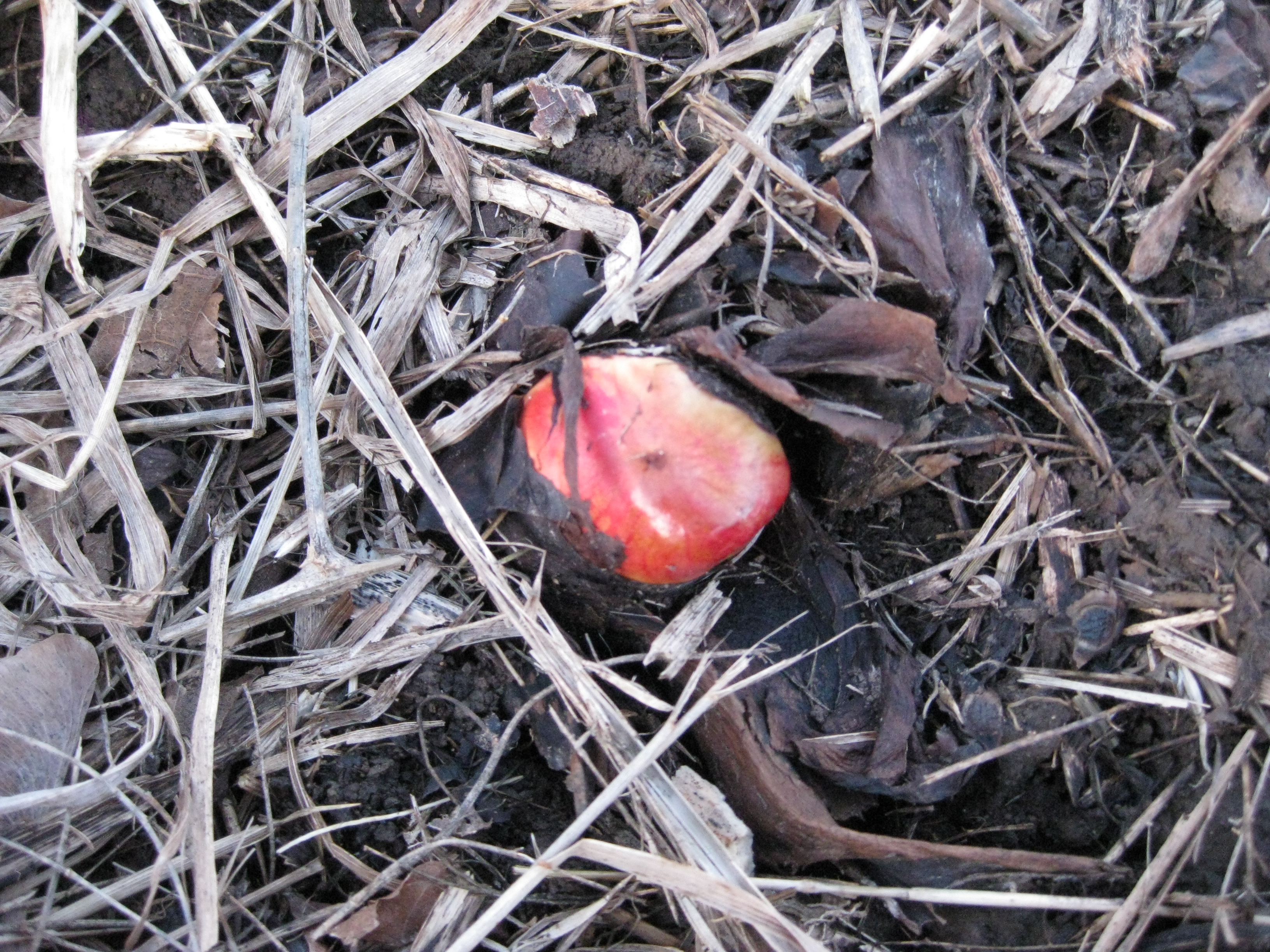
Violent thrust of rhubarb red,

Pushing up from down below.


Use It or Lose It

March 15, 2010

Compost tea made with 27 things,

Full of promise, friable and loose.

Shall we put the compost on the grass in the spring?

No let’s wait a little longer so it’s not used up.

Shall we disc the compost into April oat fields?

No let’s wait a little longer so it’s not used up.

Shall we plow the compost into May corn fields?

No let’s wait a little longer so it’s not used up.

Let’s stir the compost, let’s examine the tea.

It’s stronger and smaller, but it still smells sweet.

Shall we fertilize fields after hay’s put up?

No let’s wait a little longer so it’s not used up.

Shall we spread on new seeding after straw is made?

No let’s wait a little longer so it’s not used up.

Shall we sprinkle on pastures before an August rain?

No let’s wait a little longer so it’s not used up.

Everything is brown and harvest is complete,

Let’s put it on the fields before the snow is deep.

O farmer, tight farmer, you have waited too long.

The compost shrunk and the compost is gone.


March is the Mud Month

March 11, 2010

March is the mud month.

Returning geese, melting snow.

Rubber boots, wet gloves.

Pictured is our cowherd on their winter quarters.  We had them down to Dad’s most of the winter.  It was closer to the hay supply.  But as the weather warmed they started to damage the hay strips with their hooves.

We moved them to my contour strips which will be oats and no-till corn this year, so there is no hay ground to damage.  I am worried about them damaging the waterway which is a grass sod, but I think it will take the abuse from their hooves and spring back eventually.

Here is a picture of my contour strips last summer.

We are buying time until the frost goes out of the ground and the soil dries up, hopefully by April.  Because they will be moved into the calving pasture by April, regardless of conditions.

And this brings me to my point.  If you have animals year-around on your farm they always have to be somewhere.  And some days, even months, are not much fun to farm with livestock.

So if you are a beginning farmer here is my advice.  Stick with seasonal production until you know exactly what you want to do.

Broiler chickens, feeder pigs, lambs, calves, young cull cows, even year-old laying hens are all available in my area in the spring.  Only purchase what can be marketed by fall and have everything gone by Thanksgiving or Christmas.

And then you will enjoy beautiful down-time.  Down-time is even more valuable when you’re trying to figure out what you want to do.


Buying Oil from Hennessey Implement, Inc.

March 7, 2010

Dad was waiting in line.  We were at Hennessey Implement, Inc. customer appreciation week.  Milk, coffee, donuts, cheese & crackers served daily.

The line was ten to fifteen deep in farmers, eating, holding food in their hands, not talking.

“Look at this.  The five gallon pails are actually cheaper than the fifty-five gallon drum.”  I did the math quickly on Uncle Carl’s calculator.

“Ok,” Dad said.  I’ll get the hydraulic oil in pails.  But it’s easier to use a fifty-five gallon drum for the motor oil.”

I walked back to where Carl was talking to the oil salesman.  The silver-haired salesman was sitting at a card table filled with literature.  He was kind of in the way and farmers towered above him as they made their way around him.

Carl picked up a spec. sheet on the motor oil.

“Has it always been this busy?” I asked the salesman.

“I’m only here this week.  But yeah, it just never stops.  It’s steady.”

Two women navigated through the farmers and brought out boxes of donuts and a tray of cheese.

I walked back to where Dad was standing in line.  The farmers behind him were agitated.

“This guy overheard us talking,” Dad said.

The farmer held a price card in his hand.

“Ok,” the farmer said.  You take ten times $35.95, equals about $360.  Add $36 more equals $396.  The drum is priced at $375.95.  So the drum is cheaper.”

I did the math on the calculator.  “Oh, you’re right.  Thanks,” I said.

I walked back to Carl.  “Look at this.  The drum is cheaper.”

“Which one?” Carl said.

“The 10W30.”

“Ok, but look at the 15W40 and the hydraulic oil.”

I did the math.  I walked back to Dad.

“Ok.  Look at this. 10W30 is priced normally.  But 15W40 and the hydraulic oil are cheaper in pails.”

At this point, the other farmers were growing wolf ears, wondering what kind of special deal we had found.

When Dad placed his order he asked why the pails were cheaper.  Turns out it was a mistake, but they were honoring it.

We purchased six, five gallon pails of hydraulic oil for $29.95 each, and two, fifty-five gallon drums of 15W40 for $365.95 each.  A fifty-five gallon drum of 15W40 costs $599 where we used to buy it from.

We loaded the oil in the back of our truck and headed for home.

“What did the salesman have to say?” Dad said.

“He said it has the same ingredients as Rotella.

“It’s the same as Rotella?”

“No, he said it has the same ingredients as Rotella.”

“Did you pick up a spec. sheet?” Dad said.

“No.  Would you have been able to understand it?” I said.

“No.”

“Me neither.”

We  laughed.


The Enlightened Turkey

February 23, 2010

A turkey flew up out of the tall hay field right beside my tractor.

I stopped the tractor and haybine and looked at the clutch of turkey eggs I had run over.

Most of the eggs were broken and I could see half-developed chicks inside the broken shells.

I looked at the freshly mown hay and realized this was just the first of many trips across this field.  We had to rake, bale, and haul in the round bales of hay.  And if the eggs were not run over by then, there was still no way a turkey would come back and sit on a nest that was out in the open.

I opened the tool box on the tractor and spread out the grease rag.  I found three eggs that weren’t cracked and swaddled them in the rag and went back to mowing hay.

I had a Dark Cornish hen that was broody.   I placed the three eggs carefully under the hen and she pecked my arm, but didn’t leave the nesting box.

I checked the eggs every day.  Most of the time I had to reach under the hen to check.

One morning I heard a peep and spied a little head poking out from under the hen.

I knew the poult would need time to dry off its feathers so I left it under the hen and waited until afternoon to check again.

This time I moved the hen and found one strong poult, one dead poult, and one egg.  The egg felt empty so I cracked open the hard shell.  It was rotten.

I carried the hen and the poult over to my brooder house so they wouldn’t be bothered by the other chickens.  I set up a feeder and water for the hen and poult.

The hen covered the poult with her feathers.  I tried to catch the poult to make sure it knew where the water was and the hen ruffed up her feathers and attacked me.

I kept the hen and poult in the brooder house for the next four weeks.  They were doing fine.  I decided it was time to let them out and see what they would do.

The hen moved out into the yard and clucked to her poult to follow.  After meandering through the yard eating grass and bugs, the hen took her poult into the chicken barn.  The hen  kept other chickens away from her poult.

When I went to shut the door to the chicken barn at dusk, I was surprised to see the hen and poult roosting on the old dairy stanchion four feet above the ground.  That little poult could fly and wanted to continue sleeping under the hen for warmth and comfort.

As summer turned into fall, the poult grew into the turkey it was meant to be.  Instead of sleeping under the hen, it would sleep beside the hen and put its head and neck under the hen’s feathers.

It was larger now than any of the other chickens.  But if the chickens noticed, I couldn’t tell.

Once the snow came, I kept the chickens locked in the barn for the winter.  I could tell the turkey was from wild stock because it was more skittish than the chickens.

When the snow melted, I started letting them back outside in the daytime.  The turkey really started to come into her own and express the urges she had felt all winter.

She ran fast.  She flew up into the tree limbs.  She even flew to the top of the barn.

She started to range farther in the field than the chickens.  And one night she didn’t come back to the barn at all.  The next morning she was outside the barn waiting to rejoin the flock.

But a week or so later she was gone again and this time for 36 hours.  She continued to repeat this pattern until her absences grew longer and she never came back at all.

But I thought I spied her with the wild turkey flock throughout that summer and fall.  She had found her kind.


Inbreeding

February 16, 2010

My  post, “How We Decide: Listen To Your Gut,” explained how we had three littermate boars who all had the same abnormality in which they couldn’t extend their penis to breed.

Dad and I discussed possible causes for this condition.  He thought it may be an inbreeding problem.  I thought it had something to do with the increased use of artificial insemination, (AI), in swine.

When we started using AI fifteen years ago, maybe only 10% of the nation’s hogs were produced with AI.  Now, probably over 90% of the nation’s hogs are produced using AI.

Boars which would have been culled because of poor natural breeding ability are now being artificially collected and their genes are spread throughout the population.  I detailed the steps I am taking to combat this problem in my last post.

Dad recently read an article about inbreeding which discussed the deleterious effect it has on reproduction.  And he rightly assumed that the dam of the three boars may have been slightly inbred.  So, combining these two facts caused him to theorize the problem was inbreeding.

Good thinking.  Except I told him I knew the sire of the boars was completely unrelated to the dam.  So there is no chance of inbreeding.

But Dad thought if one of the parents is inbred, then inbreeding may be a problem in the offspring.  And that brings me to my point.

It doesn’t matter how inbred one or both parents are. As long as the parents are not related, the offspring will not be inbred.

Let me explain.  But first let me define two terms, homozygous and heterozygous.  Homozygous is when a pair of genes at any location, (locus), is identical.  Heterozygous is when a pair of genes at any locus is different.

Let’s use coat color in cattle as an example.  One parent is an inbred Black Angus and one parent is an inbred Red Angus.  The Black Angus is black and its pair of genes is represented by BB.  The Red Angus is red and its pair of genes is represented by bb.

Because we know one gene is inherited from each parent, the offspring will get one black, B, gene and one red, b, gene.  The offspring’s genes are heterozygous, Bb, even though its parents were inbred and homozygous.  A single mating between unrelated, inbred individuals wiped out all inbreeding in the offspring.

This example also illustrates how inbreeding and homozygosity is not necessarily a bad thing.  Just ask any Black Angus breeder if she is concerned that her cattle are homozygous black!


Katie Couric Investigates Antibiotic Use in Livestock

February 11, 2010

I watched Katie Couric infuriate the US livestock industry over the past two days.  She reported on sub-therapeutic use of antibiotics in livestock and the “superbugs” that may develop as a result.  It was a fair report.

A little background to catch you up to speed.  The US livestock industry routinely uses a low level of antibiotics in the feed or water of birds and animals to promote growth.  This is what is meant by the term sub-therapeutic, or growth-promoting.

One of the problems with this strategy is the possible development of “superbugs”, antibiotic-resistant bacteria.  I don’t know if this has been proven, but it seems plausible.

We gave this some thought on our farm and discontinued sub-therapeutic levels of antibiotics years ago.  We aren’t organic, however, and we do reserve the ability to use antibiotics to treat disease.

And this makes sense to us, because, after all, this is how most people use antibiotics in their own life, (hand sanitizers excluded).

And this is a paradox many animal rights people don’t understand, but most livestock farmers enjoy raising animals and don’t want to watch them suffer from disease if there is a treatment available.

Katie Couric profiled the Danish swine industry which banned sub-therapeutic antibiotics years ago.  Contrary to predictions of the industry’s demise, the Dutch pig producers learned how to raise hogs without this crutch and their industry has even expanded since the ban.

Banning sub-therapeutic antibiotics is not without a cost, though.  The cost to raise a pound of pork increased five cents per pound.  This sounds about right.

And that’s why I’m not knocking hog farmers who choose to use sub-therapeutic antibiotics.  Five cents per pound over several years can make or break a hog farm; and it is an acceptable and legal practice in the US.

But sub-therapeutic antibiotics are not necessary and it gives the livestock industry bad press.  I wish we could come to a consensus as an industry and eliminate the use of sub-therapeutic antibiotics while still reserving the ability to use antibiotics to treat disease.  But of course I’m biased because that’s the protocol for my farm.

What do you think?  Do you see the difference between antibiotics used to treat disease and sub-therapeutic antibiotics to promote growth?  Do you pay more for antibiotic-free meat?  Do you seek out the lowest-priced meat?  What is important to you?  Why?


How We Decide: Listen To Your Gut!

February 9, 2010

As I struggled with my personal life last fall, our farm struggled.  We have only four new litters of pigs when we normally would have twenty.  The reason?  I failed to listen to my gut!

I’m reading an excellent book by Jonah Lehrer titled, “How We Decide.”  It’s about what’s going on in our heads when we make a decision.  In the second chapter, Jonah talks about how experts typically make a decision.

“Although we tend to think of experts as being weighed down by information, their intelligence dependent on a vast amount of explicit knowledge, experts are actually profoundly intuitive.  When an expert evaluates a situation, he doesn’t systematically compare all the available options or consciously analyze the relevant information.  He doesn’t rely on elaborate spreadsheets or long lists of pros and cons.  Instead, the expert naturally depends on the emotions generated by his dopamine neurons.  His prediction errors have been translated into useful knowledge, which allows him to tap into a set of accurate feelings he can’t begin to explain.”

I used three littermate boars for breeding this past fall and they failed to successfully conceive a single litter.  I had a bad feeling about these boars from their birth, probably before their birth.  But I failed to listen to my intuition.

These boars were sired by artificial insemination, (AI), using semen from a boar housed in Iowa at a company called Swine Genetics International, (SGI).  I like SGI and have had a lot of good luck working with them.  We have had a closed swine herd for fifteen years.  This means we haven’t brought any new swine onto the farm.  We introduce new genetics using artificial insemination.  I joke that the only swine we buy is delivered by UPS.

SGI helpfully separates their boars by breed, and further separates by type and expected function.  For example, boars may be classified as maternal, meaning they will sire excellent mothers, or terminal, meaning they will sire excellent market hogs.  They also have high marbling lines, high growth, high lean, and other types.

The type that gets us in trouble is the Showpig line.  These boars are always very attractive to look at, but usually end up disappointing us in the end.

The sire of our three boars which couldn’t breed was a Yorkshire from the Showpig line and his name is “Be Bold.”  That is a fitting name, because we were, even though we knew better.  But look at his video, isn’t he awesome?  Can you see why we were tempted?

The three boars we kept out of him looked awesome as well.  Dad even said they were the best-looking boars we’ve ever had on the farm.  So we turned them in with the gilts and proceeded to work on corn harvest and didn’t pay much attention to them other than at morning feeding or a casual glance walking by their pen.

The problem was they couldn’t extend their penis out of the sheath.  Boars have a long, pink, corkscrew-shaped penis.   Here is a link to a diagram of a boar’s penis.

 They would mount the right end and get all tight in there and get that orgasmic look in their eyes. But their penis was not going into the gilt.  They ejaculated inside the sheath.  That’s why I even saw the cervical jelly the boars produce which is usually a sure sign something is getting bred.

Now I probably could have pulled the penis out of the sheath and helped them get started breeding.  Some farmers would do that.  But by the time I figured out the problem, I was so frustrated I was looking forward to letting Johnsonville make bratwurst out of them.  And I had other boars which had grown large enough to breed.   

This isn’t the first time we’ve been disappointed.  In fact, it happens so often, I’ve been toying with an idea that would be a safeguard.  The problem is this idea also slows genetic progress. 

Here’s the idea.  Only keep gilts out of AI litters, no boars.  You see, on our farm, a boar can produce 200 offspring in a year while a gilt can only produce 20.  If I end up liking the gilt, then I can keep gilts or boars out of her later.  That way I  introduce the new genetics into my herd, but at a slower, safer rate.

I’ve already implemented this idea in some fashion.  If a gilt or sow has a litter and is a poor mother, or there is a genetic defect in the litter, or any other reason for not liking the litter, I don’t ear notch the piglets in the litter.  That way, five months later, when I am selecting replacement gilts, I’m not tempted to choose a gilt from that litter. 

I keep detailed records and write down any problems that may have occurred.  But I have been known to justify keeping a gilt from a problem litter because she looked so good.  If she is not ear notched however, I have no records on her, and the cautious curiousfarmer of five months ago, trumps the reckless curiousfarmer of today.