Kiva: Microfinance With American Ingenuity

July 27, 2009

Can a loan of $500 dollars change someone’s life?  Microfinance says yes.  Microfinance is the supply of loans and other financial services to the poor. 

Muhammad Yunus is a Bangladeshi banker and economist.  While visiting a poor village near his university in Bangladesh in 1976,  Mr. Yunus was shocked to meet people kept in virtual servitude by usurious loans.  He made a loan of $27 to 42 women out of his own pocket.  This experience caused him to realize that an organization was needed that would provide banking services to the poor.  Grameen bank was born.

In 2006, Muhammed Yunus and Grameen bank were jointly awarded the Nobel Peace Prize “for their efforts to create economic and social development from below.”

Something about microfinance inspired me.  I like the idea of helping someone with their own idea.  After all, I’ve benefited from borrowing. 

I started looking for a way to get involved.  In 2007 I read that Premal Shah, the President of Kiva, was speaking in Madison.  Kiva is microfinance with American ingenuity.  Kiva’s mission is “to connect people through lending for the sake of alleviating poverty.”  “Kiva is the world’s first person-to-person micro-lending website, empowering individuals to lend directly to unique entreprenuers around the globe.”

I attended Mr. Shah’s invigorating talk.  The next day I made a loan of $25 dollars to Guloglan Agakishiev, who was running a butcher shop on what looked to be card tables.  Within a couple of months Guloglan had started repaying his loan of $1000 on schedule.  He finished repaying his loan in the fifteen months that was promised.

Testing Kiva even further, I let my money sit in their account and watched to see if they would sweep it into their coffers.  To their credit, they haven’t, and occasionally remind me that I have money in my account that could be loaned again or taken out.

Hooked, I started to give gift certificates to try to get more people involved.  And so now I am offering a $25 Kiva gift ceritificate to each of the first three people who comment.


A Fertility Mystery

July 23, 2009

IMG_0374


Oat/Barley field with a creek intersecting.  Notice the dark-green line in both fields with plants to the left of the line darker-green than plants to the right of the line.  Why?

I will explain how the field was managed.  Last year was a wet spring and I was unable to plant this field to oats like I had planned in April.  By the time I could work the soil around the first of June I decided to plant corn, instead.

I had read about grazing standing corn in the book, “Grassfed to Finish,” by Allan Nation.  Since I had low expectations about this field’s yield potential due to the late planting date, I decided this was the year to try this radical idea.  Even Citygirlfriend knew this was crazy.

It turned out ok, though.  I grazed eight steers for eight weeks starting in July when the corn was waist high and ending in August with the corn eight feet tall.  The steers gained well, about two lbs. a day, but that was no better than the steers that were grazing permanent pastures and alfalfa/grass hay fields.  So, since the gain was no better and the cost was higher to graze corn, I am not planning on grazing corn anytime in the future. 

The dark-green line is where I chopped down the corn and put up a single-strand electric fence.  I then cross-fenced and gave the steers a half-day to a day allotment at a time.  I also had a round bale of hay available so the steers would never accidentally run out of feed.

After the steers were butchered in August, I took down all the fencing and no-tilled oats into the bare ground.  I didn’t want the soil exposed to rain, sun, and wind.  So are you picturing how it looked?  To the right of the line was a corn field, and to the left of the line was oats.

We harvested the corn in October.  At this point, the oats were about knee-high.  We then grazed the field with the cows.  They ate much of the corn stalks and grazed the oats right down to the ground.

I disced the entire field this spring and then planted oats/barley and didn’t think twice about it.  And then I looked at it one day and noticed the line.  I knew I had to take a picture and present it to you.

The dark-green color indicates higher fertility and that higher fertility is probably more available nitrogen.  Why is there more nitrogen available?  What are the management differences?

The steers grazed and deposited their manure.  However, they wouldn’t have deposited their manure evenly.  You can see where cows deposited their manure on the right side as it shows up in darker-green clumps of forage.

I planted an oat cover crop.  Cover crops are supposed to add nitrogen to the soil.  Would it add nitrogen the next summer even though it was grazed off the previous October?

There was very little carbon on top of the soil this spring.  To the right of the line was corn stalks.  As microorganisms break down corn stalks, (carbon), nitrogen is used.  Maybe more nitrogen was available to the left of the line because of the lack of corn stalks.  This is where I’m placing my bet.

What do you think?  Is it one of these theories, or something else?  Your comments are welcome.


A Visit from Restaurant Magnus

July 12, 2009

IMG_0463

Owners and chefs from Restaurant Magnus visited our farms Sunday morning.  I applaud them for making the effort and taking the time for a farm visit.  It’s fun when someone is interested in what you are doing. 

Check out their menu.  Bold and creative.  Direct-marketing continues to introduce me to interesting people.


Knee-high by the Fourth of July

July 6, 2009

IMG_0458


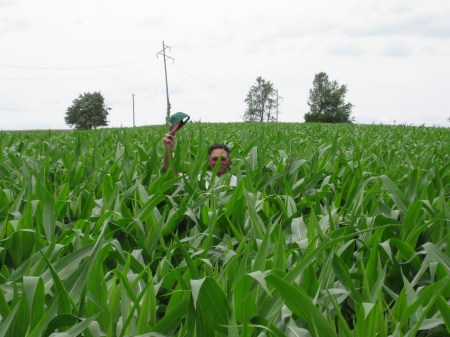
My six-foot-tall father standing in our tallest corn on July 3rd.

Knee-high by the Fourth of July is a common saying in the midwest.  It refers to the height of corn.  I guess that used to be a decent target for corn in the old days.  Corn is planted earlier now.

IMG_0453


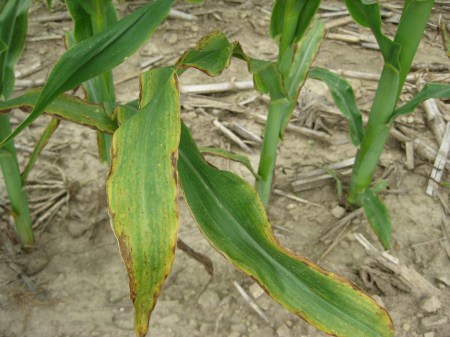
This is a corn plant showing potassium deficiency.  Yellowing on the outside of the lower leaves is the telltale sign.  This plant is alongside a gravel road so it probably has more to do with soil compaction and the inability of the corn roots to search out available potassium than an actual potassium deficiency in the soil.  The corn looks fine a few rows in.

It’s enlightening  that corn shows it’s deficiencies so readily.  What if our personal deficiencies were as visible?


Nessie in Wisconsin?

June 30, 2009

IMG_0399


My childhood career choices vacillated between Sasquatch hunter and Loch Ness monster hunter.  So imagine my surprise when I saw this behemoth surface on a Wisconsin lake.  I snapped a quick picture before it dove.

I wouldn’t want to estimate it’s size because you wouldn’t believe me anyway.  However, I will no longer be enjoying Wisconsin’s waters.  I’m not going to divulge the location of this monster as Wisconsin’s tourism industry is huge and I wouldn’t want to hurt it.  And perhaps this leviathin is a herbivore.

Sightings of this Wisconsin Nessie are not without precedent.  Jay Rath has a chapter in this book, “The W-Files,” devoted exclusively to lake monsters.

“At one time or another, many Wisconsin lakes have boasted their very own saurian monster.  In 1867, for example, Lake Michigan’s sightings were so convincing that the Chicago Tribune announced, ‘that Lake Michigan is inhabited by a vast monster, part fish and part serpent, no longer admits of doubt.’  But despite the publicity lake monster stories once received, today they are largely forgotten.”

I am sharing this information with family and friends only.  I consider you, dear reader, a friend.


The Proof is in the Pudding

June 19, 2009

IMG_0350

Large hogs enjoying their last days on an alfalfa/grass pasture.

 Are you purchasing pastured meats for your health?  Or are you more concerned that the animals are free-range?

Free-range is great fun for livestock.  But without careful management, a pasture can quickly become a dirt lot, and the health benefits that come from eating quality pasture will disappear.

If you are purchasing pastured meats for your health, and want to verify that the animals are getting the majority of their nutrients from pasture, then there is one sure way to know.  Observe the animals’ manure.

 IMG_0327

This is the picture of hog manure from one of the hogs pictured above.  It is almost as green as cattle manure and contains less grain than the hog manure pictured below, which is from a hog receiving no pasture or forage.

IMG_0354

Now that you have this knowledge, I’m sure most of you won’t use it.  And I don’t blame you.  The joke in the movie, “Tommy Boy,” is, “You can stick your head up a steer’s ass to find out how good the steaks are;  but wouldn’t you rather take the butcher’s word for it?” I’m guessing most of you would rather take the farmer’s word for it, too.

I also have two nice pictures of contrasting cattle manure.  If anyone is interested, comment or email.


First Cutting of Hay

June 7, 2009

IMG_0307


June 5, 2009.  Hay fields raked and ready to be baled.  These are the same fields that were pictured May 17 in the post, Contour Strip Cropping. 

I cut the hay fields Tuesday and Wednesday to hopefully be ready to bale on Friday.  Wednesday, Thursday, and Friday were good drying days, (sunny, low humidity), so we baled dry hay Friday.  It is raining now, (Saturday).

Yields are lower than hoped for.  I kept my fields in hay for one year too many and the fields experienced some winter-kill.  Alfalfa is known to winter-kill as it ages depending on winter conditions.  Orchardgrass is also known to winter-kill, but we haven’t had any problems until this winter.  These fields were my first experience with an improved orchardgrass.  The variety is “Extend” from Lacrosse Forage.  It is less clumpy and matures later than the common orchardgrass.  I picked out and planted the seed and it did well for me. I guess I fell in love with it and didn’t feel like rotating into corn.  Curiousfarmer is sentimental.

27 acres yielded 65 big round bales of hay.  Each round bale weighs about 1500 lbs.  So the total yield was 97,500 lbs. of hay.  That is 3,600 lbs. per acre.  We hope to yield 4,000 to 4,500 lbs. per acre for first cutting, which is by far the highest yielding cutting.  I’m interested to see how our other hay fields yield.

We are about 20% done with first cutting.  We will cut again next week when the weather cooperates.


The Law of Supply and Demand in Action

June 4, 2009

The price of soybean meal has gone through the roof.  The last load we purchased was over $.20 per lb. which is 30% greater than  the price we paid in March.  We buy a 3 ton load every ten days to two weeks.  Our cost per load has increased $300.

Farmers gossip more than a murder of crows.  The latest “news” is that we’re going to run out of soybean meal this summer.  I panicked a little.  Our direct-market hogs are on an alfalfa pasture and would be ok if only fed corn.  The logistics of getting all of the rest of our hogs onto pasture scared and excited me.  I love a challenge.  Then I realized that I was reacting to gossip and didn’t need to get crazy just yet.

I did, however, call my feed salesman and determined that it would be cost effective to substitute lysine and threonine, the two most limiting amino acids in a corn/soy diet for hogs, for soybean meal.  So I did.

For hogs weighing 200 lbs. to market, I am substituting 3 lbs. of lysine and 1 lb. of threonine for 50 lbs. of soybean meal in every ton of feed.  3 lbs. of lysine costs $2.85.  1 lb. of threonine costs $1.38.  So the total extra cost is $3.93.  50 lbs. of soybean meal costs roughly $10.  So the savings is roughly $6 per ton of feed.  We use about 6 ton of this feed per week, so the savings is $36 per week.  If soybean meal stays high all summer until harvest, and the relative prices stay similar, we will save $432 over 12 weeks.

I realize this isn’t a huge savings.  But it felt good to take some action.  And the collective action by many soybean meal users will keep us from running out of soybean meal until harvest.  This is the Law of Supply and Demand in action.


Three Little Pigs

May 28, 2009

IMG_0271

Isaac, Lael, and my 250 lbs. pastured hogs which will be butchered in June.  Note the single-strand electric fence in the foreground.

Isaac and his stepmom Lael visited my farm again and took home three little pigs.  Isaac and Lael are meat-eaters who desire to raise it themselves.  They own an acreage outside of Madison and are exploring the options for their land.  I’m glad pigs are a part of the plan.  Best of luck!


Companion Planting

May 27, 2009

IMG_0265

In the children’s book, “Bear and Bunny Grow Tomatoes,” by Bruce Koscielniak, Bear and Bunny take two different approaches to gardening.  Bear is anal and raises monocultures devoid of other plants, (weeds).  Bunny is a more relaxed individual and gardens with the weeds.  Bear has bumper crops.  Bunny has crop failures.  Bear shares his harvest with Bunny so Bunny doesn’t starve in the winter.

My ex-girlfriend tells me I am exactly like Bunny.  I, however, usually don’t experience crop failure.  And I have a method to my madness.  It’s called “Companion Planting.”  Some plants grow better together. 

In the excellent book on this subject, “Carrots Love Tomatoes,” Louis Riotte explains this principle in detail.  This  is his introduction.

“The magic and mystery of companion planting have intrigued and fascinated humans for centuries, yet it is a part of the gardening world that has never been fully explored.  Even today we are just on the threshold.  In years to come I hope that scientists, gardeners, and farmers everywhere will work together in making more discoveries that will prove of great value in augmenting the world’s food supply.

Plants that assist each other to grow well, plants that repel insects, even plants that repel other plants – all are of great practical use.  They always have been, but we are just beginning to find out why.”

In my last post, I wrote that I am striving to be “Umami.”  I’ll bet my choice of companions will have a huge effect on this.