First Cutting of Hay

June 7, 2009

IMG_0307


June 5, 2009.  Hay fields raked and ready to be baled.  These are the same fields that were pictured May 17 in the post, Contour Strip Cropping. 

I cut the hay fields Tuesday and Wednesday to hopefully be ready to bale on Friday.  Wednesday, Thursday, and Friday were good drying days, (sunny, low humidity), so we baled dry hay Friday.  It is raining now, (Saturday).

Yields are lower than hoped for.  I kept my fields in hay for one year too many and the fields experienced some winter-kill.  Alfalfa is known to winter-kill as it ages depending on winter conditions.  Orchardgrass is also known to winter-kill, but we haven’t had any problems until this winter.  These fields were my first experience with an improved orchardgrass.  The variety is “Extend” from Lacrosse Forage.  It is less clumpy and matures later than the common orchardgrass.  I picked out and planted the seed and it did well for me. I guess I fell in love with it and didn’t feel like rotating into corn.  Curiousfarmer is sentimental.

27 acres yielded 65 big round bales of hay.  Each round bale weighs about 1500 lbs.  So the total yield was 97,500 lbs. of hay.  That is 3,600 lbs. per acre.  We hope to yield 4,000 to 4,500 lbs. per acre for first cutting, which is by far the highest yielding cutting.  I’m interested to see how our other hay fields yield.

We are about 20% done with first cutting.  We will cut again next week when the weather cooperates.


The Law of Supply and Demand in Action

June 4, 2009

The price of soybean meal has gone through the roof.  The last load we purchased was over $.20 per lb. which is 30% greater than  the price we paid in March.  We buy a 3 ton load every ten days to two weeks.  Our cost per load has increased $300.

Farmers gossip more than a murder of crows.  The latest “news” is that we’re going to run out of soybean meal this summer.  I panicked a little.  Our direct-market hogs are on an alfalfa pasture and would be ok if only fed corn.  The logistics of getting all of the rest of our hogs onto pasture scared and excited me.  I love a challenge.  Then I realized that I was reacting to gossip and didn’t need to get crazy just yet.

I did, however, call my feed salesman and determined that it would be cost effective to substitute lysine and threonine, the two most limiting amino acids in a corn/soy diet for hogs, for soybean meal.  So I did.

For hogs weighing 200 lbs. to market, I am substituting 3 lbs. of lysine and 1 lb. of threonine for 50 lbs. of soybean meal in every ton of feed.  3 lbs. of lysine costs $2.85.  1 lb. of threonine costs $1.38.  So the total extra cost is $3.93.  50 lbs. of soybean meal costs roughly $10.  So the savings is roughly $6 per ton of feed.  We use about 6 ton of this feed per week, so the savings is $36 per week.  If soybean meal stays high all summer until harvest, and the relative prices stay similar, we will save $432 over 12 weeks.

I realize this isn’t a huge savings.  But it felt good to take some action.  And the collective action by many soybean meal users will keep us from running out of soybean meal until harvest.  This is the Law of Supply and Demand in action.


Three Little Pigs

May 28, 2009

IMG_0271

Isaac, Lael, and my 250 lbs. pastured hogs which will be butchered in June.  Note the single-strand electric fence in the foreground.

Isaac and his stepmom Lael visited my farm again and took home three little pigs.  Isaac and Lael are meat-eaters who desire to raise it themselves.  They own an acreage outside of Madison and are exploring the options for their land.  I’m glad pigs are a part of the plan.  Best of luck!


Companion Planting

May 27, 2009

IMG_0265

In the children’s book, “Bear and Bunny Grow Tomatoes,” by Bruce Koscielniak, Bear and Bunny take two different approaches to gardening.  Bear is anal and raises monocultures devoid of other plants, (weeds).  Bunny is a more relaxed individual and gardens with the weeds.  Bear has bumper crops.  Bunny has crop failures.  Bear shares his harvest with Bunny so Bunny doesn’t starve in the winter.

My ex-girlfriend tells me I am exactly like Bunny.  I, however, usually don’t experience crop failure.  And I have a method to my madness.  It’s called “Companion Planting.”  Some plants grow better together. 

In the excellent book on this subject, “Carrots Love Tomatoes,” Louis Riotte explains this principle in detail.  This  is his introduction.

“The magic and mystery of companion planting have intrigued and fascinated humans for centuries, yet it is a part of the gardening world that has never been fully explored.  Even today we are just on the threshold.  In years to come I hope that scientists, gardeners, and farmers everywhere will work together in making more discoveries that will prove of great value in augmenting the world’s food supply.

Plants that assist each other to grow well, plants that repel insects, even plants that repel other plants – all are of great practical use.  They always have been, but we are just beginning to find out why.”

In my last post, I wrote that I am striving to be “Umami.”  I’ll bet my choice of companions will have a huge effect on this.


Morel Mushrooms: Full of Umami

May 22, 2009

IMG_0263

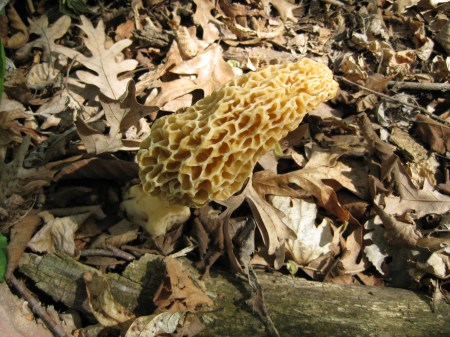
I finished planting corn Monday.  I celebrated by going Morel mushroom hunting with my Dad.  We found some beauties. 

We searched around dead or dying Elm trees.  Our forest has been ravaged by Dutch Elm disease.

Some Morels were boldly out in the open, like the one pictured above.  Most were hidden like the ones pictured below, and would be invisible to an untrained eye.  All were a pleasure to find and eat. 

IMG_0262

Why are Morels so delicious?  Mushrooms, and other protein-rich foods, are full of the fifth taste, Umami.  Umami is a Japanese word meaning, tasty.  Savory, brothy, meaty, are other ways to describe Umami.  Basically, it’s the taste of protein; or the taste as amino acids are broken down.  We all crave Umami and I enjoyed it in spades on the meat diet.

The four other main tastes are:  sweet, sour, salty, and bitter.  I was thinking metaphorically about the five tastes.  If I was to be described by one of the tastes, I would want to be Umami.  Tasty, hearty, interesting, challenging.   And I like to surround myself with Umami people.

Sweet is nice, but kind of uncomfortable for me.  Salty is the way I think of my Grandpa; cussing, telling stories about the old days.  Great quality for a grandpa.  Sour and bitter can describe many people.  I’m sure you will agree these people are simply endured and difficult to enjoy.

I’ll never be sweet or salty.  I could become sour and/or bitter.  I’m striving  to be Umami.  Which taste are you?


Contour Strip Cropping

May 17, 2009

IMG_0258

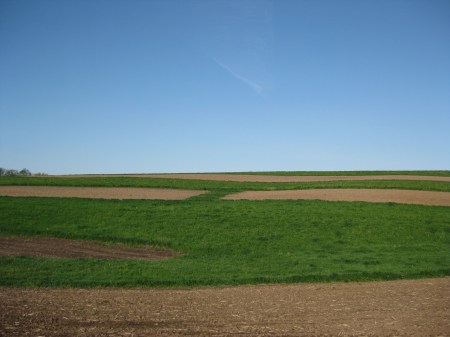
Contour strip cropping is a farming practice designed to minimize soil erosion.  Farming is practiced with the contour of the hillside or across the slope to slow water runoff during a rain.   Fields are arranged in alternating strips of an erodible cropping practice such as corn or soybeans with a soil conserving practice such as hay.

The picture above was taken today.  The tilled fields were planted to corn May 12th.  The green fields are alfalfa/orchardgrass hay fields which will be cut for hay three times in the summer and grazed by cattle once in the fall.

The narrow green strip in the middle of the corn field is a waterway.  It is important to not till in a natural swale or waterway to prevent erosion.  The large green strip across the bottom of the picture is the largest waterway on my farm.  The farmer who owned my farm before me said that when he bought the farm around 1940 there was a ditch big enough to drive a tractor in.  The early farmers didn’t understand some of the conservation practices we use today.  They cleared the land and plowed and planted wheat.


Baby Chicks

May 14, 2009


 IMG_0239

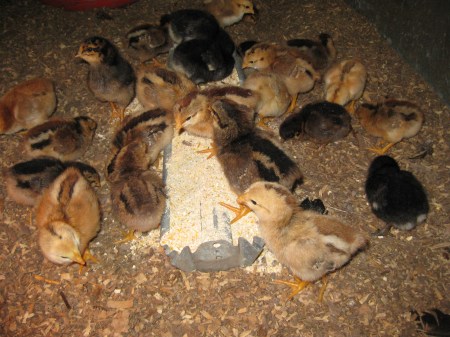
Kenosha elementary incubated 30 fertile eggs from my chickens.  They had 24 hatch; which is an 80% success rate.  Well done, roosters and hens.  Check out my protocol in the post, “Spring is here.”

The teachers said the students were ecstatic to see the chicks hatch after waiting three long weeks.  Other schools could do this project.  Incubators aren’t expensive.  Hook up with a local farmer.


No-till Planting Corn into Sod

May 9, 2009

IMG_0209

I no-till planted 25 acres of corn on Monday, May 4th.  This is our equipment, engaged in planting. 

IMG_0206

There are three wheels in this picture.  The first wheel is the coulter.  The coulter cuts a two-inch deep slot into the soil.  The next wheel is the depth wheel.  Not visible is the corn being deposited into the slot between the depth wheels.  The next wheel is the press wheel.  The press wheels close the seed furrow and press soil around the corn kernel.  All of these wheels are adjustable and we often adjust based on soil conditions.


Pork Carcass Breakdown: What to Expect

May 3, 2009

You want to buy pork, in bulk, direct from a farmer.  What should you expect?  Here is a link to pork carcass cutout charts.

Pork carcasses are usually sold as whole or half carcasses.  Traditionally, there are more cured and smoked products in a pork carcass resulting in a greater butchering cost when compared to beef.  I will detail a hog we butchered recently with butchering costs.

Description Weight Price Amount
Processing 172 lbs. $.45 $77.40
Cooling & Offal Pickup 172 lbs. $.22 $37.84
Hams 44 lbs. $.40 $17.60
Slicing Bacon 16 lbs. $.60 $9.60
Rolled shoulder 25 lbs. $.25 $6.25
Sausage Links 14 lbs. $.85 $11.90
Spare Ribs 10 lbs.    
Pork Chops 30 lbs.    


The total weight of the pork we took home was 139 lbs.  Some of the pork was lost as bones and other waste.  Pork carcasses will vary of course.  The amount of take-home pork will also vary based on the amount of processing, (i.e. deboning, etc.), you choose.

Based on $172 to the farmer and $160.59 to the butcher, the total cost is $332.59.  Divided by a take-home weight of 139 lbs., cost per lb. is $2.39.

Comment or email if you have questions.


Selection: A Force for Change

April 27, 2009

img_0123

769: a two year old heifer with her first calf; nursing, just twenty minutes after being born unassisted.  Observe her maternal instinct as she licks her calf.  She is undisturbed by my taking of her picture a few yards away.  Anyone who has raised cattle knows that it isn’t always this easy.  The following post will explain how we select for these traits.


Selection:  “A natural or artificial process that results or tends to result in the survival and propagation of some individuals or organisms but not of others with the result that the inherited traits of the survivors are perpetuated.”  Webster’s

A geneticist has a powerful tool with which to change a population:  Selection.  A herd is a moving population of genetics.  The selection decisions each farmer makes will determine the future of his/her herd.

I just had a revelation.  Selection is also what changes our personal lives.  The choices we make determine to a large extent the content and quality of our life.  Do I put as much thought and effort into personal life decisions as I do in selection decisions for my herd?  How about you?  Do you map out your life, or does it just happen to you?

“The best way to predict the future is to create it.”  Peter Drucker


My parents went on a bull-buying trip to Leland Red Angus Ranch in North Dakota. They purchased three bulls for $7,650.  Most farmers don’t spend over $1,500 on a bull.  Why are we willing to spend more?

In many respects we are frugal farmers.  We don’t own any one piece of machinery worth $7,650.  Why would we spend that much on bulls?  Simple, we understand and value the tremendous genetic contribution a bull, (herdsire), makes in a herd.

Our cowherd consists of 135 cows and 5 bulls.  A bull has 27 times the genetic impact of a cow in our herd, (135 divided by 5).  Some may argue that we should spend more on our bulls.  The cost is ancillary.  Finding the right bull for our herd is the main thing.  How do we know which bull is “right” for our herd?

I will explain which selection factors are important to us and how we choose a herdsire.  We have simplified our selection criteria into four main factors and in this order of importance:

1.  Disposition/Appearance

2.  Calving ease

3.  Fertility

4.  Maternal Soundness

If these four criteria are successfully met, we will start to look at other factors such as growth and carcass traits to choose between two similar bulls.  This is probably opposite of most in the cattle industry.  Growth and carcass traits usually receive top merit and our four criteria receive much less selection weight. 

Why is this so?  Have you heard the golf saying, “drive for show and putt for dough?”  What this refers to is most golfers want to impress their buddies with a super-long drive and will spend much of their time practicing that aspect of their game.  Analytical golfers know that the club that takes the most strokes is the putter, and any improvement there will have the greatest effect on reducing their scores.  But putting isn’t sexy.

In the cattle industry, most people want to wean big calves and brag to their buddies about the awesome growth of their cattle.  Unfortunately, growth is negatively correlated with percent calf crop.  Percent calf crop, (the number of calves weaned compared to the number of cows in a herd), is the number one production parameter by far when predicting profitability.  But percent calf crop isn’t sexy.

Selection criteria that will affect percent calf crop are: calving ease, fertility, and maternal soundness.  A cow needs to have a live calf, successfully raise the calf until weaning, breed and have a calf next year.  That is why we select for these three traits.

Why is disposition/appearance on the top of our selection criteria?  It is a convenience trait.  A convenience trait is something that makes life easier. 

We like to have a calm setting when we work with our cattle.  It’s better for the people and better for the animals.  Much of that can be accomplished with excellent animal handling and we always strive to approach our animals with patience.

But disposition is also highly heritable.  We make our life easier by maintaining a genetically calm herd. 

Appearance is also subjectively evaluated at the same time as disposition.  We want to raise animals we enjoy observing.  This may seem silly and unscientific, but I suspect years of observing cattle causes us to favor functional cattle over unbalanced cattle.

Now you know what we select for in our cattle.  How do we select?

The first selection is the selection of a breed.  Choose a breed based on its strengths, what it’s known for.  Red Angus is known for calving ease, fertility, good mothers, marbling.

The next selection is the selection of a herd.  We want to buy bulls from a breeder that has similar philosophies and management as us.  Like most people, we also prefer to buy from someone we like and trust.  It’s important to visit the farm and meet the producers and see the cattle before the sale to alleviate time crunch.  We make farm and ranch visits a part of our vacations.  Producers are always happy to take a couple of hours to show you around their place.  My parents and I have each visited Leland Red Angus on separate occasions.

Now we come to bull selection.  Disposition, our most important trait, has to be evaluated in person.  We approach a bull and observe his behavior.  Disposition is a pass/fail trait.  The bull should quietly walk away from you as you come closer.  This would be a pass.  He fails if he runs away with his head up in the air; too flighty.  He also fails if he holds his ground or approaches while shaking his head.  This is aggressive and dangerous behavior which will only get worse as he gets older.

We have experienced one other type of behavior in the Red Angus breed which is worth noting.  The ultra-quiet bull will not exhibit any aggressive behavior; but will not walk away when approached.  We thought this was a positive and selected two bulls in the past like this.  We now classify this behavior as a fail.  The reason?  Each of these bulls turned aggressive after a few years.  We think it’s because they failed to respect us.  Disposition can be taken too far.  Animals can be too quiet.  What about our other traits?

Fortunately, calving ease, fertility, and maternal soundness cannot be selected to an unhealthy extreme, unlike most traits.  We are striving for 100% success in each of these traits.  How do we select for these traits?

Maternal soundness is the ability of a cow to take care of her calf.  She has mothering instinct.  She has enough milk for her calf to grow well.  Yet she doesn’t give so much milk that her udder begins to lose form and her calf has a difficult time nursing on a too-large teat for the first time.

Selection for this trait can be done two ways.  Make sure the herd you are selecting from doesn’t make excuses for a cow that fails to wean a calf.  They should have a philosophy of culling problem cows.  And observe the cows and specifically the mothers of the bulls you are thinking of buying.

Calving ease and fertility are best selected by using modern genetic evaluation programs.  The Red Angus breed has a genetic evaluation tool called EPDs, Expected Progeny Differences.  EPDs show the relative genetic merit of an individual within a breed.  The easiest way to use EPDs is to look up the breed percentile rankings for the EPD for each trait you are selecting for, and then determine how well you want your herdsires to rank.

Fertility is expressed with an EPD called Stayability.  Stayability predicts the odds that a cow will have a calf every year until at least the age of six.  The Red Angus breed used the age of six because economic research shows that this is the age when a cow begins to show a profit.

Calving ease is expressed in two ways:  calving ease direct and calving ease maternal.  Calving ease direct predicts the odds that a bull’s progeny will be born unassisted.  Calving ease maternal predicts the odds that a bull’s daughter will have her first calf unassisted.

Based on experience and availability, I wanted bulls that ranked in the top 40% of the breed for these three traits.  Leland Red Angus sends out a sale catalog before their sale with all of this information and more.  I went through the catalog and found 45 bulls that met my criteria out of 153 bulls available. 

My parents drove to Leland’s and evaluated the 45 bulls before the sale.  They eliminated some based on appearance and disposition.  The bulls that would work for us they assigned a relative value in dollars to guide our purchase during the sale.

They ended up purchasing bulls 41, 118, and 145.  I calculated the average EPD’s for the three bulls they purchased and congratulated them on a job well-done.  The three bulls averaged in the top 15% of the breed for calving ease direct, top 10% for calving ease maternal, and top 20% for stayability.  Because of selection, our future looks bright!