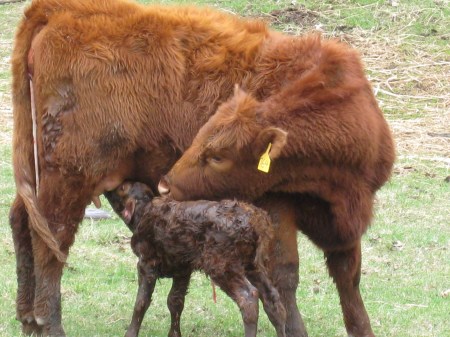
769: a two year old heifer with her first calf; nursing, just twenty minutes after being born unassisted. Observe her maternal instinct as she licks her calf. She is undisturbed by my taking of her picture a few yards away. Anyone who has raised cattle knows that it isn’t always this easy. The following post will explain how we select for these traits.
Selection: “A natural or artificial process that results or tends to result in the survival and propagation of some individuals or organisms but not of others with the result that the inherited traits of the survivors are perpetuated.” Webster’s
A geneticist has a powerful tool with which to change a population: Selection. A herd is a moving population of genetics. The selection decisions each farmer makes will determine the future of his/her herd.
I just had a revelation. Selection is also what changes our personal lives. The choices we make determine to a large extent the content and quality of our life. Do I put as much thought and effort into personal life decisions as I do in selection decisions for my herd? How about you? Do you map out your life, or does it just happen to you?
“The best way to predict the future is to create it.” Peter Drucker
My parents went on a bull-buying trip to Leland Red Angus Ranch in North Dakota. They purchased three bulls for $7,650. Most farmers don’t spend over $1,500 on a bull. Why are we willing to spend more?
In many respects we are frugal farmers. We don’t own any one piece of machinery worth $7,650. Why would we spend that much on bulls? Simple, we understand and value the tremendous genetic contribution a bull, (herdsire), makes in a herd.
Our cowherd consists of 135 cows and 5 bulls. A bull has 27 times the genetic impact of a cow in our herd, (135 divided by 5). Some may argue that we should spend more on our bulls. The cost is ancillary. Finding the right bull for our herd is the main thing. How do we know which bull is “right” for our herd?
I will explain which selection factors are important to us and how we choose a herdsire. We have simplified our selection criteria into four main factors and in this order of importance:
1. Disposition/Appearance
2. Calving ease
3. Fertility
4. Maternal Soundness
If these four criteria are successfully met, we will start to look at other factors such as growth and carcass traits to choose between two similar bulls. This is probably opposite of most in the cattle industry. Growth and carcass traits usually receive top merit and our four criteria receive much less selection weight.
Why is this so? Have you heard the golf saying, “drive for show and putt for dough?” What this refers to is most golfers want to impress their buddies with a super-long drive and will spend much of their time practicing that aspect of their game. Analytical golfers know that the club that takes the most strokes is the putter, and any improvement there will have the greatest effect on reducing their scores. But putting isn’t sexy.
In the cattle industry, most people want to wean big calves and brag to their buddies about the awesome growth of their cattle. Unfortunately, growth is negatively correlated with percent calf crop. Percent calf crop, (the number of calves weaned compared to the number of cows in a herd), is the number one production parameter by far when predicting profitability. But percent calf crop isn’t sexy.
Selection criteria that will affect percent calf crop are: calving ease, fertility, and maternal soundness. A cow needs to have a live calf, successfully raise the calf until weaning, breed and have a calf next year. That is why we select for these three traits.
Why is disposition/appearance on the top of our selection criteria? It is a convenience trait. A convenience trait is something that makes life easier.
We like to have a calm setting when we work with our cattle. It’s better for the people and better for the animals. Much of that can be accomplished with excellent animal handling and we always strive to approach our animals with patience.
But disposition is also highly heritable. We make our life easier by maintaining a genetically calm herd.
Appearance is also subjectively evaluated at the same time as disposition. We want to raise animals we enjoy observing. This may seem silly and unscientific, but I suspect years of observing cattle causes us to favor functional cattle over unbalanced cattle.
Now you know what we select for in our cattle. How do we select?
The first selection is the selection of a breed. Choose a breed based on its strengths, what it’s known for. Red Angus is known for calving ease, fertility, good mothers, marbling.
The next selection is the selection of a herd. We want to buy bulls from a breeder that has similar philosophies and management as us. Like most people, we also prefer to buy from someone we like and trust. It’s important to visit the farm and meet the producers and see the cattle before the sale to alleviate time crunch. We make farm and ranch visits a part of our vacations. Producers are always happy to take a couple of hours to show you around their place. My parents and I have each visited Leland Red Angus on separate occasions.
Now we come to bull selection. Disposition, our most important trait, has to be evaluated in person. We approach a bull and observe his behavior. Disposition is a pass/fail trait. The bull should quietly walk away from you as you come closer. This would be a pass. He fails if he runs away with his head up in the air; too flighty. He also fails if he holds his ground or approaches while shaking his head. This is aggressive and dangerous behavior which will only get worse as he gets older.
We have experienced one other type of behavior in the Red Angus breed which is worth noting. The ultra-quiet bull will not exhibit any aggressive behavior; but will not walk away when approached. We thought this was a positive and selected two bulls in the past like this. We now classify this behavior as a fail. The reason? Each of these bulls turned aggressive after a few years. We think it’s because they failed to respect us. Disposition can be taken too far. Animals can be too quiet. What about our other traits?
Fortunately, calving ease, fertility, and maternal soundness cannot be selected to an unhealthy extreme, unlike most traits. We are striving for 100% success in each of these traits. How do we select for these traits?
Maternal soundness is the ability of a cow to take care of her calf. She has mothering instinct. She has enough milk for her calf to grow well. Yet she doesn’t give so much milk that her udder begins to lose form and her calf has a difficult time nursing on a too-large teat for the first time.
Selection for this trait can be done two ways. Make sure the herd you are selecting from doesn’t make excuses for a cow that fails to wean a calf. They should have a philosophy of culling problem cows. And observe the cows and specifically the mothers of the bulls you are thinking of buying.
Calving ease and fertility are best selected by using modern genetic evaluation programs. The Red Angus breed has a genetic evaluation tool called EPDs, Expected Progeny Differences. EPDs show the relative genetic merit of an individual within a breed. The easiest way to use EPDs is to look up the breed percentile rankings for the EPD for each trait you are selecting for, and then determine how well you want your herdsires to rank.
Fertility is expressed with an EPD called Stayability. Stayability predicts the odds that a cow will have a calf every year until at least the age of six. The Red Angus breed used the age of six because economic research shows that this is the age when a cow begins to show a profit.
Calving ease is expressed in two ways: calving ease direct and calving ease maternal. Calving ease direct predicts the odds that a bull’s progeny will be born unassisted. Calving ease maternal predicts the odds that a bull’s daughter will have her first calf unassisted.
Based on experience and availability, I wanted bulls that ranked in the top 40% of the breed for these three traits. Leland Red Angus sends out a sale catalog before their sale with all of this information and more. I went through the catalog and found 45 bulls that met my criteria out of 153 bulls available.
My parents drove to Leland’s and evaluated the 45 bulls before the sale. They eliminated some based on appearance and disposition. The bulls that would work for us they assigned a relative value in dollars to guide our purchase during the sale.
They ended up purchasing bulls 41, 118, and 145. I calculated the average EPD’s for the three bulls they purchased and congratulated them on a job well-done. The three bulls averaged in the top 15% of the breed for calving ease direct, top 10% for calving ease maternal, and top 20% for stayability. Because of selection, our future looks bright!


 Posted by Curiousfarmer
