Selection: A Force for Change

April 27, 2009

img_0123

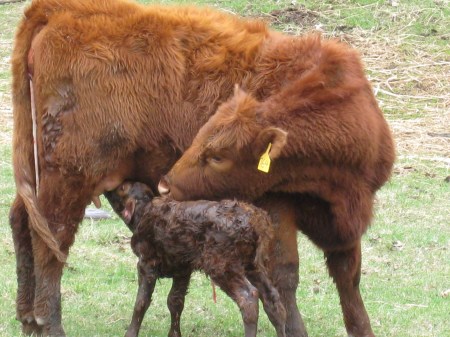
769: a two year old heifer with her first calf; nursing, just twenty minutes after being born unassisted.  Observe her maternal instinct as she licks her calf.  She is undisturbed by my taking of her picture a few yards away.  Anyone who has raised cattle knows that it isn’t always this easy.  The following post will explain how we select for these traits.


Selection:  “A natural or artificial process that results or tends to result in the survival and propagation of some individuals or organisms but not of others with the result that the inherited traits of the survivors are perpetuated.”  Webster’s

A geneticist has a powerful tool with which to change a population:  Selection.  A herd is a moving population of genetics.  The selection decisions each farmer makes will determine the future of his/her herd.

I just had a revelation.  Selection is also what changes our personal lives.  The choices we make determine to a large extent the content and quality of our life.  Do I put as much thought and effort into personal life decisions as I do in selection decisions for my herd?  How about you?  Do you map out your life, or does it just happen to you?

“The best way to predict the future is to create it.”  Peter Drucker


My parents went on a bull-buying trip to Leland Red Angus Ranch in North Dakota. They purchased three bulls for $7,650.  Most farmers don’t spend over $1,500 on a bull.  Why are we willing to spend more?

In many respects we are frugal farmers.  We don’t own any one piece of machinery worth $7,650.  Why would we spend that much on bulls?  Simple, we understand and value the tremendous genetic contribution a bull, (herdsire), makes in a herd.

Our cowherd consists of 135 cows and 5 bulls.  A bull has 27 times the genetic impact of a cow in our herd, (135 divided by 5).  Some may argue that we should spend more on our bulls.  The cost is ancillary.  Finding the right bull for our herd is the main thing.  How do we know which bull is “right” for our herd?

I will explain which selection factors are important to us and how we choose a herdsire.  We have simplified our selection criteria into four main factors and in this order of importance:

1.  Disposition/Appearance

2.  Calving ease

3.  Fertility

4.  Maternal Soundness

If these four criteria are successfully met, we will start to look at other factors such as growth and carcass traits to choose between two similar bulls.  This is probably opposite of most in the cattle industry.  Growth and carcass traits usually receive top merit and our four criteria receive much less selection weight. 

Why is this so?  Have you heard the golf saying, “drive for show and putt for dough?”  What this refers to is most golfers want to impress their buddies with a super-long drive and will spend much of their time practicing that aspect of their game.  Analytical golfers know that the club that takes the most strokes is the putter, and any improvement there will have the greatest effect on reducing their scores.  But putting isn’t sexy.

In the cattle industry, most people want to wean big calves and brag to their buddies about the awesome growth of their cattle.  Unfortunately, growth is negatively correlated with percent calf crop.  Percent calf crop, (the number of calves weaned compared to the number of cows in a herd), is the number one production parameter by far when predicting profitability.  But percent calf crop isn’t sexy.

Selection criteria that will affect percent calf crop are: calving ease, fertility, and maternal soundness.  A cow needs to have a live calf, successfully raise the calf until weaning, breed and have a calf next year.  That is why we select for these three traits.

Why is disposition/appearance on the top of our selection criteria?  It is a convenience trait.  A convenience trait is something that makes life easier. 

We like to have a calm setting when we work with our cattle.  It’s better for the people and better for the animals.  Much of that can be accomplished with excellent animal handling and we always strive to approach our animals with patience.

But disposition is also highly heritable.  We make our life easier by maintaining a genetically calm herd. 

Appearance is also subjectively evaluated at the same time as disposition.  We want to raise animals we enjoy observing.  This may seem silly and unscientific, but I suspect years of observing cattle causes us to favor functional cattle over unbalanced cattle.

Now you know what we select for in our cattle.  How do we select?

The first selection is the selection of a breed.  Choose a breed based on its strengths, what it’s known for.  Red Angus is known for calving ease, fertility, good mothers, marbling.

The next selection is the selection of a herd.  We want to buy bulls from a breeder that has similar philosophies and management as us.  Like most people, we also prefer to buy from someone we like and trust.  It’s important to visit the farm and meet the producers and see the cattle before the sale to alleviate time crunch.  We make farm and ranch visits a part of our vacations.  Producers are always happy to take a couple of hours to show you around their place.  My parents and I have each visited Leland Red Angus on separate occasions.

Now we come to bull selection.  Disposition, our most important trait, has to be evaluated in person.  We approach a bull and observe his behavior.  Disposition is a pass/fail trait.  The bull should quietly walk away from you as you come closer.  This would be a pass.  He fails if he runs away with his head up in the air; too flighty.  He also fails if he holds his ground or approaches while shaking his head.  This is aggressive and dangerous behavior which will only get worse as he gets older.

We have experienced one other type of behavior in the Red Angus breed which is worth noting.  The ultra-quiet bull will not exhibit any aggressive behavior; but will not walk away when approached.  We thought this was a positive and selected two bulls in the past like this.  We now classify this behavior as a fail.  The reason?  Each of these bulls turned aggressive after a few years.  We think it’s because they failed to respect us.  Disposition can be taken too far.  Animals can be too quiet.  What about our other traits?

Fortunately, calving ease, fertility, and maternal soundness cannot be selected to an unhealthy extreme, unlike most traits.  We are striving for 100% success in each of these traits.  How do we select for these traits?

Maternal soundness is the ability of a cow to take care of her calf.  She has mothering instinct.  She has enough milk for her calf to grow well.  Yet she doesn’t give so much milk that her udder begins to lose form and her calf has a difficult time nursing on a too-large teat for the first time.

Selection for this trait can be done two ways.  Make sure the herd you are selecting from doesn’t make excuses for a cow that fails to wean a calf.  They should have a philosophy of culling problem cows.  And observe the cows and specifically the mothers of the bulls you are thinking of buying.

Calving ease and fertility are best selected by using modern genetic evaluation programs.  The Red Angus breed has a genetic evaluation tool called EPDs, Expected Progeny Differences.  EPDs show the relative genetic merit of an individual within a breed.  The easiest way to use EPDs is to look up the breed percentile rankings for the EPD for each trait you are selecting for, and then determine how well you want your herdsires to rank.

Fertility is expressed with an EPD called Stayability.  Stayability predicts the odds that a cow will have a calf every year until at least the age of six.  The Red Angus breed used the age of six because economic research shows that this is the age when a cow begins to show a profit.

Calving ease is expressed in two ways:  calving ease direct and calving ease maternal.  Calving ease direct predicts the odds that a bull’s progeny will be born unassisted.  Calving ease maternal predicts the odds that a bull’s daughter will have her first calf unassisted.

Based on experience and availability, I wanted bulls that ranked in the top 40% of the breed for these three traits.  Leland Red Angus sends out a sale catalog before their sale with all of this information and more.  I went through the catalog and found 45 bulls that met my criteria out of 153 bulls available. 

My parents drove to Leland’s and evaluated the 45 bulls before the sale.  They eliminated some based on appearance and disposition.  The bulls that would work for us they assigned a relative value in dollars to guide our purchase during the sale.

They ended up purchasing bulls 41, 118, and 145.  I calculated the average EPD’s for the three bulls they purchased and congratulated them on a job well-done.  The three bulls averaged in the top 15% of the breed for calving ease direct, top 10% for calving ease maternal, and top 20% for stayability.  Because of selection, our future looks bright!


Traffic Accident

April 26, 2009

I’m ok and no one was hurt, but I was in a traffic accident three hours ago.  I was on my way to church in my truck and a minivan was pulled over on the wrong side of the road delivering a weekly shopping paper into a mailbox.  I slowed down and moved into the other lane to go by them.  As I came closer they pulled back onto the road right in front of me.  I was going at least 40 mph and would have hit them head-on.  I instinctively chose the ditch.  I hit a culvert almost immediately and went airborne for 35 feet landing with the front end of my truck digging out the yard.  I rolled to a stop and took off my seatbelt.  My airbag didn’t activate.  If I hadn’t been wearing my seatbelt I would have broke my neck in the cab or  in the windshield. 

I know the guy whose front yard I ended up in.  Dave happened to be looking out his window and saw the whole thing.  He thought it was going to be a head-on and was amazed I avoided them.  I would have seriously messed them up because I had all the momentum.  They pulled off the road and walked to my truck.  They were more shook-up than me, and I found myself consoling the woman who had been driving.

We called the police and waited for them to come and fill out an accident report.  It turns out her license had been suspended and she had been picked up for that before.  She told me her eyes were blurry and she doesn’t see well.  Her brother-in-law was riding with her.  He didn’t have a license either.  I could tell right away they were not healthy people.

T’he police officer wouldn’t allow them to drive home, of course.  She received a ticket for operating without a license and for operating on the wrong side of the road.  And she couldn’t call her husband because the phone in their house was out.  So Dave offered to pick me up in Argyle where they lived if I wanted to drive them home.  So I found myself driving home the people who caused me to wreck my truck.  If Idon’t laugh I’ll cry.

All in all, I’m very happy and give thanks to God.  No one was hurt.  Be safe and drive defensively.


Bottle Calf

April 18, 2009


My niece visited last weekend.  She said she wanted a “bottle calf.”  A bottle calf is an orphan and we don’t usually have one.  My niece must have inherited the wishing ability from her grandma.  The next morning we found a cow that had given birth to twins.  Cows are not like ewes and will usually only claim one calf and leave the other one to die.  One of the twins was strong and had already nursed.  The other twin was weak and cold so we brought him to the barn and my niece gave him a bottle of milk replacer.  She named him “Honey.”

A couple days later a cow gave birth to a calf that was premature and died.  We walked the cow into the corral and placed her in the catch chute and helped Honey nurse the cow.  The cow wanted a calf and after a couple of days she now claims Honey as her own.  The cow is happy to have a calf and Honey is happy to have a mom.  My niece returned home and would no longer be helping with chores, so we were happy to not have a bottle calf to take care of.


Planting Oats

April 11, 2009


My niece and I planting oats/barley.  In the background is my house and red barn.  The three white buildings over the top of my head are called “hoop buildings.”  This is where most of our hogs are raised.

This field was corn last year.  I plant a mix of oats and barley.  It will be combined about August 1 and used as hog feed.  The straw will be baled and used as bedding in the hoop buildings.  We also plant alfalfa and grasses now as an underseeding.  It will grow up under the oats and will be grazed by the cows in the fall.  Next year it will be an alfalfa/grass hay field.  It will remain a hay field for three years, then one to two years corn, then back to oats.  That is our crop rotation.  Check out my seeding recipes here.


Spring is Here!

April 10, 2009

Spring is here!  Baby calves, baby piglets, planting oats, and 70 hour workweeks.  Spring is the perfect thing to follow long winter hibernation.  I feel I am a part of nature, not apart from nature.  Do you have seasons in your life?

My niece’s third grade class is planning on hatching chicken eggs and they asked me to furnish fertile eggs.   I have been providing fertile hatching eggs to one class or another for several years.  So far, everyone has had success incubating and hatching baby chicks from my chickens’ fertile eggs.  I’ll explain my protocol. 

One rooster is recommended for every ten hens.  House the roosters with the hens for at least two weeks prior to saving eggs.  Save eggs for five days or less prior to incubation.  Only select clean, well formed, normal eggs.  I put fresh straw in all of the nesting boxes to ensure cleanliness.   Store the eggs in egg cartons at 60 F.  Elevate one end of the egg carton and switch ends twice a day.  This prevents the contents of the egg from sticking inside the shell.  Place all the eggs in an incubator and follow the directions. 

Embryos will not start to develop until placed in an incubator or a hen begins to sit on them.  This is how a chicken can lay eggs over several days and still have all the chicks hatch at the same time.

The natural option is to allow a broody hen to sit on eggs.  A broody hen is one that wants to sit on a nest of eggs.  Most modern chickens have the broodiness bred out of them as they stop laying eggs once they become broody.  I still have some hens that exhibit broodiness and will allow some to sit on a nest and raise their own chicks. 

Everyone is excited when the chicks begin to pip through their shells.  Sometimes a chick is not strong enough to break out of its shell and will die.  An environment that was perfect for development becomes a confining prison resulting in death. 

Spring is here!  Pip, pip, away!


Genetics or Environment?

April 5, 2009

I sold showpigs to 4-H and FFA students this past week.  Showing swine is near and dear to me as I probably wouldn’t be farming today if it weren’t for showing swine.  Striving to improve on my placing at the Lafayette County Fair caused me to begin my life-long study of genetics and improvement of livestock through selection.  Check out “How I Became a Swine Seedstock Supplier.”

Our swine show is an excellent learning opportunity.  Showpigs are weighed and identified in April.  The maximum weight was 88 lbs. on Saturday. 

The students then have the responsibility of caring for the swine until the show in July.  After the show, each student is allowed to sell one showpig in the livestock auction.  Local businesses support the students by purchasing a pig or other species of livestock.  Prices are usually above market price so the students are almost guaranteed to make money on their livestock project.  Students are also required to keep production and financial records on their livestock project.  Students learn responsibility, accounting, and marketing skills all in one fun project.

Not everyone is successful, however.  There is a minimum weight, (220 lbs.), to sell in the livestock auction.  This requires an average daily gain of about 1.5 lbs per day, (170 lbs. of gain in 113 days).  This is not difficult to accomplish with today’s swine.  However, to achieve this average daily gain, a pig needs clean feed and water, shelter, shade, and a way to cool off, (sprinkler or wallow), when it gets hot.  If a student fails to provide these ingredients every day, he/she may find his/her pig is too light to sell at the auction.  Another great learning experience.

One family had never purchased from me before.  I helped them deliberate whether a smaller pig, (46 lbs.), would be big enough by fair-time.  They asked me how well my pigs gain weight.  I told them average because I was more interested in what their pigs have weighed at the fair in the past.  I asked this because it’s been my experience that families tend to have similar experiences from year to year even though the pigs are different.  Some families always bring 300 lb. pigs to the fair.  Other families always struggle to make the minimum weight.

This is easily explained because average daily gain is only moderately heritable.  Heritability is expressed from 0 to 1 with 0 being not heritable and 1 being completely heritable.  Average daily gain in swine is about .3.  This means that 30% of the variation in average daily gain is due to genetics. 

What causes the other 70%?  Environment!  That explains why the people managing the pigs are a much greater factor than the genetics of the pigs.

The family decided to take the smaller showpig.  I will let you know how they did after the fair in July.

What are you blaming genetics for?  Could your environment be a greater factor?


Thinking in Odors

April 1, 2009

Most people think in words.  Temple Grandin, a highly influential animal scientist, thinks in pictures. Ms. Grandin believes this makes her more attuned to the way animals think.  She has used this gift to improve the lives of countless animals.  

I, however, think like a dog.  I think in odors.  For example, the numeral one is warm milk, the letter A is baby poop, sister is chocolate pudding. 

School was difficult.  I was labeled an under-achiever.  It takes longer for me to “get” something.  Once I have it though, I never lose it.  I attribute this to the primitive area of the brain where an odor/memory is located, the olfactory cortex.

Objects which have a strong odor are usually associated with their own odor.  The odor could also have a different meaning.  For example, onion is onion; but onion is also sorrow.

Abstract concepts are extremely difficult.  This is what one through ten looks like for me:  one: warm milk, two: baby shampoo, three: cat poop, four: talcum powder, five: chocolate, six: lemon, seven: coffee, eight: banana, nine: gasoline, ten: wet dog. 

After ten, odors go together.  For example sixteen is wet dog and lemon.  I’m only able to approximate as the numbers go higher.  I’m approaching my fortieth birthday and that represents quadruple wet dog for me, but it is almost indistinguishable from thirty or fifty.

Remembering people is strange as well.  If I want to remember someone I have never met, I need to manufacture an odor memory to associate with them.  It’s similar to the visual mnemonic tricks I have heard people use.

If I am meeting you for the first time you may accuse me of being a close talker.  This is because I am trying to pinpoint an odor to remember you by.  Once that odor is established in my olfactory cortex, it will always be with me.

Ex-girlfriends conjure up particularly strong odor/memories.  My first girlfriend: cotton candy.  My last girlfriend: vinegar.  I never told her that vinegar represents her.  How do you tell someone that?  I think she is reading my blog, so now she knows.  Sorry P.

I haven’t been able to use this gift/curse for anything positive like Ms. Grandin has.  New research has shown that dogs can sometimes detect cancer.  The most I have accomplished is recognizing gastrointestinal distress.

If you or someone april you know is also an odor/thinker, please fools comment.  Thank you.