Reputation Selling Heifers

March 26, 2010

“Would you take 650 a head for the entire group?” Greg said.

“We would,” Dad said.  “But we’ve got guys coming to the sale. And I told Kevin I’m bringing them.  And Bloomington advertised already.”

“Yeah,” I said.  “I wished we could have talked a week ago.  We’ll definitely call you next year.  I didn’t realize you bought cattle in the spring.”

“Whenever.  Whenever there are good cattle to be bought,” John said.

“Do you think we made the right decision,” Dad said.

“Yeah, it’s our reputation,” I said.  “It’s probably going to cost us about 2,000 dollars, though.”

“How do you figure?”

“I figure they’ll bring about 600 dollars net at the sale barn.  So 50 dollars a head times 40 head equals 2,000 dollars.”

“I guess that sounds about right,” Dad said.  “Would could we do?  We’ve made a commitment.”

“And we’re in this business for the long haul.  So even if it costs us a couple thousand short-term, we can make it up long-term by having consistently good cattle that people want to buy.  Let’s call it an investment in our future.”

As our hay supply dwindled and the groundhog didn’t see his shadow, we thought about selling our yearling heifers.  We planned to select the heifers we wanted to breed and keep for cows and then offer the rest privately for farmers to add to their cowherd.  Whatever was left would be sold at the local livestock auction.  We have been doing this ever since we improved our genetics using Red Angus bulls and have always had a positive response from farmers.

We placed an ad in the local Shopping News.  It read, “Yearling Red Angus replacement heifers for sale.  Matthew Walter, phone number.”

We ran the ad for three weeks and I received no calls the first week, two calls the second week, and four calls the third week.  Nibbles, but no bites.

It appeared that our price was a little high.  We were asking $700 a head.  The feeder calf market was soft in January and the first half of February.  Our best estimate was that we would get $500 to $550 a head at the sale barn.

One guy stopped in a couple of times and told us we were $100 too high.  We thanked him for his interest and told him we would tell him when we took them to the sale barn.

Dale stopped in and walked through them.  We could tell he was impressed when 978 walked up and licked his arm.  People are impressed by quiet cattle.

Dale was interested, but in the whole group.  He wanted us to call him when we took them to the sale barn.

We called Kevin at Bloomington a week in advance of the sale so he could advertise them.  We contacted a trucker to help us haul them.  Everything was lined up for the March 12th sale.  And then John and Greg stopped in and made us a great offer.

The very night after we declined Greg’s offer, Kevin called us to make sure we were bringing our heifers.  He said they had received calls and there was definitely some interest in them.  Dad and I were glad we weren’t going back on our word.

We sat and watched cattle sell.  There is always tremendous variation in the prices.  Four red heifers averaging 666 lbs., brought 95 cents per lb.  Five black heifers averaging 632 lbs., brought only 88 cents per lb.

Thirteen red heifers averaging 656 lbs., brought 99.5 cents per lb.  I hoped ours would bring that much.

Our heifers came in the ring.  They looked good.  Thirty-eight heifers averaging 666 lbs., brought 102.5 cents per lb.  Two small heifers averaging 420 lbs. , brought 112.5 cents per lb.  Dale was the winning bidder for all of them.

They averaged $672 each.  Even after commission and trucking was paid, we still made well over $650 each.

We were happy.  We made some money.  And more importantly, we stuck to our word and kept our reputation intact.


Tearing Out Fence

March 20, 2010

Dad is ok.  But we had an emotional St. Patrick’s Day.

Dad sat down on a pail to take a break while I used my chainsaw to cut some shrubs in the fence row  about ten feet away.  I was trying to avoid the barb wire, of course, but hit a wire that was embedded in the tall grass.  It broke and went flying into his face.

I gave him a ride home on the ATV and Mom took him to the local clinic where he received three stitches in his lip and a tetanus shot.  Mom took him to McDonald’s after that. He had a shamrock shake.

Dad was hurt at 2:30 and was back helping me clear out the fence row by 4.  We finished clearing the fence row by 6.  A quarter mile of fence cleared in a day and a half, even with an injury timeout.

Pictured below are the brace posts.  The brace posts are tied together with wire, with a brace between them.  This gives you something to pull against when stretching the barb wire.

The brace was traditionally placed at an angle.  But this results in one post being pushed out of the ground over time.   We place our brace  level and I will picture this when we make this fence new.

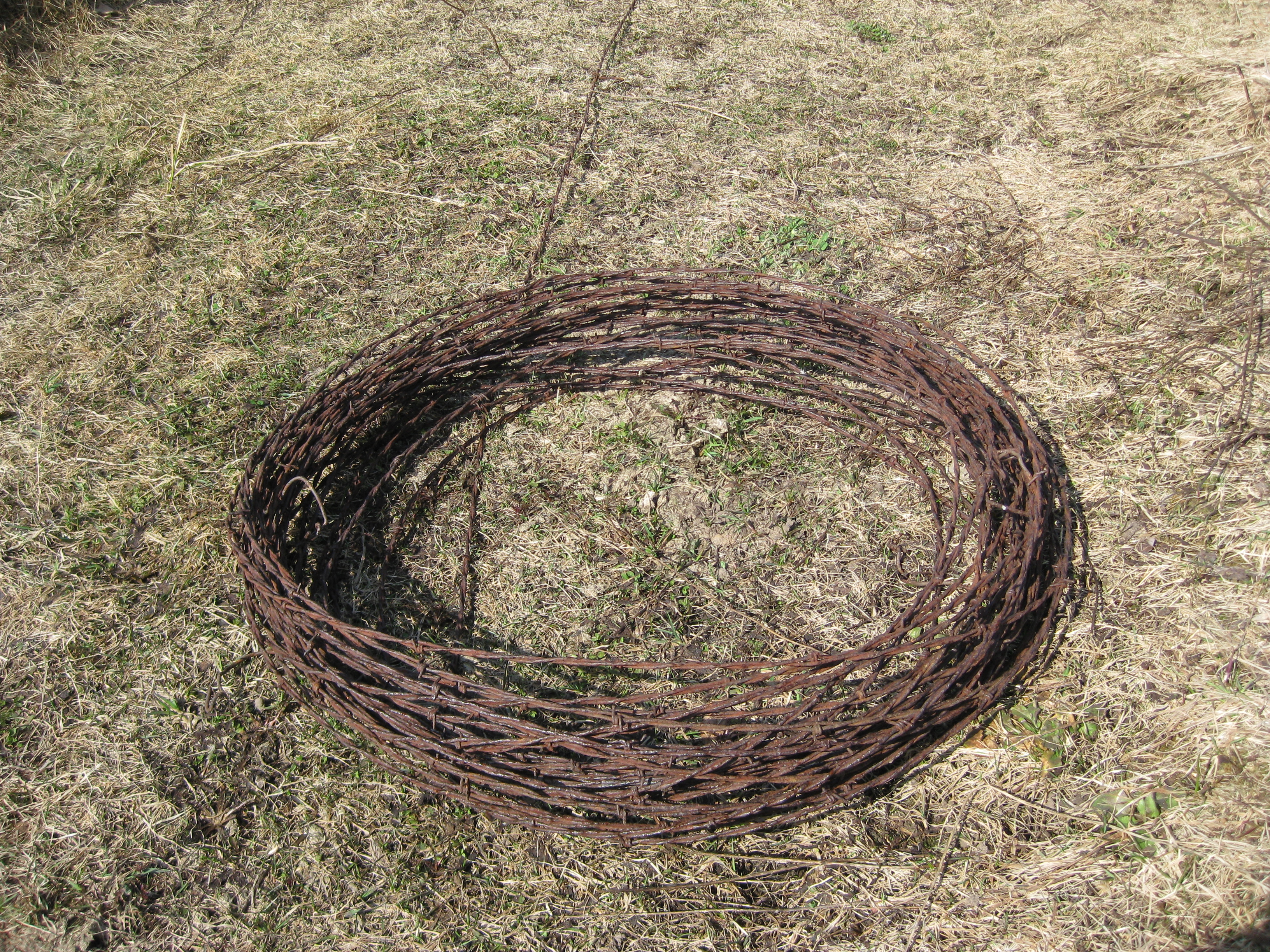
This is the old barb wire being rolled up.  Our neighbor was rolling up his barb wire on a barrel.  Dad said not many people know how to roll up barb wire.

The wire is on the ground and a hoop is formed and rolled along the ground crisscrossing the wire as you roll.  It doesn’t seem like rocket science to me; but I benefited from Dad’s teaching.

This is the worst stretch of fence because of all the brush that has grown up in it.  Dad wasn’t the only one to get hurt.  I sprained a tendon in my forearm trying to do too much, too fast.

We have been talking about replacing this fence for at least the last three years.  It was great to find some beautiful March weather to get after it.

Now it’s the first day of spring and it snowed.  This will give us a few days to heal until the ground is dry enough to put in the new fence.


Cattle Coral Design: Low-Stress Stockmanship

February 3, 2010

Below is a drawing of our corral.  Mark from ISU asked for more information on our corral.  Thanks Jammer for helping with Autocad.

Dad spent all of one winter studying a book of corral designs.  He built his own design the next summer.  We have used it for over 25 years and there isn’t a lot we would change.

There is an exterior gate between #2 and #1 and an exterior gate between #8 and #9.  Gates open so that the corral could be used as a circular riding arena.  I will describe how we use the corral to preg-check the cows.

Cattle are lured into the large alleyway, #1, with hay or walked in using low-stress stockmanship.   Gates are opened from the exterior into #2, and through #5, #3, and #4.  Cattle are walked using pressure from at least three people from #1 to #2.  By the time we get the exterior gate shut, cattle are beginning to move into #3 and #4.  I run around and shut the gate between #3 and #5 to keep too many cows from crowding in.

When the veterinarian arrives, I move all the cows except for about fifteen back into #2.  Fifteen cows are now in #3.  And #4 is empty.  I now walk two cows at a time into #5 and #6 which has a crowding gate and they go down the alleyway into the catch chute, #7.  One or more cows stands and waits in the alleyway with a bar behind her to keep her from backing out.

When the system is working well, I’m slowly bringing in more cows as the vet. is preg-checking them.  One person is helping move the cows down the alleyway while standing in #10. 

If a cow is bred, she is vaccinated and turned back out into the pasture.  If a cow is not bred, (open), she is moved into #4.  At the end of the day we can load the open cows using the alleyway or back the trailer into #10 and load there.

Ok, this is quick and dirty.  Comment if you have questions and I will clarify.


Pregnancy-Checking Cows

November 14, 2009

IMG_7478


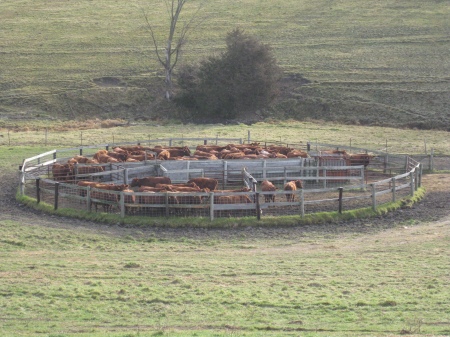
Sixty-seven cows waiting in the corral.

We pregnancy checked our cows last Tuesday and Wednesday.  The vet. checked 129 cows.  10 cows were not bred, which is “open” in farm-speak.  That makes 8% open or 92% bred in a 60 day breeding season.  I was hoping for less than 10%, so I’m happy.

Five cows were not checked because we are taking them to market because of old age.  All 134 cows were in one herd with five bulls.  This is the 2nd year of mob-grazing and the results are better than last year.


2009 Hay and Forage Summary

September 25, 2009

IMG_7390

Cattle grazing my best hay field, September 24, 2009.

In my post, “2009 New Hay Seeding,” I promised summer yield statistics.  When the cattle finish grazing the hay field pictured, every hay field will have been harvested or grazed three times.  Here are the statistics.

All the hay was baled in 1500 lb. round bales.  Estimated moisture content is 15%.

1st cutting: 120.4 acres, 341 bales, 511,500 lbs., 4,248 lbs./acre.

2nd cutting: 82.1 acres, 127 bales, 190,500 lbs., 2,320 lbs./acre.

3rd cutting: 61.3 acres, 68 bales, 102,000 lbs., 1,664 lbs./acre.

Total: 88 average acres, 536 bales, 804,000 lbs., 9,136 lbs./acre.

The reason the number of acres declines from one cutting to the next is because I start grazing selected hay fields with the cattle instead of harvesting them by machine.  I do this to help mitigate the summer slump in pasture growth and keep my cattle gaining well.

I graze fields which are self-contained, (no corn strips as cattle are hard to keep out of corn fields).  And prefer fields which are difficult to access with manure.  Without manure, fields decline in fertility.  Grazing, instead of machine harvesting and feeding elsewhere, keeps more of the soil’s fertility in place.

Hay fields were grazed with the mob of 134 cows and 134 calves and 5 herd bulls.  Here are the grazing statistics:

1st grazing: 38.3 acres, 10 days, 3.83 acres/day.

2nd grazing: 59.1 acres, 15 days, 3.94 acres/day.

1st grazing corresponds to 2nd cutting and 2nd grazing corresponds to 3rd cutting.  So if I take the average yield for 2nd and 3rd cutting and multiply by the number of acres grazed/day, I find the equivalent amount of forage the mob was eating.

1st grazing: 3.83 acres x 2,320 lbs. = 8,885 lbs./day.

2nd grazing: 3.94 acres x 1,664 lbs. =6,556 lbs./day.

I’ll have to do more “cipherin” to figure if it’s more economical to hay or graze.  I do most of my heavy thinkin’ in the winter and will have an updated post for you then.  I’ll tell you one thing.  I prefer to graze 2nd and 3rd cutting and oftentimes that is how farmers make decisions.

Below is a close-up picture of the field pictured above.  It is 1st year hay with what I consider  the ideal mix of grass to hay.  My recipe was 10 lbs. alfalfa, 2lbs. Climax Timothy, and 4 lbs. Baraula Orchardgrass from Barenbrug Seeds.  Baraula is the latest maturing Orchardgrass I have ever used and I will be planting more of it next year.   This field yielded tremendously and makes me think about the potential for my farm.  Here are the statistics:

1st cutting: 12.1 acres, 61 bales, 91,500 lbs., 7,500 lbs./acre, 77% better than the average.

2nd cutting: 12.1 acres, 29 bales, 43,500 lbs., 3,595 lbs./acre, 55% better than the average.

As shown, it is being grazed now.  I was late getting the mob to this field so it will not be grazed anymore this year.  Most of the other hay fields will be grazed by the cattle in October/November after a killing frost but before the snow flies.

IMG_7397


Selection: A Force for Change

April 27, 2009

img_0123

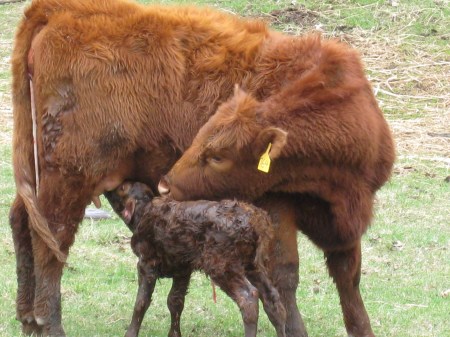
769: a two year old heifer with her first calf; nursing, just twenty minutes after being born unassisted.  Observe her maternal instinct as she licks her calf.  She is undisturbed by my taking of her picture a few yards away.  Anyone who has raised cattle knows that it isn’t always this easy.  The following post will explain how we select for these traits.


Selection:  “A natural or artificial process that results or tends to result in the survival and propagation of some individuals or organisms but not of others with the result that the inherited traits of the survivors are perpetuated.”  Webster’s

A geneticist has a powerful tool with which to change a population:  Selection.  A herd is a moving population of genetics.  The selection decisions each farmer makes will determine the future of his/her herd.

I just had a revelation.  Selection is also what changes our personal lives.  The choices we make determine to a large extent the content and quality of our life.  Do I put as much thought and effort into personal life decisions as I do in selection decisions for my herd?  How about you?  Do you map out your life, or does it just happen to you?

“The best way to predict the future is to create it.”  Peter Drucker


My parents went on a bull-buying trip to Leland Red Angus Ranch in North Dakota. They purchased three bulls for $7,650.  Most farmers don’t spend over $1,500 on a bull.  Why are we willing to spend more?

In many respects we are frugal farmers.  We don’t own any one piece of machinery worth $7,650.  Why would we spend that much on bulls?  Simple, we understand and value the tremendous genetic contribution a bull, (herdsire), makes in a herd.

Our cowherd consists of 135 cows and 5 bulls.  A bull has 27 times the genetic impact of a cow in our herd, (135 divided by 5).  Some may argue that we should spend more on our bulls.  The cost is ancillary.  Finding the right bull for our herd is the main thing.  How do we know which bull is “right” for our herd?

I will explain which selection factors are important to us and how we choose a herdsire.  We have simplified our selection criteria into four main factors and in this order of importance:

1.  Disposition/Appearance

2.  Calving ease

3.  Fertility

4.  Maternal Soundness

If these four criteria are successfully met, we will start to look at other factors such as growth and carcass traits to choose between two similar bulls.  This is probably opposite of most in the cattle industry.  Growth and carcass traits usually receive top merit and our four criteria receive much less selection weight. 

Why is this so?  Have you heard the golf saying, “drive for show and putt for dough?”  What this refers to is most golfers want to impress their buddies with a super-long drive and will spend much of their time practicing that aspect of their game.  Analytical golfers know that the club that takes the most strokes is the putter, and any improvement there will have the greatest effect on reducing their scores.  But putting isn’t sexy.

In the cattle industry, most people want to wean big calves and brag to their buddies about the awesome growth of their cattle.  Unfortunately, growth is negatively correlated with percent calf crop.  Percent calf crop, (the number of calves weaned compared to the number of cows in a herd), is the number one production parameter by far when predicting profitability.  But percent calf crop isn’t sexy.

Selection criteria that will affect percent calf crop are: calving ease, fertility, and maternal soundness.  A cow needs to have a live calf, successfully raise the calf until weaning, breed and have a calf next year.  That is why we select for these three traits.

Why is disposition/appearance on the top of our selection criteria?  It is a convenience trait.  A convenience trait is something that makes life easier. 

We like to have a calm setting when we work with our cattle.  It’s better for the people and better for the animals.  Much of that can be accomplished with excellent animal handling and we always strive to approach our animals with patience.

But disposition is also highly heritable.  We make our life easier by maintaining a genetically calm herd. 

Appearance is also subjectively evaluated at the same time as disposition.  We want to raise animals we enjoy observing.  This may seem silly and unscientific, but I suspect years of observing cattle causes us to favor functional cattle over unbalanced cattle.

Now you know what we select for in our cattle.  How do we select?

The first selection is the selection of a breed.  Choose a breed based on its strengths, what it’s known for.  Red Angus is known for calving ease, fertility, good mothers, marbling.

The next selection is the selection of a herd.  We want to buy bulls from a breeder that has similar philosophies and management as us.  Like most people, we also prefer to buy from someone we like and trust.  It’s important to visit the farm and meet the producers and see the cattle before the sale to alleviate time crunch.  We make farm and ranch visits a part of our vacations.  Producers are always happy to take a couple of hours to show you around their place.  My parents and I have each visited Leland Red Angus on separate occasions.

Now we come to bull selection.  Disposition, our most important trait, has to be evaluated in person.  We approach a bull and observe his behavior.  Disposition is a pass/fail trait.  The bull should quietly walk away from you as you come closer.  This would be a pass.  He fails if he runs away with his head up in the air; too flighty.  He also fails if he holds his ground or approaches while shaking his head.  This is aggressive and dangerous behavior which will only get worse as he gets older.

We have experienced one other type of behavior in the Red Angus breed which is worth noting.  The ultra-quiet bull will not exhibit any aggressive behavior; but will not walk away when approached.  We thought this was a positive and selected two bulls in the past like this.  We now classify this behavior as a fail.  The reason?  Each of these bulls turned aggressive after a few years.  We think it’s because they failed to respect us.  Disposition can be taken too far.  Animals can be too quiet.  What about our other traits?

Fortunately, calving ease, fertility, and maternal soundness cannot be selected to an unhealthy extreme, unlike most traits.  We are striving for 100% success in each of these traits.  How do we select for these traits?

Maternal soundness is the ability of a cow to take care of her calf.  She has mothering instinct.  She has enough milk for her calf to grow well.  Yet she doesn’t give so much milk that her udder begins to lose form and her calf has a difficult time nursing on a too-large teat for the first time.

Selection for this trait can be done two ways.  Make sure the herd you are selecting from doesn’t make excuses for a cow that fails to wean a calf.  They should have a philosophy of culling problem cows.  And observe the cows and specifically the mothers of the bulls you are thinking of buying.

Calving ease and fertility are best selected by using modern genetic evaluation programs.  The Red Angus breed has a genetic evaluation tool called EPDs, Expected Progeny Differences.  EPDs show the relative genetic merit of an individual within a breed.  The easiest way to use EPDs is to look up the breed percentile rankings for the EPD for each trait you are selecting for, and then determine how well you want your herdsires to rank.

Fertility is expressed with an EPD called Stayability.  Stayability predicts the odds that a cow will have a calf every year until at least the age of six.  The Red Angus breed used the age of six because economic research shows that this is the age when a cow begins to show a profit.

Calving ease is expressed in two ways:  calving ease direct and calving ease maternal.  Calving ease direct predicts the odds that a bull’s progeny will be born unassisted.  Calving ease maternal predicts the odds that a bull’s daughter will have her first calf unassisted.

Based on experience and availability, I wanted bulls that ranked in the top 40% of the breed for these three traits.  Leland Red Angus sends out a sale catalog before their sale with all of this information and more.  I went through the catalog and found 45 bulls that met my criteria out of 153 bulls available. 

My parents drove to Leland’s and evaluated the 45 bulls before the sale.  They eliminated some based on appearance and disposition.  The bulls that would work for us they assigned a relative value in dollars to guide our purchase during the sale.

They ended up purchasing bulls 41, 118, and 145.  I calculated the average EPD’s for the three bulls they purchased and congratulated them on a job well-done.  The three bulls averaged in the top 15% of the breed for calving ease direct, top 10% for calving ease maternal, and top 20% for stayability.  Because of selection, our future looks bright!