Kiva: Microfinance With American Ingenuity

July 27, 2009

Can a loan of $500 dollars change someone’s life?  Microfinance says yes.  Microfinance is the supply of loans and other financial services to the poor. 

Muhammad Yunus is a Bangladeshi banker and economist.  While visiting a poor village near his university in Bangladesh in 1976,  Mr. Yunus was shocked to meet people kept in virtual servitude by usurious loans.  He made a loan of $27 to 42 women out of his own pocket.  This experience caused him to realize that an organization was needed that would provide banking services to the poor.  Grameen bank was born.

In 2006, Muhammed Yunus and Grameen bank were jointly awarded the Nobel Peace Prize “for their efforts to create economic and social development from below.”

Something about microfinance inspired me.  I like the idea of helping someone with their own idea.  After all, I’ve benefited from borrowing. 

I started looking for a way to get involved.  In 2007 I read that Premal Shah, the President of Kiva, was speaking in Madison.  Kiva is microfinance with American ingenuity.  Kiva’s mission is “to connect people through lending for the sake of alleviating poverty.”  “Kiva is the world’s first person-to-person micro-lending website, empowering individuals to lend directly to unique entreprenuers around the globe.”

I attended Mr. Shah’s invigorating talk.  The next day I made a loan of $25 dollars to Guloglan Agakishiev, who was running a butcher shop on what looked to be card tables.  Within a couple of months Guloglan had started repaying his loan of $1000 on schedule.  He finished repaying his loan in the fifteen months that was promised.

Testing Kiva even further, I let my money sit in their account and watched to see if they would sweep it into their coffers.  To their credit, they haven’t, and occasionally remind me that I have money in my account that could be loaned again or taken out.

Hooked, I started to give gift certificates to try to get more people involved.  And so now I am offering a $25 Kiva gift ceritificate to each of the first three people who comment.


Nessie in Wisconsin?

June 30, 2009

IMG_0399


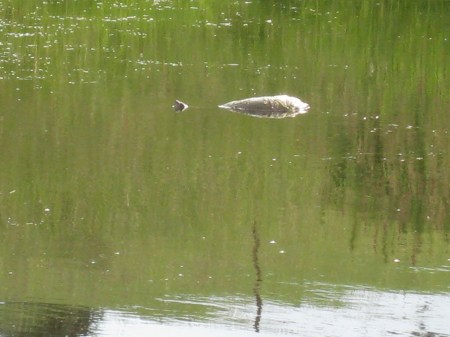
My childhood career choices vacillated between Sasquatch hunter and Loch Ness monster hunter.  So imagine my surprise when I saw this behemoth surface on a Wisconsin lake.  I snapped a quick picture before it dove.

I wouldn’t want to estimate it’s size because you wouldn’t believe me anyway.  However, I will no longer be enjoying Wisconsin’s waters.  I’m not going to divulge the location of this monster as Wisconsin’s tourism industry is huge and I wouldn’t want to hurt it.  And perhaps this leviathin is a herbivore.

Sightings of this Wisconsin Nessie are not without precedent.  Jay Rath has a chapter in this book, “The W-Files,” devoted exclusively to lake monsters.

“At one time or another, many Wisconsin lakes have boasted their very own saurian monster.  In 1867, for example, Lake Michigan’s sightings were so convincing that the Chicago Tribune announced, ‘that Lake Michigan is inhabited by a vast monster, part fish and part serpent, no longer admits of doubt.’  But despite the publicity lake monster stories once received, today they are largely forgotten.”

I am sharing this information with family and friends only.  I consider you, dear reader, a friend.


Morel Mushrooms: Full of Umami

May 22, 2009

IMG_0263

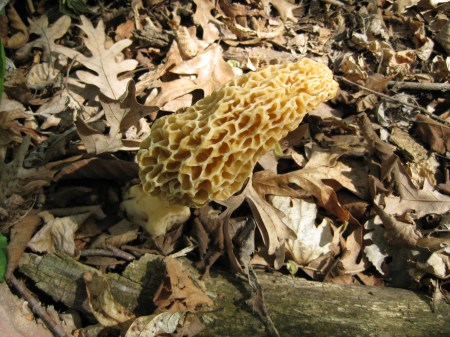
I finished planting corn Monday.  I celebrated by going Morel mushroom hunting with my Dad.  We found some beauties. 

We searched around dead or dying Elm trees.  Our forest has been ravaged by Dutch Elm disease.

Some Morels were boldly out in the open, like the one pictured above.  Most were hidden like the ones pictured below, and would be invisible to an untrained eye.  All were a pleasure to find and eat. 

IMG_0262

Why are Morels so delicious?  Mushrooms, and other protein-rich foods, are full of the fifth taste, Umami.  Umami is a Japanese word meaning, tasty.  Savory, brothy, meaty, are other ways to describe Umami.  Basically, it’s the taste of protein; or the taste as amino acids are broken down.  We all crave Umami and I enjoyed it in spades on the meat diet.

The four other main tastes are:  sweet, sour, salty, and bitter.  I was thinking metaphorically about the five tastes.  If I was to be described by one of the tastes, I would want to be Umami.  Tasty, hearty, interesting, challenging.   And I like to surround myself with Umami people.

Sweet is nice, but kind of uncomfortable for me.  Salty is the way I think of my Grandpa; cussing, telling stories about the old days.  Great quality for a grandpa.  Sour and bitter can describe many people.  I’m sure you will agree these people are simply endured and difficult to enjoy.

I’ll never be sweet or salty.  I could become sour and/or bitter.  I’m striving  to be Umami.  Which taste are you?


Thinking in Odors

April 1, 2009

Most people think in words.  Temple Grandin, a highly influential animal scientist, thinks in pictures. Ms. Grandin believes this makes her more attuned to the way animals think.  She has used this gift to improve the lives of countless animals.  

I, however, think like a dog.  I think in odors.  For example, the numeral one is warm milk, the letter A is baby poop, sister is chocolate pudding. 

School was difficult.  I was labeled an under-achiever.  It takes longer for me to “get” something.  Once I have it though, I never lose it.  I attribute this to the primitive area of the brain where an odor/memory is located, the olfactory cortex.

Objects which have a strong odor are usually associated with their own odor.  The odor could also have a different meaning.  For example, onion is onion; but onion is also sorrow.

Abstract concepts are extremely difficult.  This is what one through ten looks like for me:  one: warm milk, two: baby shampoo, three: cat poop, four: talcum powder, five: chocolate, six: lemon, seven: coffee, eight: banana, nine: gasoline, ten: wet dog. 

After ten, odors go together.  For example sixteen is wet dog and lemon.  I’m only able to approximate as the numbers go higher.  I’m approaching my fortieth birthday and that represents quadruple wet dog for me, but it is almost indistinguishable from thirty or fifty.

Remembering people is strange as well.  If I want to remember someone I have never met, I need to manufacture an odor memory to associate with them.  It’s similar to the visual mnemonic tricks I have heard people use.

If I am meeting you for the first time you may accuse me of being a close talker.  This is because I am trying to pinpoint an odor to remember you by.  Once that odor is established in my olfactory cortex, it will always be with me.

Ex-girlfriends conjure up particularly strong odor/memories.  My first girlfriend: cotton candy.  My last girlfriend: vinegar.  I never told her that vinegar represents her.  How do you tell someone that?  I think she is reading my blog, so now she knows.  Sorry P.

I haven’t been able to use this gift/curse for anything positive like Ms. Grandin has.  New research has shown that dogs can sometimes detect cancer.  The most I have accomplished is recognizing gastrointestinal distress.

If you or someone april you know is also an odor/thinker, please fools comment.  Thank you.


Meat Diet-Side Effect

March 26, 2009

I went to the Dentist today to check out the calculus deposits that have sprung out of nowhere while on the meat diet.

“I have never seen this much tartar deposits in the crevices of the teeth!”  Is what the dentist told me.  He has been practicing for over ten years.

What is going on?  One other person mentioned how she noticed more calculus while on a carb-restricted diet.  Has this happened to anyone else?

I am going to question Dr. Eades of Protein Power and Mark Sisson of Mark’s Daily Apple.  I will post any response I receive.


Backyard Food

March 12, 2009

Do you have a backyard?  Do you do anything with it besides maintain a lawn?  Home-gardening is increasing.  It is rewarding to grow your own food.  Have you ever thought about growing something that moves?

A young guy and his mom visited me yesterday.  They live near Madison on a small acreage.   They are interested in starting pig production.  I envy them for how much fun they are about to have.  There is nothing quite like beginning animal husbandry.

They plan to buy three feeder pigs in May and butcher them in November.  They will be backyard pig-raising experts by December. 

The increased level of serotonin in their brains from this accelerated learning and human-animal interaction will cause them to remember 2009 as a great year.  The year of the PIG.

I am excited by anyone willing to grow their own food.  There is a back-to-the-land movement.  Sometimes it’s happening inside city limits.  Madison passed an ordinance allowing people to keep a backyard flock of chickens.  The people responsible for this even have their own organization, “Mad City Chickens.”

Are you expanding your backyard food production?  Is 2009 the year you start?


Wild Food Foraging Fun

February 26, 2009

What is going on in the header photo?  Someone asked if I was in a cult?  Does a cult get muddy in the Mississippi river?

We were foraging for Wapato or Arrowhead.  Tremendous amount of stomping in the mud to break loose golf-ball sized tubers that were a staple in the diet of some Native American tribes.

It was a class taught by Sam Thayer.  Forager’s Harvest is his company, which seeks to bring responsible wild food foraging, his passion, to a wider audience. 

Sam is a genius.  When he walks through the woods, he not only knows every plant; he also knows the scientific name, life cycle, habitat, which part is edible, and how to prepare it.  He presents all this information in a fun way.  I couldn’t help but catch his excitement.

The classes are an interesting mix of people of varying ages and skill levels.  This photo was taken by Rose Casey, a middle-aged gardener from Madison.  Thanks Rose.

If this interests you, don’t be shy, jump right in.  It’s the best way to learn.  Sam’s book is the best; but there are other books available as well. 

Don’t eat anything you don’t know.  And don’t worry; you will be able to accurately identify plants.  It is what we are meant to do.  Do you have trouble identifying a dandelion? 

I was foraging long before I knew Sam.  I just didn’t think of it as foraging.  When the wild raspberries are ripe, I eat my fill in raspberries every day for about two weeks.

As a farmer, we are always battling weeds. To eat my enemy gives me great satisfaction. 

Stinging Nettle is a plant that has tormented me since childhood and is one of the first to appear in the spring.  Cooking renders the plant unable to harm.  Sam says Nettle is higher in vitamins and minerals than spinach.  I’m looking forward to spring.  Happy Foraging!


Why are Old Farmers Quiet?

February 22, 2009

Why are old farmers quiet?  Some would say it’s because they are hard of hearing, and that would be true.  But I think it’s more than that.

A lifetime of seasons:  planting, growing, harvesting, dying.  A lifetime of doing:  Planning, trying, succeeding, failing.  What is there to say?  What is to be warned about when the failures made the man as much as the successes.

A humble farmer knows success comes not from him.  Sun, water, soil, seed, collaborate to make the miracle he’s witnessed many times. 

And who would say it isn’t a miracle?  Seed, carried in bags, stuck into cold soil in the spring.  Seed, hauled away in wagons in the fall.

A farmer’s work is faith in action; to believe in the miracle once again, and to act, by putting the seed into the soil.