Pregnancy-Checking Cows

November 14, 2009

IMG_7478


Sixty-seven cows waiting in the corral.

We pregnancy checked our cows last Tuesday and Wednesday.  The vet. checked 129 cows.  10 cows were not bred, which is “open” in farm-speak.  That makes 8% open or 92% bred in a 60 day breeding season.  I was hoping for less than 10%, so I’m happy.

Five cows were not checked because we are taking them to market because of old age.  All 134 cows were in one herd with five bulls.  This is the 2nd year of mob-grazing and the results are better than last year.


Salvage: A Junk Run to Belmont

October 15, 2009

IMG_7453


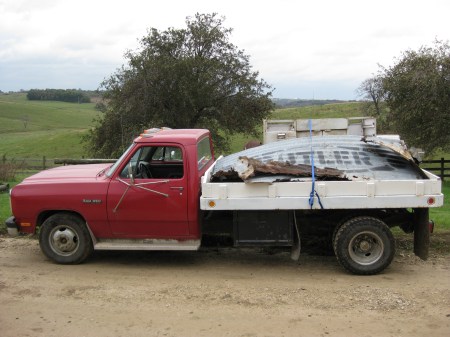
Loaded for a junk run to 1st Capitol Salvage in Belmont.

As we accumulate trash on the farm, we sort.  Recyclables, trash, and metal.  We take the recyclables and trash to our township pickup point in Calamine, open two days a week.   This is a service paid for by our property taxes. 

The metal is thrown into an old wagon and when the wagon is full we make a junk run.  This happens a few time per year.  The fun part about this is that scrap metal is actually worth something.  So as we get rid of what we consider trash, we have a payday.

1st Capitol Salvage was paying $100 per ton, yesterday.  I don’t know if this is a good or bad price.  I do know that a few years ago there was a huge demand for scrap metal and prices were at least double.  I saw junk moving out of fields and fencelines that hadn’t moved in my lifetime.  People made part-time jobs out of cleaning up other people’s junk.

We never let our farm get to the point where a junk-man would salivate.   It’s a constant struggle to keep a farm looking decent.  I’m glad we have a system in place to help us.

Our small load only weighed 580 lbs.  We drove away with a check for $29 dollars.  Another successful junk run!


Michael Pollan Speaks in Madison Wisconsin

October 11, 2009

“What is all the fuss about?  Why are farmers protesting?”  I thought as I sat and listened to Michael Pollan speak at the Dane County Farmer’s Market.   After reviewing my notes I started to understand why he upsets some farmers.

Michael Pollan is an excellent writer and speaker who can convincingly make a case for probably anything he feels strongly about.  I thank him for caring about food and for pointing out a flawed system.  I won’t be signing a petition to appoint him Ag Secretary though.  Because, as even he admitted, policy is not his area of expertise, and I fear the wheels would come off if he were allowed to drive.

I feel strongly about this because I see parallels between the American farm and food system and my own.  My farm is transitioning from commodity-based livestock production to direct-market livestock production with minimal purchased inputs.  We are not relying on an off-farm salary while we make this transition, so changes are made cautiously and evaluated every step of the way.  Whatever the flaws of the American farmer and food system, we do feed a lot of people.  And that is worth something.

I’m intrigued by organic production, but fear I don’t have the time or patience to learn.  I would love to help a young couple start an organic CSA on part of my farm.  Then my curiosity would be filled as I reported on what they did.  And they would have access to land to realize their dream to farm and feed people. 


But enough about me, let me tell you what Michael Pollan had to say.

There is a movement rising to change the American food system.  Nearly 8,000 people turned out for his speech on the UW campus.  And there was evidence of pushback as protesters also were in attendance.

Mr. Pollan said the goal of the American food system should be: “To provide fresh, high-quality food to everyone in USA and a decent return to American farmers and contribute to the solution of environmental problems.”

Hard to argue with that.  But then he connects the dots between the environmental crisis on one side and the health crisis on the other.  Guess what he place in the middle as causative:  Agriculture.

Mr. Pollan said modern industrial agriculture drinks oil and spews greenhouse gas.  He said agriculture used to use one calorie of fossil fuel to produce two calories of food.  Modern agriculture uses ten calories of fossil fuel to produce one calorie of food.  He said it takes 28 ounces of oil to produce one double quarter pounder at McDonald’s.  I don’t know if that was with cheese.

I have seen figures like this before and I question them.  I will be writing a post this winter detailing how much oil my farm uses and how much food we produce because I’ve been curious about this.

Mr. Pollan then says that energy comes from the sun and Photosynthesis is the only free lunch.  He would like to wean the food system off of fossil fuels and put it back on sunshine.  Food can be resolarized.

The health care crisis is code for ‘cost of industrial food production.’  Since 1960, spending on health care has risen from 5% of GDP to 18% of GDP as the amount spent on food has decreased from 18% to 9.5% of discretionary income.  I don’t buy into this simplified argument.

Mr. Pollan says we still need to support farmers.  We just need to change the subsidies to reward quality and diversity and environmental solutions instead of rewarding for quantity. 

I agree that government programs become ‘monsters’ that seek to sustain themselves rather than accomplish whatever it was designed to accomplish in the first place.  I think we need results-based government programs.

Mr. Pollan spoke about our food culture.  “We need to reregionalize food.  People need to learn to eat from a shorter food chain.  He says the USDA is starting to get this and used the example of the new, ‘Know Your Farmer, Know Your Food’ program.

“We need to teach our children how to eat lunch.  This is a controversial statement until you consider that we are teaching them how to eat lunch by giving them chicken nuggets and tater tots and ten minutes.”

Michelle Obama was applauded for her organic garden and for speaking out about the importance of growing and cooking real food.  Claire Strader introduced Mr. Pollan, which was fitting because she is a Wisconsin grower that has become the White House gardener.

Mr. Pollan doesn’t feel there is a lack of farmland.  But there is a lack of farmers.  We have been demeaning farmers for the last 100 years and that has resulted in a brain drain on the farm.  That is something we both agree on.  It is going to take major brainpower to continue to feed people in a sustainable way.


2009 Hay and Forage Summary

September 25, 2009

IMG_7390

Cattle grazing my best hay field, September 24, 2009.

In my post, “2009 New Hay Seeding,” I promised summer yield statistics.  When the cattle finish grazing the hay field pictured, every hay field will have been harvested or grazed three times.  Here are the statistics.

All the hay was baled in 1500 lb. round bales.  Estimated moisture content is 15%.

1st cutting: 120.4 acres, 341 bales, 511,500 lbs., 4,248 lbs./acre.

2nd cutting: 82.1 acres, 127 bales, 190,500 lbs., 2,320 lbs./acre.

3rd cutting: 61.3 acres, 68 bales, 102,000 lbs., 1,664 lbs./acre.

Total: 88 average acres, 536 bales, 804,000 lbs., 9,136 lbs./acre.

The reason the number of acres declines from one cutting to the next is because I start grazing selected hay fields with the cattle instead of harvesting them by machine.  I do this to help mitigate the summer slump in pasture growth and keep my cattle gaining well.

I graze fields which are self-contained, (no corn strips as cattle are hard to keep out of corn fields).  And prefer fields which are difficult to access with manure.  Without manure, fields decline in fertility.  Grazing, instead of machine harvesting and feeding elsewhere, keeps more of the soil’s fertility in place.

Hay fields were grazed with the mob of 134 cows and 134 calves and 5 herd bulls.  Here are the grazing statistics:

1st grazing: 38.3 acres, 10 days, 3.83 acres/day.

2nd grazing: 59.1 acres, 15 days, 3.94 acres/day.

1st grazing corresponds to 2nd cutting and 2nd grazing corresponds to 3rd cutting.  So if I take the average yield for 2nd and 3rd cutting and multiply by the number of acres grazed/day, I find the equivalent amount of forage the mob was eating.

1st grazing: 3.83 acres x 2,320 lbs. = 8,885 lbs./day.

2nd grazing: 3.94 acres x 1,664 lbs. =6,556 lbs./day.

I’ll have to do more “cipherin” to figure if it’s more economical to hay or graze.  I do most of my heavy thinkin’ in the winter and will have an updated post for you then.  I’ll tell you one thing.  I prefer to graze 2nd and 3rd cutting and oftentimes that is how farmers make decisions.

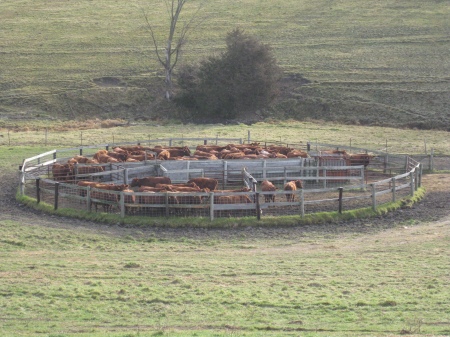
Below is a close-up picture of the field pictured above.  It is 1st year hay with what I consider  the ideal mix of grass to hay.  My recipe was 10 lbs. alfalfa, 2lbs. Climax Timothy, and 4 lbs. Baraula Orchardgrass from Barenbrug Seeds.  Baraula is the latest maturing Orchardgrass I have ever used and I will be planting more of it next year.   This field yielded tremendously and makes me think about the potential for my farm.  Here are the statistics:

1st cutting: 12.1 acres, 61 bales, 91,500 lbs., 7,500 lbs./acre, 77% better than the average.

2nd cutting: 12.1 acres, 29 bales, 43,500 lbs., 3,595 lbs./acre, 55% better than the average.

As shown, it is being grazed now.  I was late getting the mob to this field so it will not be grazed anymore this year.  Most of the other hay fields will be grazed by the cattle in October/November after a killing frost but before the snow flies.

IMG_7397


Farming Fun With Friends

September 15, 2009

IMG_7363


Posed photo:  manure spreader and rented “bobcat” loader in hoop building after cleaning out and adding two loads of lime.

My father and farming partner had surgery for colon cancer two weeks ago.  He is home and recovering but will not be able to lift anything for a few more weeks.   

It’s been a challenging couple of weeks working without him.  Thank God I have friends and family willing to pitch in and help me out.  Thank you.  Some jobs are almost impossible alone.

I finished baling the 3rd cutting of hay.  We were blessed with dry weather which was necessary to make dry hay this time of year. 

After that I needed to clean out a hoop building and spread the manure on the designated hay strips which will be corn next year.  Two friends each ran a tractor with manure spreader for me.  I loaded the manure with the rented “bobcat.”

The “bobcat” probably costs more than $30,000 new.  But we can rent it for $150-200 dollars and get a hoop building clean.  It has tracks like a bulldozer so it works great on the dirt floor of the hoop building.  In 3-4 hours I can have 20+ loads of manure spread on my fields and a clean hoop building.

After that I put 1-2 loads of lime, (crushed limestone), on the floor of the hoop building to reestablish a base.  Lime is considered a fertilizer for crops and works great in this capacity because it packs kind of like wet sand.

I’ll let the hoop building set empty until I’m ready to put pigs into it and then I will unroll straw or cornstalk bedding and I’m ready to go.  We won’t clean the hoop building out again until the next batch of pigs goes to market.

It’s fun to complete a task with friends.  And it’s fun to run a “bobcat”.  This is farming fun with friends!


Money is the Only Thing That Can Be Insured

September 8, 2009

IMG_7333

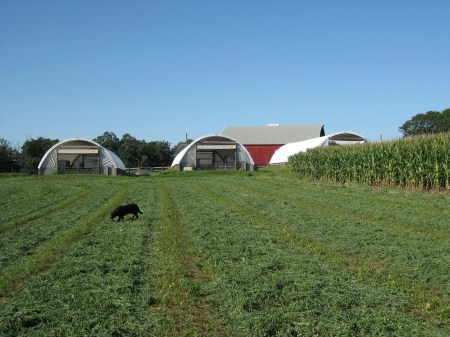
Nothing in this picture is insured, not the barn, not the hoop buildings, not the crops, not even the dog.  I only insure that which would be financially devastating to replace.   Am I a reckless wildman of the north woods?  Or am I an astute businessman? 

I go over my farm insurance with my agent nearly every year.  A few years ago he pushed a paper across his desk and asked me to sign it.

“What’s this?” I asked.

“Oh, it’s just a waiver.  The insurance company won’t insure the hoop buildings for wind or hail.”

“Hmmm,” I scratched my head and smiled.  “What else could happen to them?” I asked.

“Oh, someone could take a knife and run along them,” he said, still trying to make the sale.

I thought to myself, “If someone is doing that, then I have bigger problems than hog housing.” 

“I guess I’ll take my chances,” I said and pushed the paper back across his desk.  “Let’s go over the rest of the policy.”  Now I was in a cutting mood and starting to get the high a spendthrift feels upon finding a nickel.

“The barn is insured for $10,000,” he said.

The premium for the barn was $150.  I thought about how little economically I use the barn.  I keep a few square bales of hay and straw in the top and I keep my chickens, (which is a hobby), in the bottom.  But I love that big, old, red barn.  If I were to drop the insurance I would somehow feel like I was neglecting the barn.

“We both know it couldn’t be replaced for $10,000,” he said.

Never talk through the close.

I perked up.  “You’re right, it couldn’t be replaced for $10,000.”

“But you could build something else, like a pole shed,” he stammered as he felt another premium slipping away.

I thought to myself, “If I wanted a pole shed, I would build a pole shed.  What I want is this barn, and the only real insurance is to avoid fires, keep up the roof and structure, and pray.”

What I was in considering in actuality was a $150 lottery ticket which would pay out $10,000 and the only way to win was for my barn to burn down.  I didn’t want any part of it.

So the test I came up with is, Could I afford to lose it?  What I was left with is insurance on my house and garage and personal belongings for $200,000 for a premium of $316 per year.  $500,000 liability for $82.  $36 because I have a 4-wheeler.  And an $18 policy fee which is unexplainable and would drive me crazy if I gave it much thought so I won’t for now.

So what do you think?  Was I raised by wolves?


Health Savings Account

August 27, 2009

J9 recently commented and ask that I explain my healthcare.  Thank you for this suggestion.  This topic is timely as the country debates health reform. 

So I’m writing this on a rainy Thursday morning, trying to decide whether to eat eggs or hamburgers for breakfast.  Yes, my diet is still meat heavy.  I’m conducting a lifelong test on the question, “Does saturated fat clog arteries?”

I have a Health Savings Account combined with High Deductible Health Insurance through Golden Rule Insurance.  My insurance premiums and the money I contribute to the savings account are tax-deductible. 

Congress created this program in 2003.  I jumped on it quickly because I already had high-deductible health insurance.  It’s a burden to pay the premiums and to contribute to the savings account, but it’s nice to have money I can use for medical expenses.  And any money I don’t use for medical expenses can be used tax-free for any purpose once I reach retirement age. 

So what does this look like in practice?  I have a $3000 deductible policy.  For this insurance I pay $2223 annually.  I contribute $2850 annually to my savings account.  So my total health cost for the year is $5073.

I am in favor of healthcare reform.  However, I reluctantly admit, I am not writing letters or attending listening  sessions.  I do little more than vote.  I am waiting to see what congress comes up with and will choose the best option for me.


Hog Market is Crashing

August 24, 2009

The hog market is crashing.  Hog farmers are going out of business.  Our hog buyer has been laid off. 

According to NPPC President, Don Butler, the U.S. hog industry has lost nearly $4.5 billion since September, 2007.  Producers have lost an average of $21.37 per hog.  Losses per hog may be over $50 per head this fall.

We sold a load of commodity hogs August 4th.  The price per 100 lbs. of hog was $43.48.  Just ten days later on August 14th we sold another load and the price per 100 lbs. of hog was $37.60.  That’s a difference of nearly $15 per 250 lb. hog.

Direct-marketing pork has helped us stay optimistic about raising hogs.  Unfortunately, many producers are finding nothing to be optimistic about and are exiting the hog industry.  How low will these markets go until reaching seasonal lows in December?  I will keep you posted.

Here is a conversation I had at the hog market, recently.


I waited at the hog market with my old herdboars.

“They can’t be together,” I said to the old man waiting to unload his hogs. 

“This one will tear the other one up.  He already did a month ago, jumped over a gate four feet high.”

“Looks like he could do it now,” the old man said as the boar measured the gate with his snout.

“He’s a good-looking boar.”

“Thanks,” I said.

“Where’d you get him from?” the old man asked.

“I raise boars,” I said.  “I use AI to bring in new genetics.”

“Oh, you use AI?”

“Yes.  Where do you get your boars?” I asked.

“Ohio.  Durocs one year, Yorkshires the next.”

“That’s a good cross,” I said.

The old man looked up towards the scale and asked, “Where’s Scott?”

“He’s on vacation,” I said.  “But next week’s his last week.”

“What, why?” the old man asked.

“He got laid off.  They’re closing down German Valley and Rory is going to drive from Lancaster to fill in here.”

“The hell you say.”


Combining Oats/Barley

August 16, 2009

IMG_7320


Harvesting oats/barley with our 1970’s era Massey Ferguson combine.  I won’t know an exact yield until I have fed all of it to our hogs over the next year.  We finished baling the straw on Friday.

Oats/barley is higher in protein and fiber than corn, but lower in energy.  I use oats/barley in the hog rations at a rate of 20% of the ration when it’s available.  So that’s 400 lbs. per ton.  I reduce the soybean meal by 50 lbs. per ton when I include oats/barley in the ration.  I see no noticeable difference in hog performance at this inclusion rate.


Sweet Corn for Tacos

August 10, 2009

IMG_7307

I picked 3 dozen ears of sweet corn to give to friends.  Two friends were home and gladly accepted the gift.  I drove around town wondering what to do with the remaining dozen.

A temporary taco stand was set up in the park by main street.

“Maybe they would be up for a trade,” I thought as I parked my car.

“How many tacos you want?” a woman asked me.

“Uuuuh,” I said and walked over to where a man was cooking meat on a large, flat grill.

“How many tacos you want?” he asked me.

“What kind of meat?” I asked him.

“Pork.”

“Oh.  Do you like corn?”

I realized I was acting quite weird.

“Sweet corn.  I’m a farmer.  I have a dozen ears in my car.  Would you like to trade?”

The cook looked confused and uncomfortable.  The woman sidled over to help translate.

“I’ll show you,” I said, and walked back to my car.

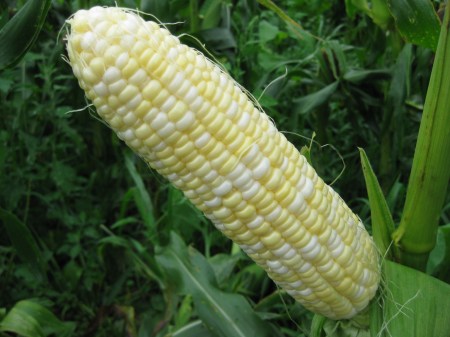
I set the bag of sweet corn on a cooler.  When the cook stopped turning the meat, I took out an ear and pulled the husk back to show the plump, yellow and white kernels.

The cook said something excitedly in Spanish to the woman.

“How much?” he asked.

“It’s worth 4 dollars a dozen,” I said.

“4 tacos are 6 dollars,” he said.

I wasn’t sure what he was driving at.

“Ok, how about 3 tacos?” I countered.

He nodded and went back to cooking.

My friend from Honduras tells me most of the Hispanic immigrants in Lafayette county are from small towns and rural areas of Mexico.  They came to the US for work, of course.  But they enjoy the bucolic atmosphere of Lafayette county. 

They began wrapping up the tacos and the woman said, “He’s giving you four.”

We country folk sure know how to drive a hard bargain.