New Hay Seeding With Oat Companion Crop

August 15, 2010

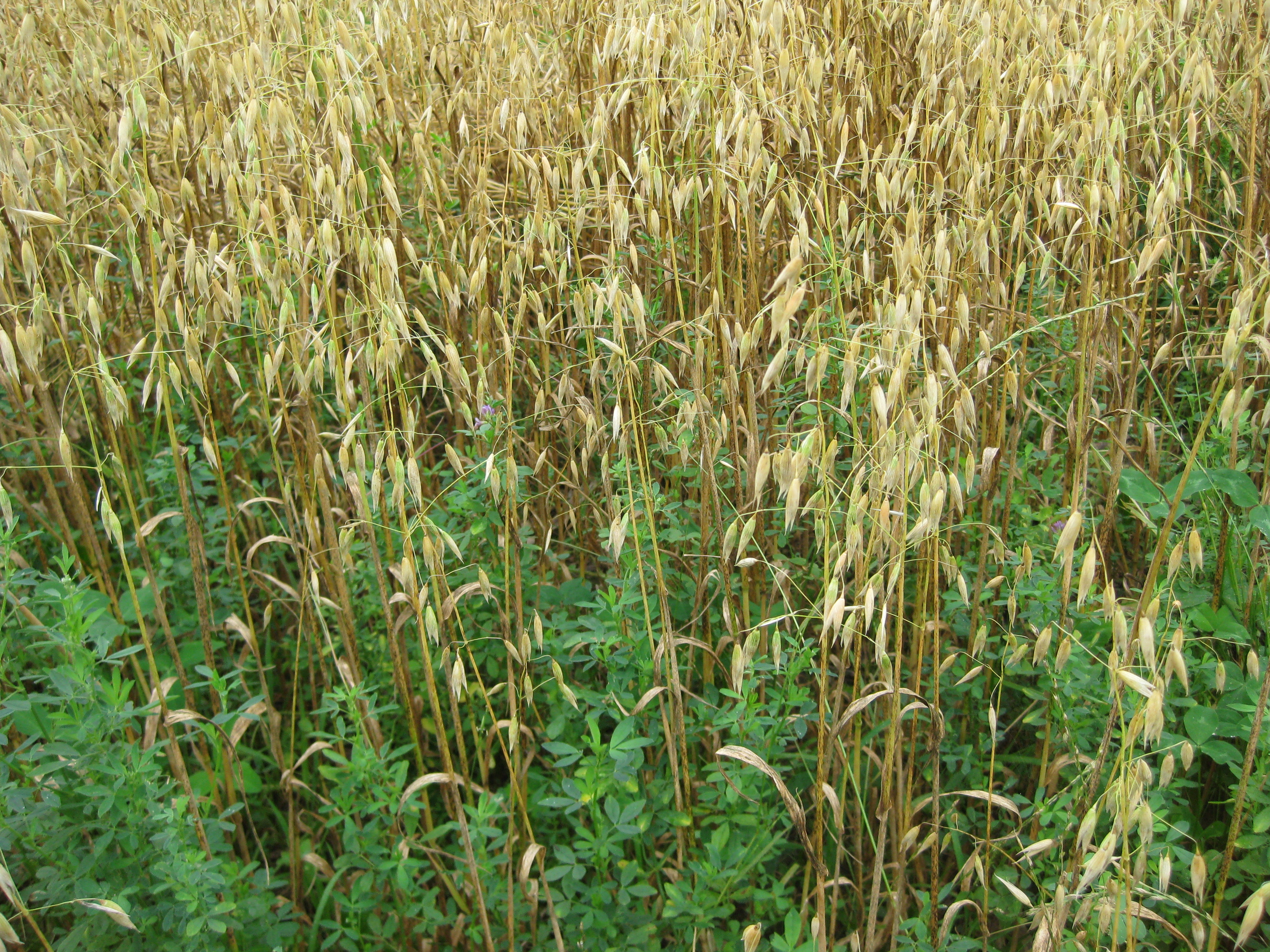
Oats and new hay seeding, early July.

I planted this field in early April.  I plant 2.5 bushels of oats, 10 lbs. of alfalfa, and assorted grasses.  Check out “2009 New Hay Seeding,” if you would like more detail.

We plant this mixture as soon as the ground is fit in early spring.  Oats are a fast starter and suppress any weeds that germinate.  The alfalfa and grasses are slow to start, but come on strong after the oats are harvested.

Many farmers are going away from planting a companion crop to their new hay seeding.  If the oats are not managed well, they may kill the new seeding.

Here are some tips we have found to prevent this.

1.  Spread no manure on the field during the preceding year.  My opinion is the nitrogen in the manure causes the oats to grow too tall and will lodge, (go down), as it matures.

2.  Plant an oat variety with strong standability.

3.  Plant an early-maturing oat variety.  The earlier the oats can be harvested, the better it is for the new seeding.

4.  If a field has had manure, or you feel the oats may lodge for any other reason, cut the oats as a forage crop in June.  This crop can be dried and baled, or ensiled.  It makes excellent feed for cattle.

We harvested our oats in late July and they will be mixed into the hog rations at an inclusion rate of 20-25%.  Gestation rations can include a higher amount of oats.

The straw will be dried and baled and used as bedding for hogs in the hoop buildings.

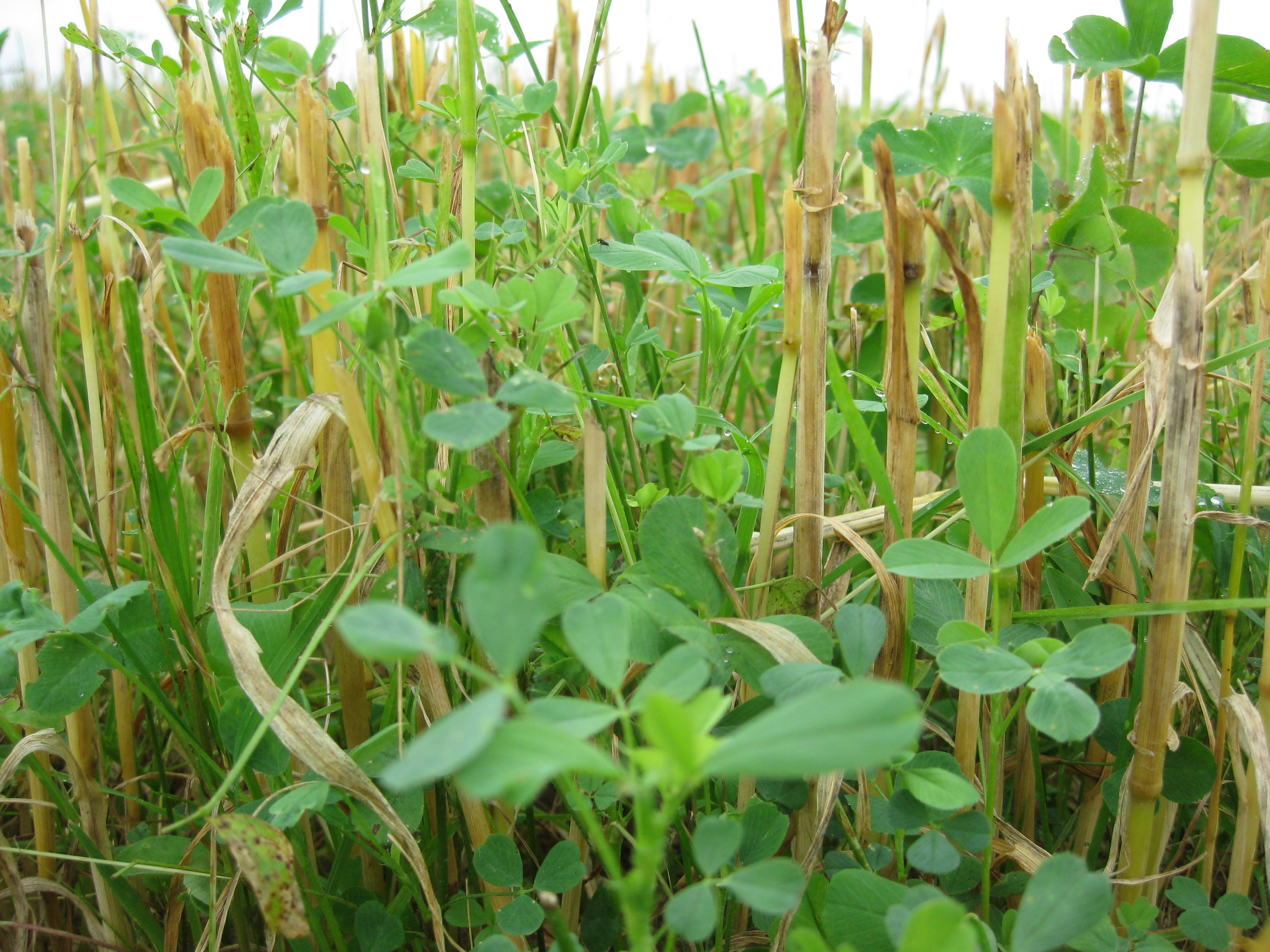
Oats can be an excellent companion crop for new hay seeding.  If everything goes well, look at the beautiful alfalfa, clover, and grasses, green and growing after the oats are harvested.

Breeding Season II: Problems

August 10, 2010

My early July post, “Breeding Season Starts”, was full of optimism.  We started breeding season with five, virile bulls, breeding 131 beautiful cows.  We now have one, extremely popular bull, with 131 cows.

The bull in the bottom of the picture above, “New Chapter”, fought with the other bulls instead of breeding the cows.  We took him to market after he hurt the other five-year-old bull, “New York.”  “New York” is refusing to rejoin the herd and is recovering his confidence in the back pasture.  “Red Direction” and “Judge” are lame and limping along with the herd.

But “Julius”, “Julius” is thriving!  Look at him in action!

Even though he’s busy, he still makes each cow feel special after he puts a kink in her tail.

We’ve kicked around some options to make sure the cows get bred.  We could take the yearling bulls out of the heifer pasture and put them with the cows.  We could buy bulls, but we may not find quality bulls on short notice.

We’ve decided to watch and wait.  We aren’t seeing many cows “in heat” now.  We think the bulls settled many of the cows during the first heat cycle.  A cow’s cycle is 21 days.  We are nearing the end of the 2nd heat cycle, so a decision needs to be made because the 3rd cycle is their last chance to get bred.  All cows that don’t breed are butchered.

We won’t know for sure what percentage of the cows are bred until November when a veterinarian pregnancy checks them.  I’ll let you know how we did, then.


Lafayette County Fair: Swine Ultrasound

August 6, 2010

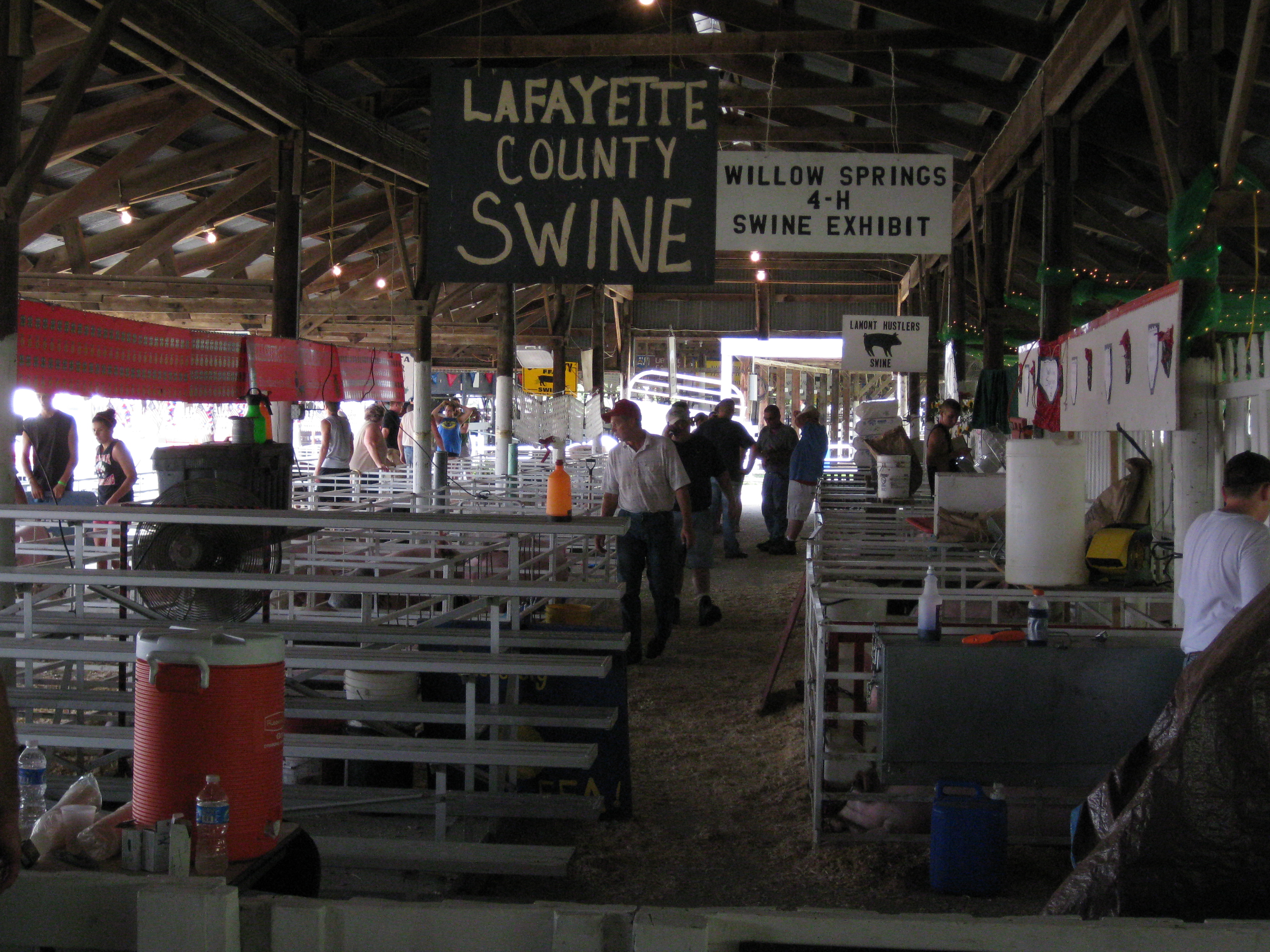
Swine barn, Lafayette County Fair.

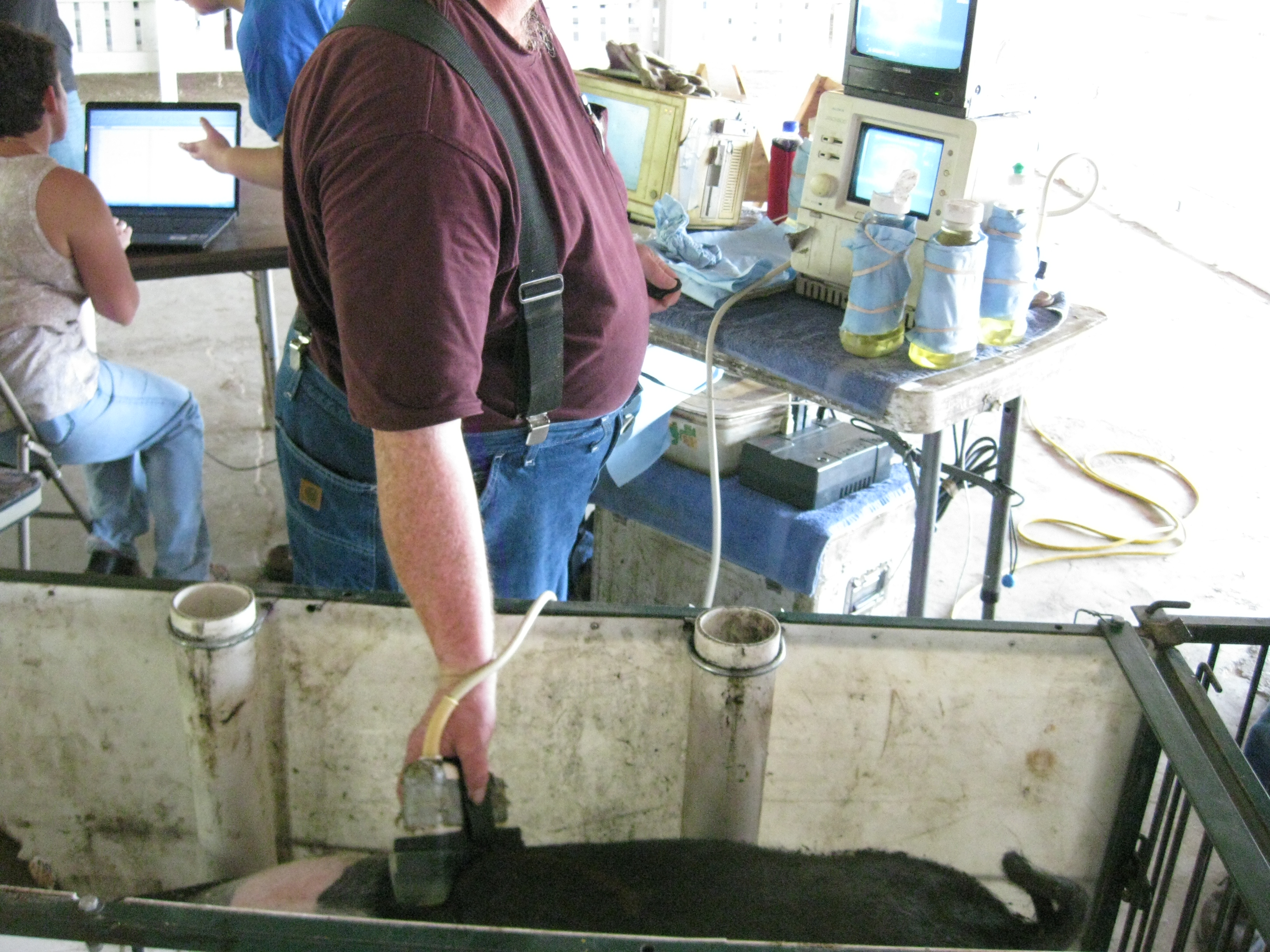
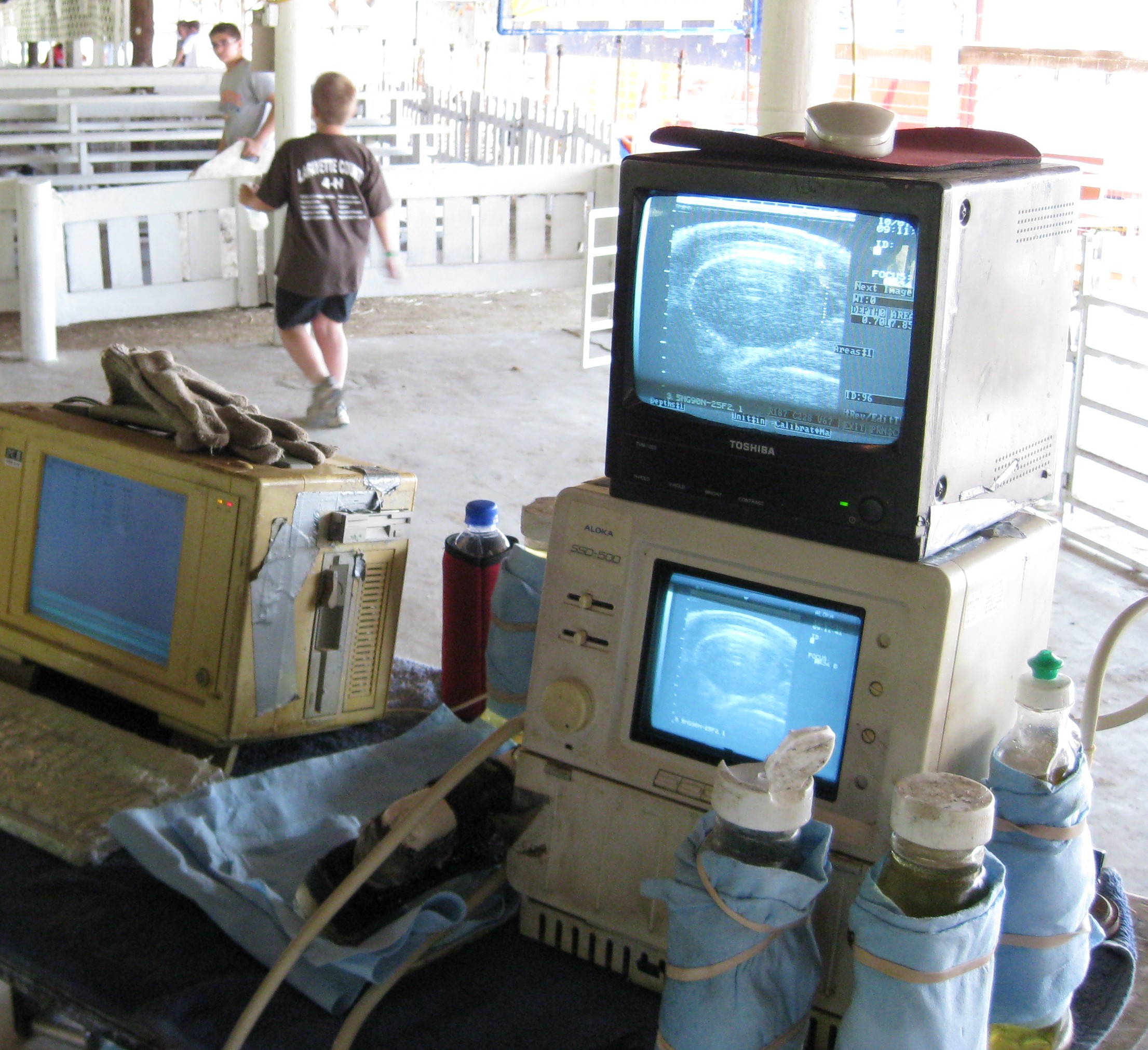
Because of my background as a certified swine ultrasound technician, the fair superintendent asked me to line-up a technician.  Ultrasound is used to evaluate a hog’s carcass.  Below is a picture of the technician with the probe on a hog’s back.  The information is entered into a computer and a formula is used to rank the hogs on percent lean.

The measurements taken are backfat and loin muscle area.  These two statistics, along with the weight of the hog, are used in the percent lean formula.  Look at the screen in the picture below and see if you can see the layer of backfat above the roundish loin muscle area, (pork chop).  Also visible is a rib in the lower right-hand corner.

Even though I used to be an ultrasound technician, I miss the old days when we actually measured the carcass.  We would show our hog at the fair on Friday.  Sell it at the auction on Saturday.  Load it onto the trailer on Sunday.  And see it’s carcass hanging on the rail on Wednesday.

One summer my sister went to band camp and as introductions were made, each camper told what they had been doing this summer.  When it was my sister’s turn, she said, “I got a blue ribbon at the carcass show.”


Milkweed and Monarch Caterpillar

August 1, 2010

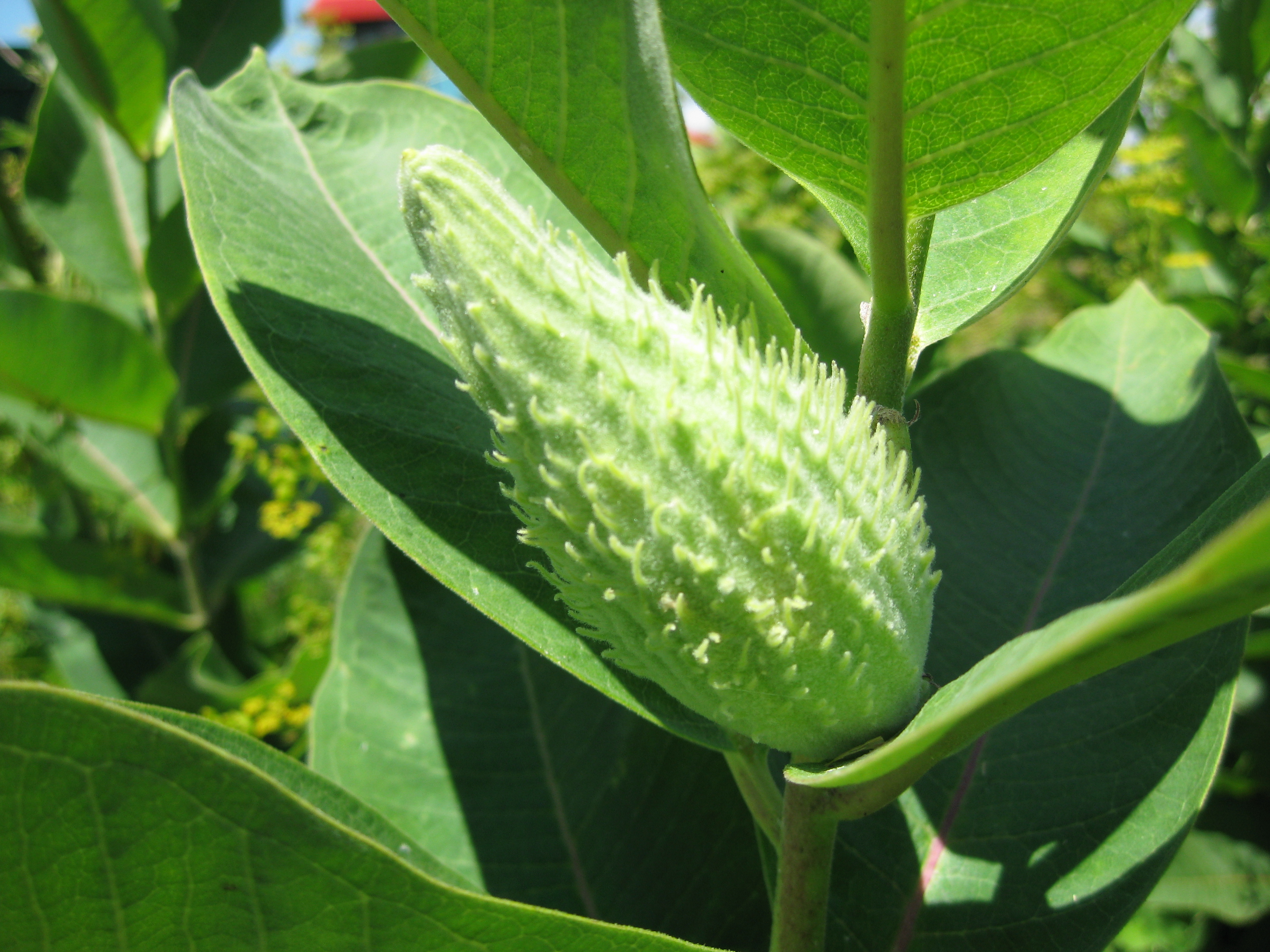
Common Milkweed (Asclepias syriaca) pod.

Milkweed is an incredible plant.  According to Sam Thayer, there are six vegetables available from Milkweed, (shoots, leafy tops, flower buds, flowers, immature pods, and white).  I’ve only eaten shoots, flower buds, flowers, and pods.  It’s fun to mark the summer season as one part of the plant goes out, and another comes in.

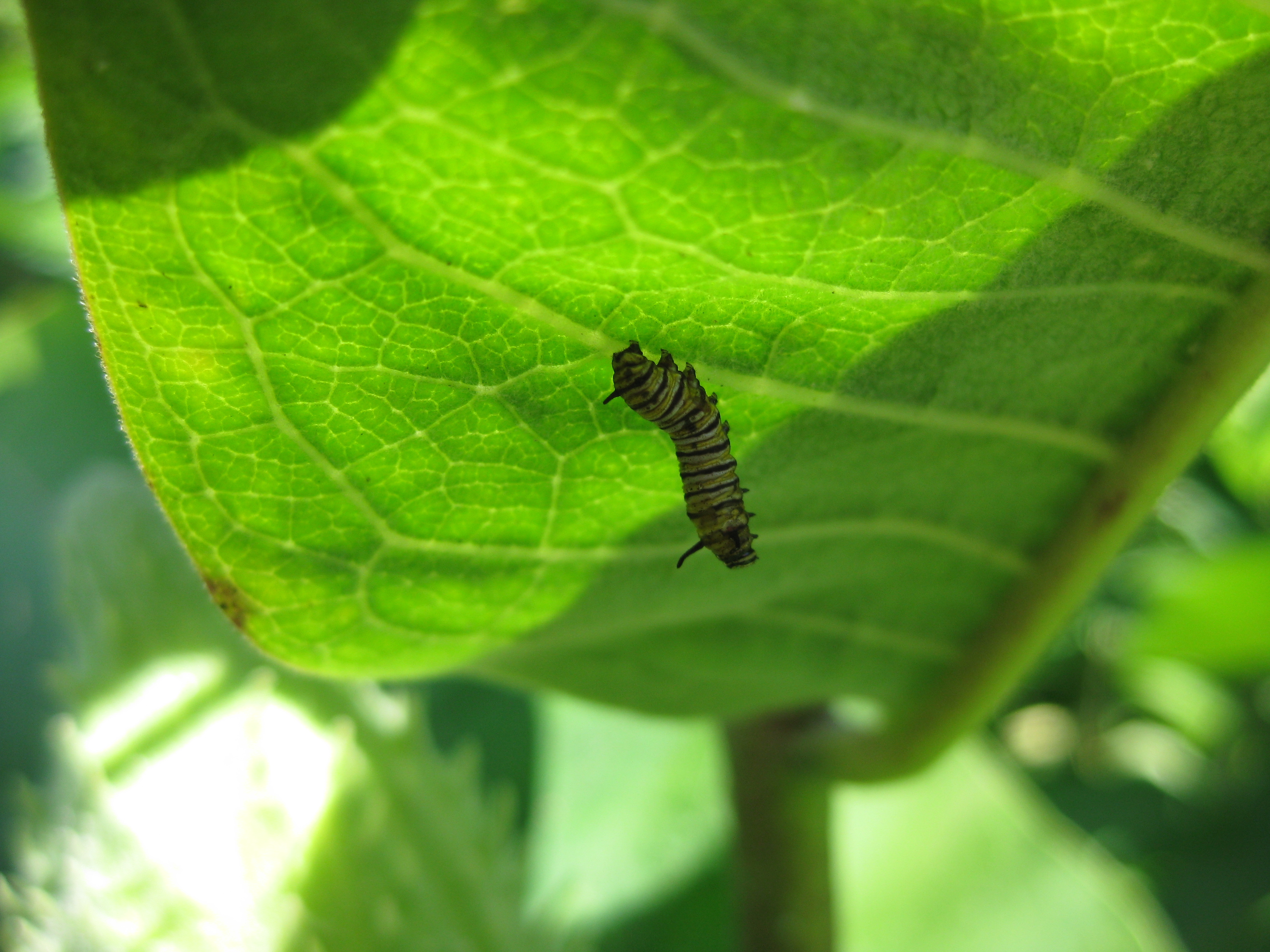
It’s also fun to look for monarch caterpillars (Danaus plexippus).  Look at the little guy in the picture below.

What an amazing life he is going to have.  All he does now is eat and poop.  Pretty soon he’ll form a chrysalis and take a nap for a fortnight.  Then he’ll crawl out and wait for the new things on his back to dry.  Then… fly!


Round and Square-Baling Straw

July 29, 2010

Baling square bales of straw.

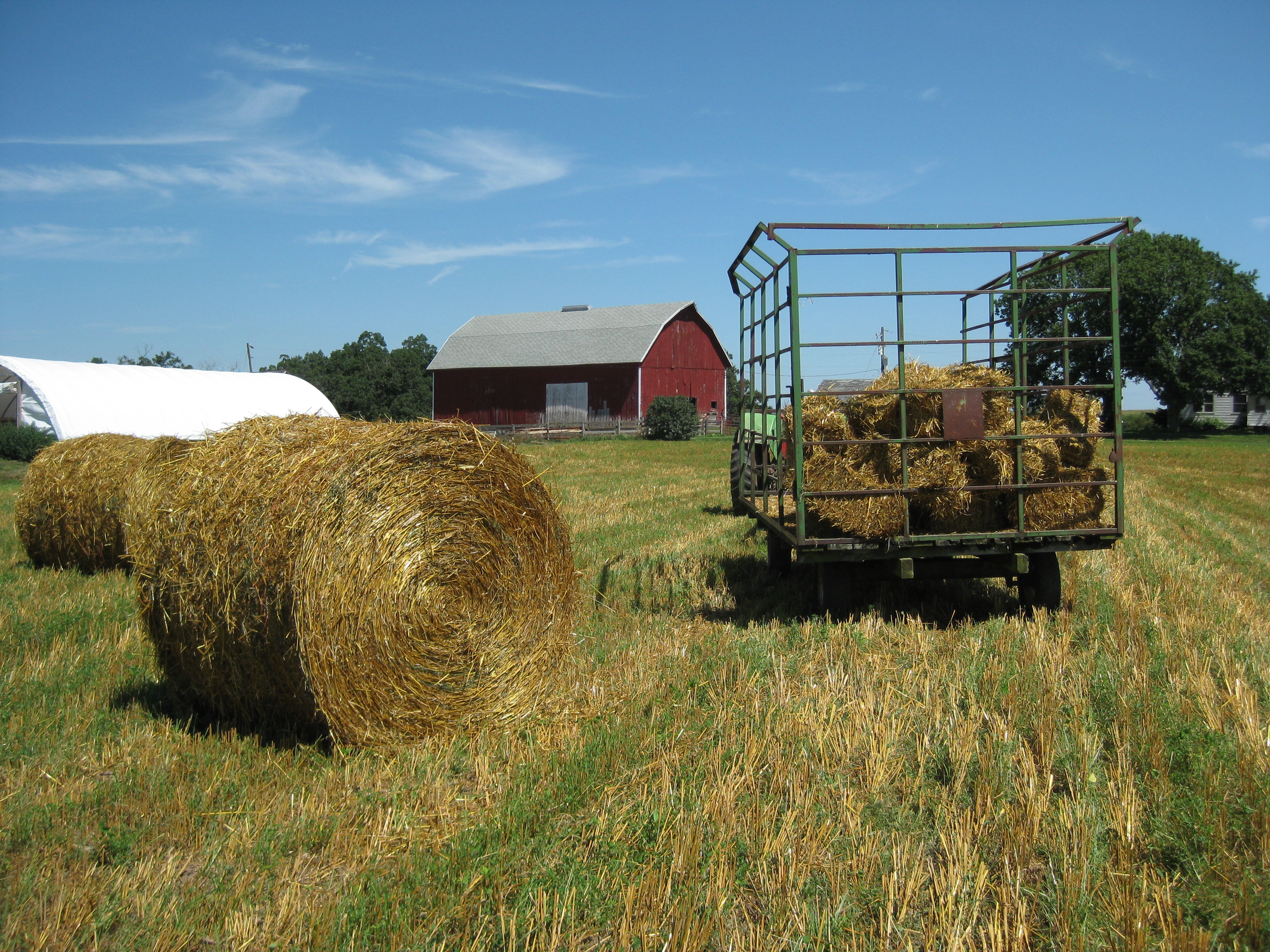
After the oats are harvested with our combine, the straw dries in the field for a day or two and is raked into rows and baled.

Most of the straw is round-baled.  This is much easier than small square bales because all of the work is done mechanically.with round bales.  The round bales are used in the hoop buildings to bed the pigs.

We bale a couple of loads, (250 bales), of small square bales.  These bales are used to bed the sow shelters or to bed the trailer when we take animals to the butcher.

Square bales have to be unloaded by hand and stacked in the barn.  I always appreciate the round-baler more after finishing this job.


Why Corn is So Productive

July 25, 2010

Corn (Zea mays)

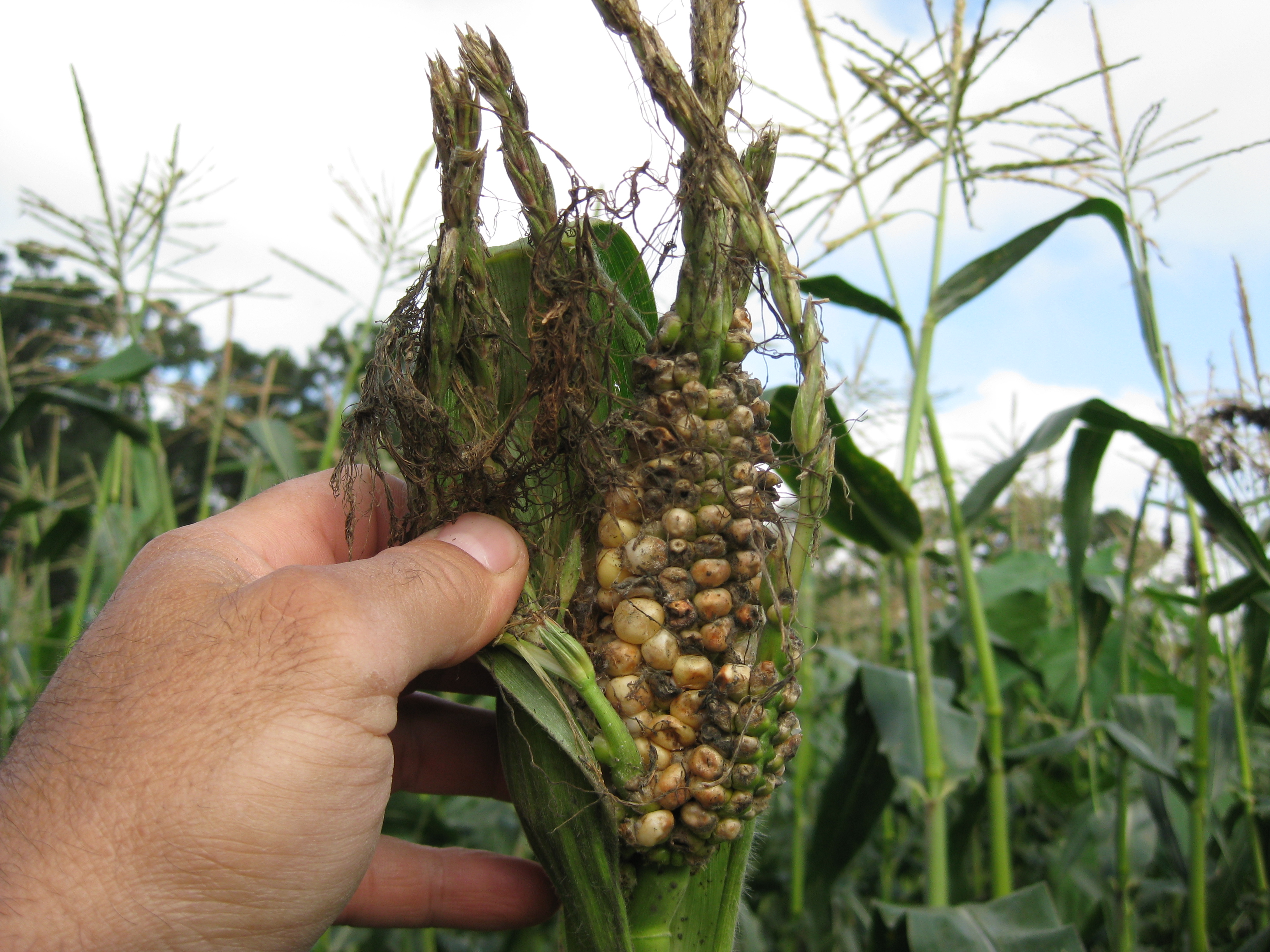
I found this plant in my sweet corn patch.  It captured my attention, because the ear is at the top of the plant with the tassel.  It must be a genetic throwback to when corn was just another tall grass.  Normally, the ear is located one-third to one-half way up the stalk.

And I realized this is the reason corn can be so productive compared to other grains such as wheat, oats, or barley.  On our farm, corn can produce more than 9,000 lbs. per acre.  Oats only produces about 3,000 lbs. per acre.

Corn carries all of the grain weight lower on the stalk.  All other grasses and grains that I know of carry their grain weight at the top of the stalk.  This causes them to be susceptible to lodging or breaking over.

Here is a picture of some of our lodged oats. More of a challenge to harvest, but we finished harvesting the oats last Wednesday.


REAP-Day on the Farm

July 19, 2010

REAP food group, Madison, put on a wonderful “Day at the Farm” at Jordandal Farms, my direct-marketing partners.

People turned out in droves.  I think people want to visit a farm, but are too shy to ask.

Eric and Carrie went all-out showing off their farm.  Here is one of Eric’s Jersey cows with her five-day-old calf.

Here are baby chicks in the brooder house.  Each specific livestock had a sign with pertinent information.

Eric and Carrie showed off their chickens, Jersey dairy cows, and sheep.

We brought some of our Red Angus cattle and hogs to their farm.

Chefs from some of Madison’s finest restaurants prepared an excellent meal.  Employees and volunteers from REAP made everything go smoothly.  I can’t believe this was the first time they ever tried one of these.  Here we all are after a successful Day at the Farm.


Sleeping During Calving

July 15, 2010

A robin’s nest, with fledglings, in our cattle catch-chute.

I realized I needed to post this picture when WSB asked an astute question: “If the breeding season is short, will you get any sleep during calving season?”

Yes, and this picture explains why.

This is my proudest cattle picture.  I’m striving to breed problem-free cattle.  We aren’t there yet, as my post, “A Weekend During Calving Season” illustrates, but if birds can successfully nest in our catch-chute…

We pulled two calves coming breach, (backwards), in April.  We helped one calf nurse a cow with too-large teats.  We transferred a twin calf onto a cow that had lost her calf in the creek.  We pulled one large calf out of a heifer on May 7th. But that was it, out of more than 130 births. We didn’t use the corral from May 7th until the middle of June when we corralled some cattle for grass-finished beef.

Calving problem-free cattle in April and May should be fun.  I’ll keep you updated.

Breeding isn’t going as well as I planned.  Soon I’ll post about the problems we’ve already experienced early in this breeding season.


Opportunistic Plants

July 13, 2010

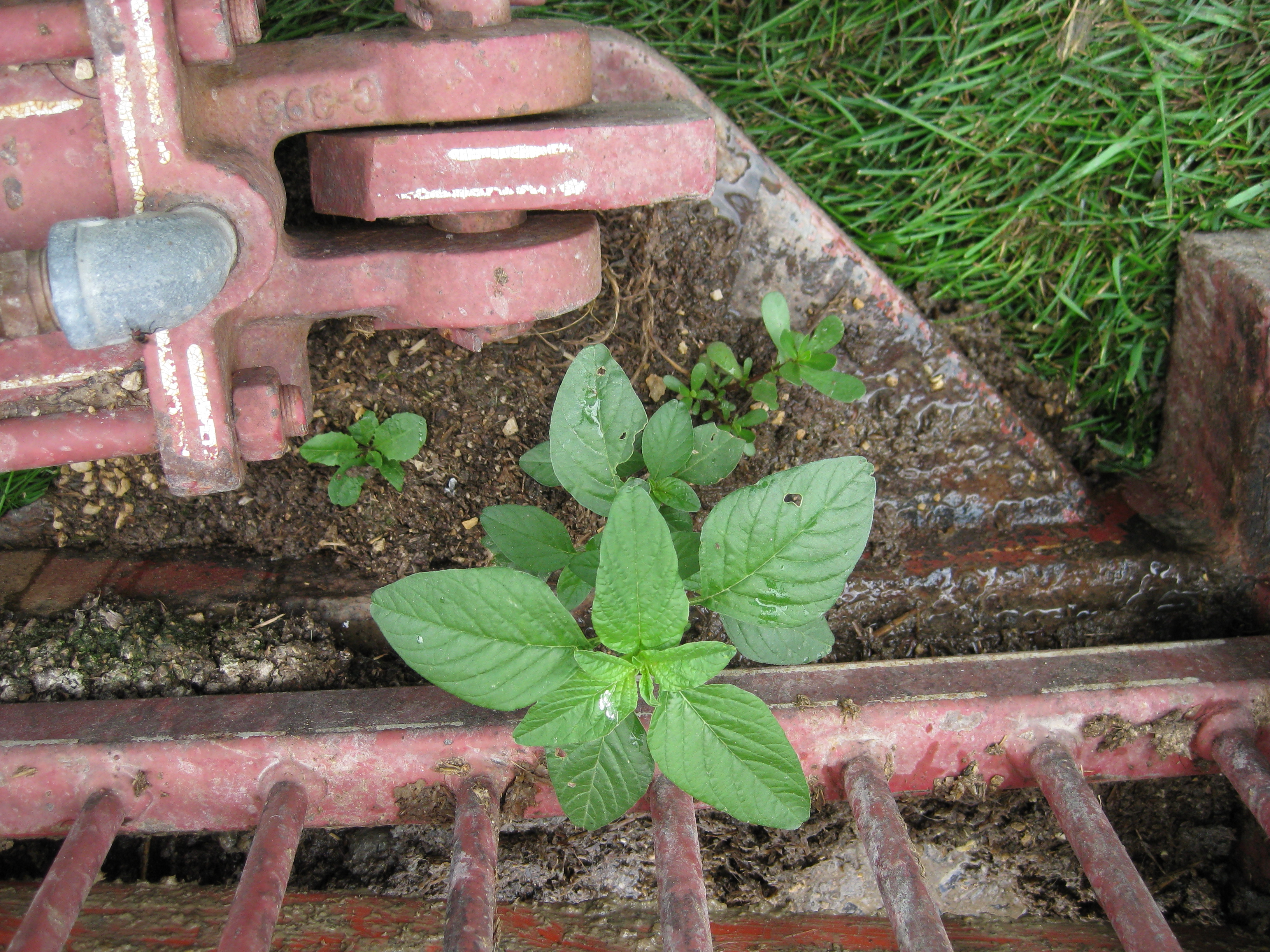
Amaranthus retroflexus

We used the hydraulic trailer to load hogs to take to the butcher today.  There is a flat piece of metal on each side of the trailer that collects manure.  I was amazed to see plants growing in the shallow manure.  And not just any plants, but the plants I wrote about yesterday: Amaranthus retroflexus and Chenopodium album.

I love living here.

Chenopodium album


Lamb’s Quarters? Pigweed? Scientific Names, Please!

July 11, 2010

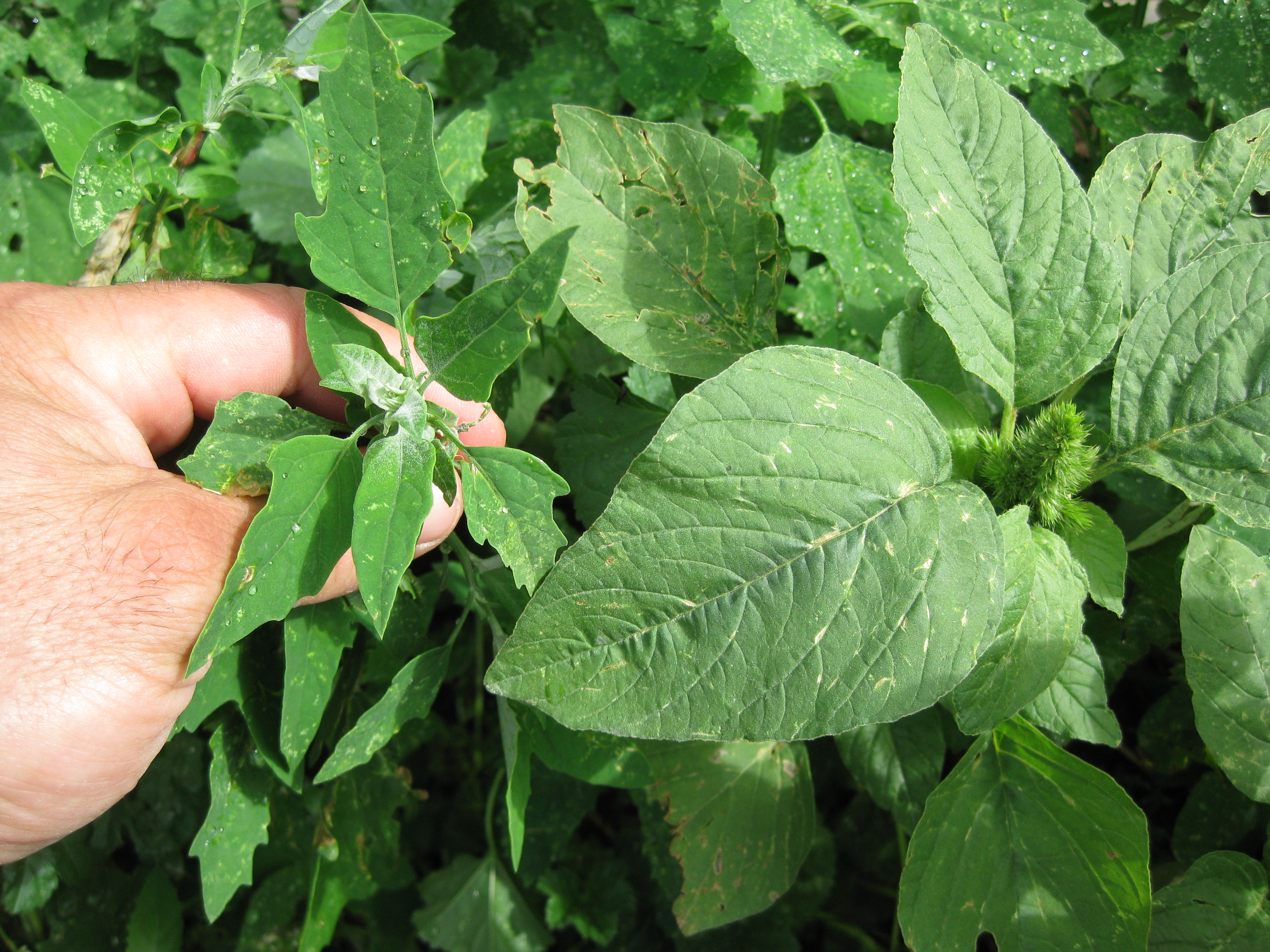
Lamb’s Quarters in hand, Pigweed on right.  Or is it the other way around?  It may be, depending on where you live.

I took Shepherd and Gameboy to the Johnson Public Library and signed them up for library cards.  Serendipity helped me find “Stalking the Wild Asparagus” by Euell Gibbons, in the used book pile.  I quickly gave the librarian a dollar for this wild food foraging classic from the 1960’s.

I turned to the chapter on Pigweed, because Citygirlfriend has been sautéing Pigweed, lately.  But I was confused because the picture looked like the plant I call Lamb’s Quarters.  As I read further, I realized I need to start using scientific names.  Euell explains why, with reasoning that resonates.

“Years ago, I was very impatient with anyone using a long Latin name to designate a common, ordinary plant.  I considered the use of these tongue-twisting titles to be an affectation, designed to show off the knowledge of the user.  Why couldn’t these high-brows use the common name, which everyone understood?

I think it was the Pigweed, more than anything else, that cured me of this attitude.  Pigweeds are among the commonest of the unwanted plants in fields, gardens and barnyards in Pennsylvania.  Therefore, I was not surprised to find that pigweeds were also common in Indiana, when I traveled there.  I learned that farmers in Tennessee, Texas, New Mexico, California and even Hawaii were troubled with pigweeds.  Obviously these farmers should get together and learn some way of controlling this troublesome weed.  The only difficulty with this procedure was that, in each of these localities, the “pigweed” was a different kind of plant.  To complicate matters even more, ‘Chenopodium album’, the pigweed of Pennsylvania, also grew in all these other places.  In some sections it was called Lamb’s Quarters, in some Goosefoot and in still other it was referred to as Wild Spinach.

I began to see why the botanical classification was necessary.  Many totally different plants are called pigweed in some parts of the world.  The plant I call pigweed is known by dozens of other common or folk names in different places.  Therefore any attempt to use the common name in distant places would only lead to confusion.  But I can say ‘Chenopodium album’ and a trained botanist from any part of the world would instantly know the precise plant meant.  Far from confounding the confusion, these Latin names greatly simplify the task of communication in this area.

More than that, the botanical name can tell me more about the plant in question than even the most descriptive common name ever could.  If I had never seen this particular plant, the name ‘Chenopodium’ should tell me that this weed is a member of the same family to which garden beets and spinach belong.  If I don’t have this knowledge at my fingertips, I can easily look it up in any botanical manual.  About this time I’ll begin to suspect this plant might be good to eat.”

Well said, Euell!  So I’m using scientific names now.  The plant in my hand  is Chenopodium album, and the plant on the right is Amaranthus retroflexus.  Both are wild edibles enjoyed at our table.