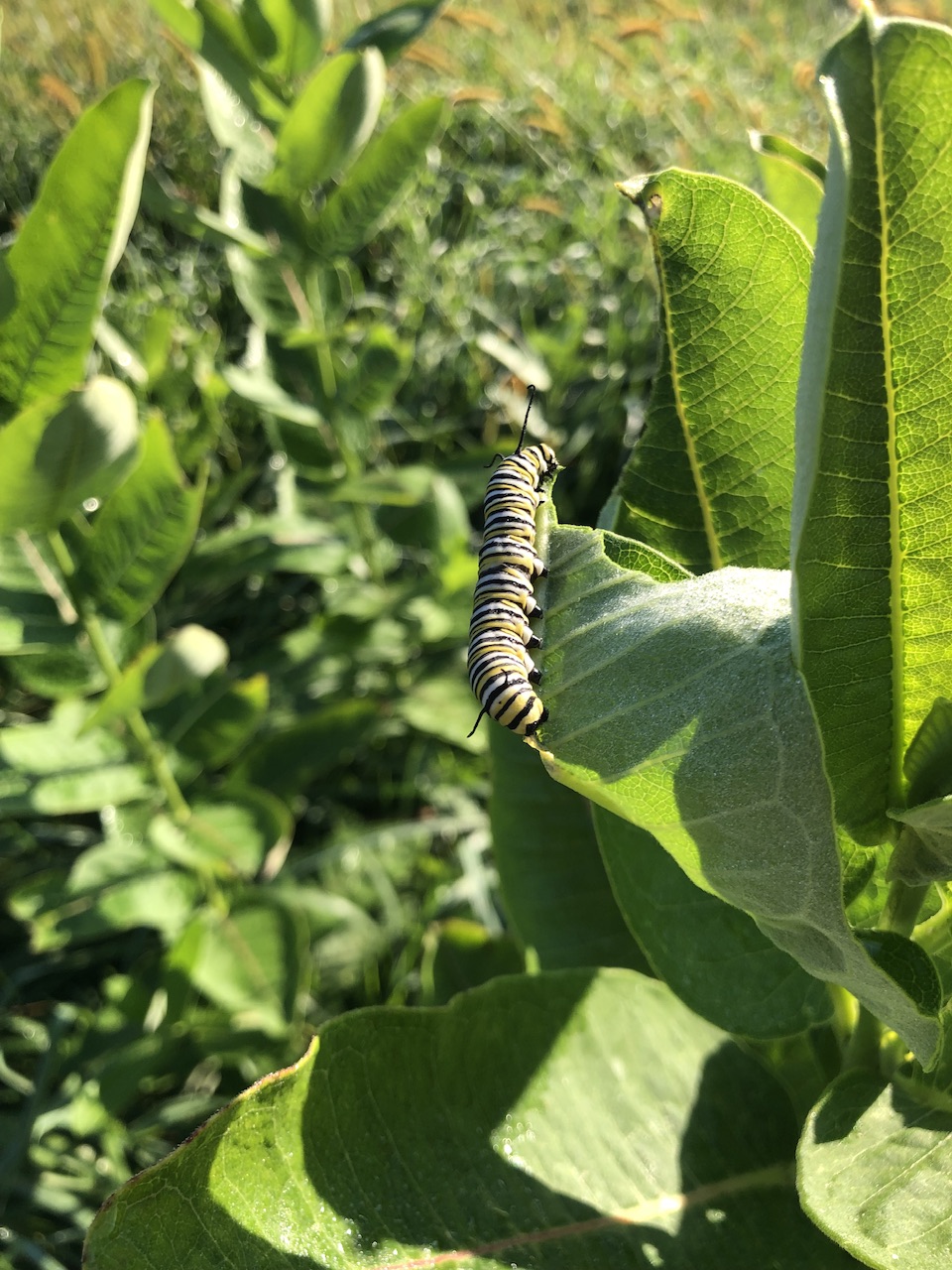
“What is that?” Mommy asked.
“A Monarch caterpillar,” Romeo answered.
We came home from an excellent program at the Johnson Public library with our very own Monarch caterpillar and care instructions. We picked fresh milkweed every day or so and switched out the old.
It was amazing watching the little guys. Most of their time was spent eating. But sometimes they would go still for awhile and then split and shed their old skin and go back to eating crazy.
The big transition was when they crawled off the milkweed and looked for a place to form a chrysalis. They use a silk producing organ called a spinneret, located just under their mouth, to form a sticky base. Then they turn around and anchor their butt to the base and hang in a j shape. After hanging for a while, they shed their skin for a final time, revealing a beautiful green and gold chrysalis.
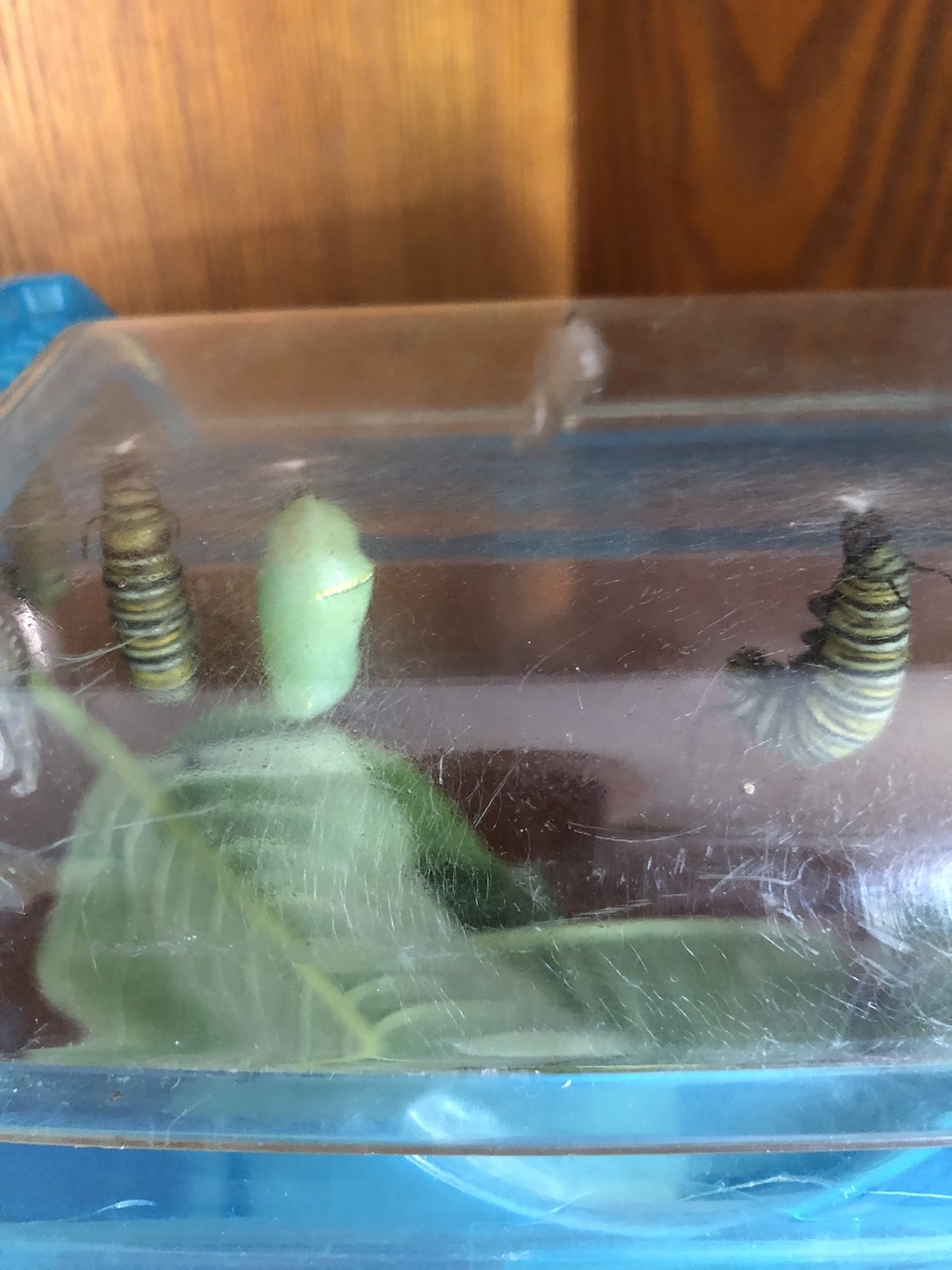
I know I’m anthropomorphizing when I say that all these transitions look incredibly painful to me. Who knows how it feels to the caterpillar? But they don’t have much choice in the matter. Instinct pushes them forward. I’ve never heard of a caterpillar on a diet, watching its figure.
The craziest transition happens inside the chrysalis. The caterpillar’s body releases powerful digestive enzymes, the same ones used to digest the fairly indigestible milkweed, and digests itself, leaving only a heart, a couple of breathing tubes, and a little bit of brain. The rest of its body breaks down into a nutrient rich soup, from which the caterpillar reforms itself into the beautiful Monarch butterfly over the course of ten days or so.
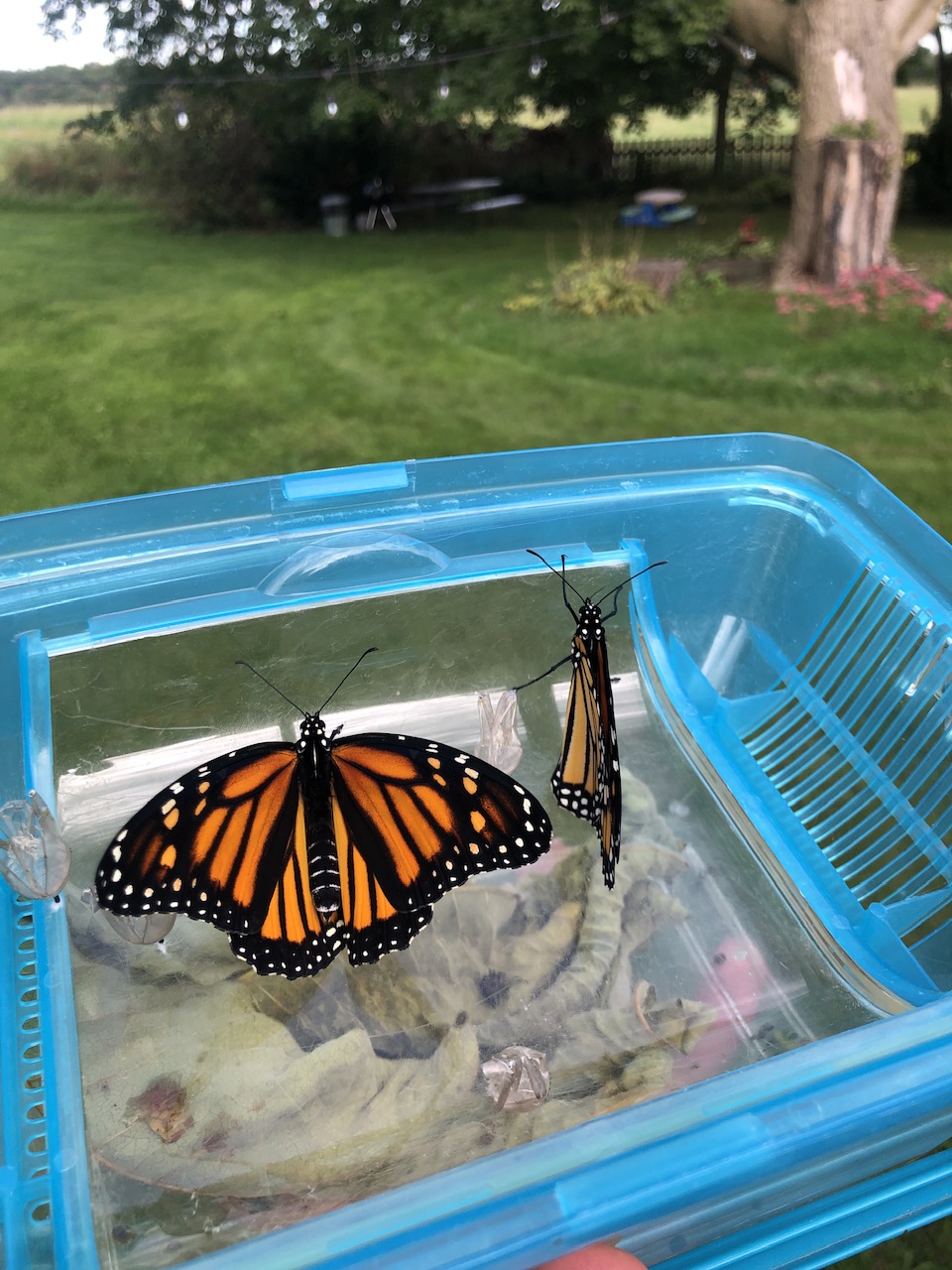
The chrysalis becomes transparent the last few days, the black and orange butterfly wings showing through. And then the new butterfly emerges, resting and drying its wings. We release them after several hours and watch, as their new wings push them to new heights.
Are they surprised? Do they remember being a caterpillar? Do caterpillars dream of flying?
We had so much fun with this, I started scouting pastures ahead of our cattle herd. Our mob of cattle eat a little milkweed and knock down the rest. I felt bad about this until I read Monarchs prefer laying their eggs on new growth. With our long rest period and diverse pastures, I feel we are still pollinator friendly. But I started helping the ones I could, and we ended up raising ten this year.
At the end of September I scouted a pasture with Romeo and pulled up next to a patch of milkweed. I’d seen Monarch butterflies around, but I knew they were preparing to fly to Mexico where they overwinter.
“It’s too late in the season, but let’s look anyway,” I said.
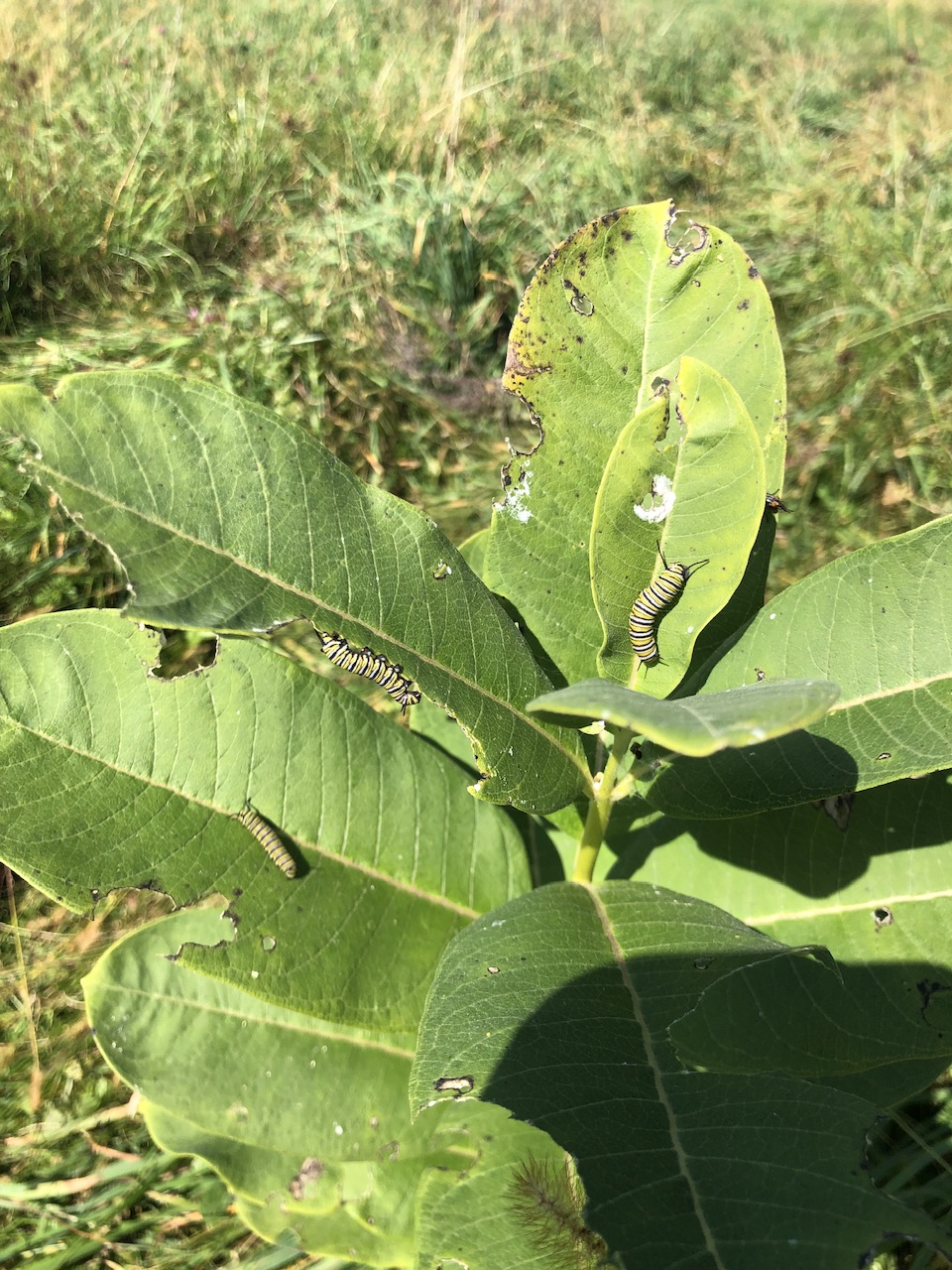
I recognized my hubris when I spotted three caterpillars, happily eating. If I had to fly to Mexico for the winter I would have left already, but what do I know?
So some of the Monarch butterflies were still mating and reproducing in southwest Wisconsin at the end of September. This got me to thinking, is it possible for Monarch butterflies to mate and reproduce and still fly to Mexico?
The internet says “no.” When Monarch butterflies mate and reproduce, it speeds up their aging and they die in a few weeks. The last generation of the summer are different. They spend their days eating and preparing for the journey south.
This super generation won’t mate and reproduce until they leave their winter homes in the mountains of Mexico in the spring, and fly north as far as Texas where they will reproduce. The offspring from that mating will fly north again, following spring and the milkweed, repeating this cycle, until the last generation reaches the southern edge of Canada.
Then somehow, with cues from nature, this super generation flies back precisely to their ancestors’ wintering grounds in the mountains of Mexico. Amazing!


 Posted by Curiousfarmer
