Summertime Drought

June 25, 2012

We’re in the midst of a summertime drought.  The second cutting of hay is considerably smaller than the first cutting.  The first field in my cutting schedule is seven acres.  Its yield decreased from 25 round bales of hay for first cutting to 3 and one third bales for second cutting.  Second cutting is always smaller than first, but this is abnormally so.

The permanent pasture my steers and hogs use is drying up fast.  My backup plan is to graze hay fields.  So I put a temporary electric fence in and started grazing a hay field, pictured below.

Summertime droughts are not uncommon here.  Rarely do we have crop failures, though.  So irrigation for crops is not used.  An exception is my partners, Carrie and Eric.  They rely so heavily on their pastures for chickens, sheep, and dairy cows, they’ve decided to put in a pasture irrigation system called K-line.  I’m interested to see how it works for them.


Planting Buckwheat

June 21, 2012

The barley/rape pig pasture, disced and planted with Buckwheat.  I planted on June 19th.  I planted it at a rate of about sixty pounds per acre.  A fifty pound bag cost me 55 dollars.

While researching alternative crops due to a crop failure this spring, (I ended up replanting corn), I came across Buckwheat.  I learned enough about it to make me want to try some.  I called my local seed supplier and they could get me a fifty lb. bag.  I wasn’t sure when or where I would use it, but I wanted to have it on hand in case I had an opportunity.  When I saw how well the cattle and hogs ate the barley/rape field, leaving very little crop residue, I decided this was my opportunity, and with perfect timing.  It’s recommended to plant Buckwheat after June 15th in Wisconsin.

I’m not sure exactly how I’ll use Buckwheat.  I’ll probably end up grazing it with the cattle and hogs.  Some of the things which intrigued me were its nutritional profile.  It’s very high in Lysine, which is the most limiting amino acid in a corn/soy diet for swine.

It also produces a very dark, strong flavored honey when bees use it as their primary nectar source.  One acre of Buckwheat can be used by bees to produce 150 lbs. of honey according to the source I found.  I would like to try some Buckwheat honey.  Maybe I can get my beekeeper friends to place a hive close.

According to Wikipedia, Buckwheat is not a grain, and can be eaten by people with gluten intolerance.  I wonder what Buckwheat pancakes taste like?


Grazed Barley/Rape Field

June 20, 2012

In the previous post, BC asked for more photos, and specifically what the field looks like when they’ve finished grazing.  This is the field, four days after turning in 31 steers and 30 hogs.  The field is about 3/4 of an acre.  The hogs received some grain besides.

In my next post, I’ll show what I did with the field now that they have finished grazing.


Cattle/Hogs Grazing Barley/Rape

June 18, 2012

This is the Barley/Rape field on June 15th as I turned the steers and sows in for grazing.  I planted it April 27th and posted pictures on May 11th.  Growth is slow the first couple of weeks, but really takes off after that.


Sows on Pasture

June 1, 2012

“Bewilder” the Duroc boar, with a Duroc sow.  The sows are enjoying the pasture this spring.  I used to house them at my parents’ farm in concrete and dirt lots.

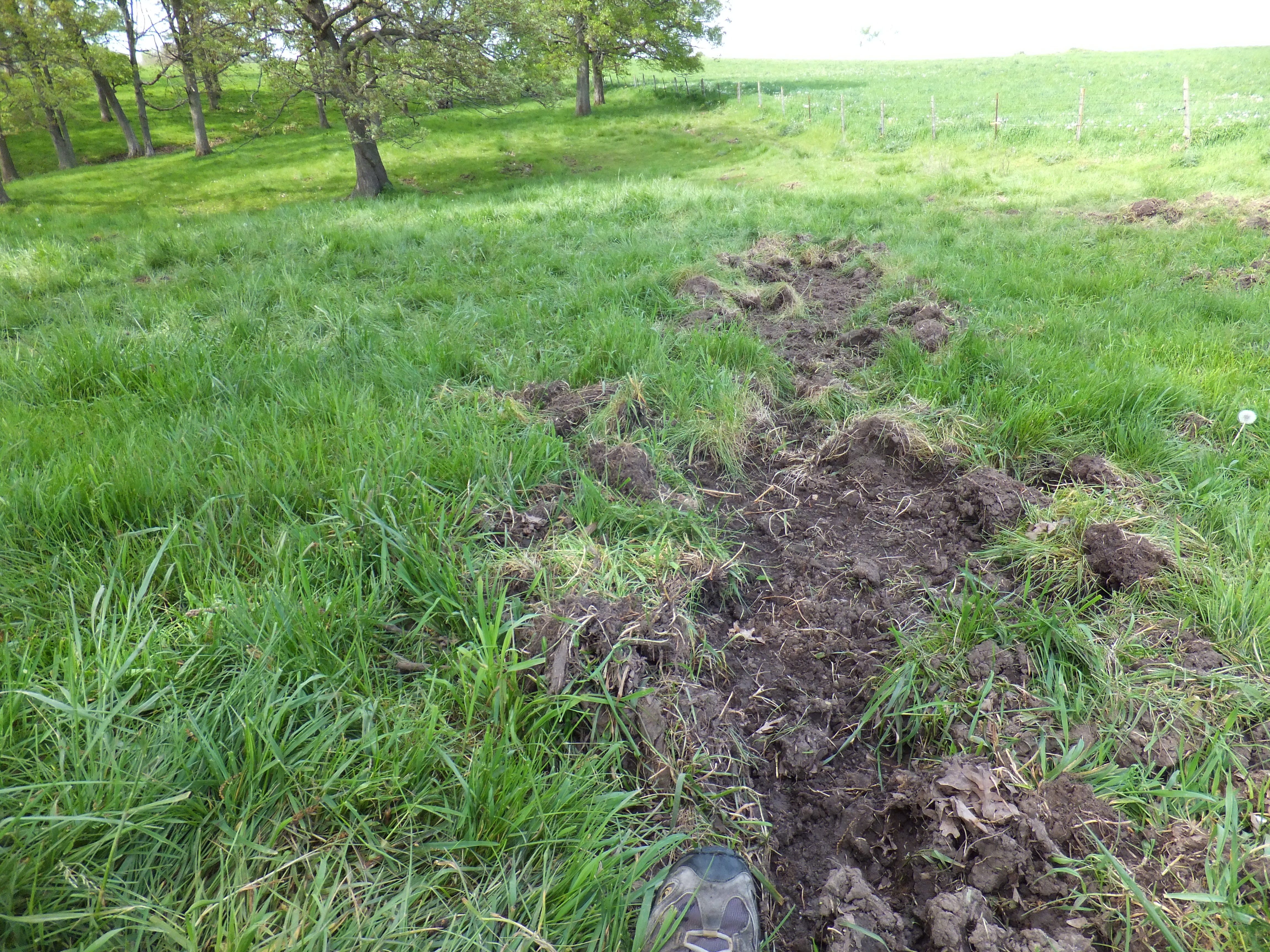
I’m still figuring things out.  One of the problems is “rooting,” or the digging behavior pigs exhibit.  Since this is permanent pasture, I hate to see the sod turned up, because I’m not sure how I’ll go about fixing it.  A sow can do the damage you see in the picture below in fifteen minutes.

I’ve tried “ringing,” putting a piece of metal in their snout to deter rooting.  It doesn’t seem to make much difference, and since it doesn’t seem very humane, I’m not doing that any more.

The biggest success I’ve had to reduce the rooting, is by reducing their daily grain feeding.  I’m feeding half the grain I used to.  The sows seem very satisfied to make up the difference grazing the pasture.  They spend hours every day grazing.  I think they were rooting more out of boredom.  Now they are required to work much harder for their daily calories, walking around in the process, and when they are full, they sleep.

I had to include one more picture of the Duroc sow below.  Isn’t she a beauty?  She is bred for her second litter.

Look at how well-muscled she is, yet still sound walking with femininity.  She is also an excellent grazer.  Thanks for indulging my bragging.


Cutting Down a Tree in the Yard

May 16, 2012

My friend helped me cut down a tree in our yard.  Half of it split and damaged the house three years ago, and I was dragging my feet cutting the other half down because its a nice tree with late afternoon shade for the house.  Now that its gone though, I’m glad.  Most of the trunk was dead, only about a two-inch section on one side was alive.

We put a rope up high in the tree around the bigger branches to help guide the tree and tied it to my tractor.  We weren’t entirely successful at guiding the tree, as the tree took out the power line when it fell, but I’m thankful we missed the house and shed and no one was injured.


Planted Pig Pasture

May 11, 2012

This one acre field was used last winter for the steers.  I fed hay and bedded them down with straw.  Once I turned the steers out to pasture, I loaded the manure which had accumulated over the winter and spread it on the rye field which was then tilled and planted to corn.

After allowing the soil to dry, I tilled this field and then planted barley and rapeseed on April 27th.  The field doesn’t look like much now, but it will be beautiful in six weeks when its ready for grazing.

The unfortunately named rapeseed also produces a beautiful yellow flower.  Rapeseed has two leaves with two segments each, which almost makes it look a 4-leaf clover.  This is the same plant which Canola oil is made from.


New Truck, New Haybine

May 6, 2012

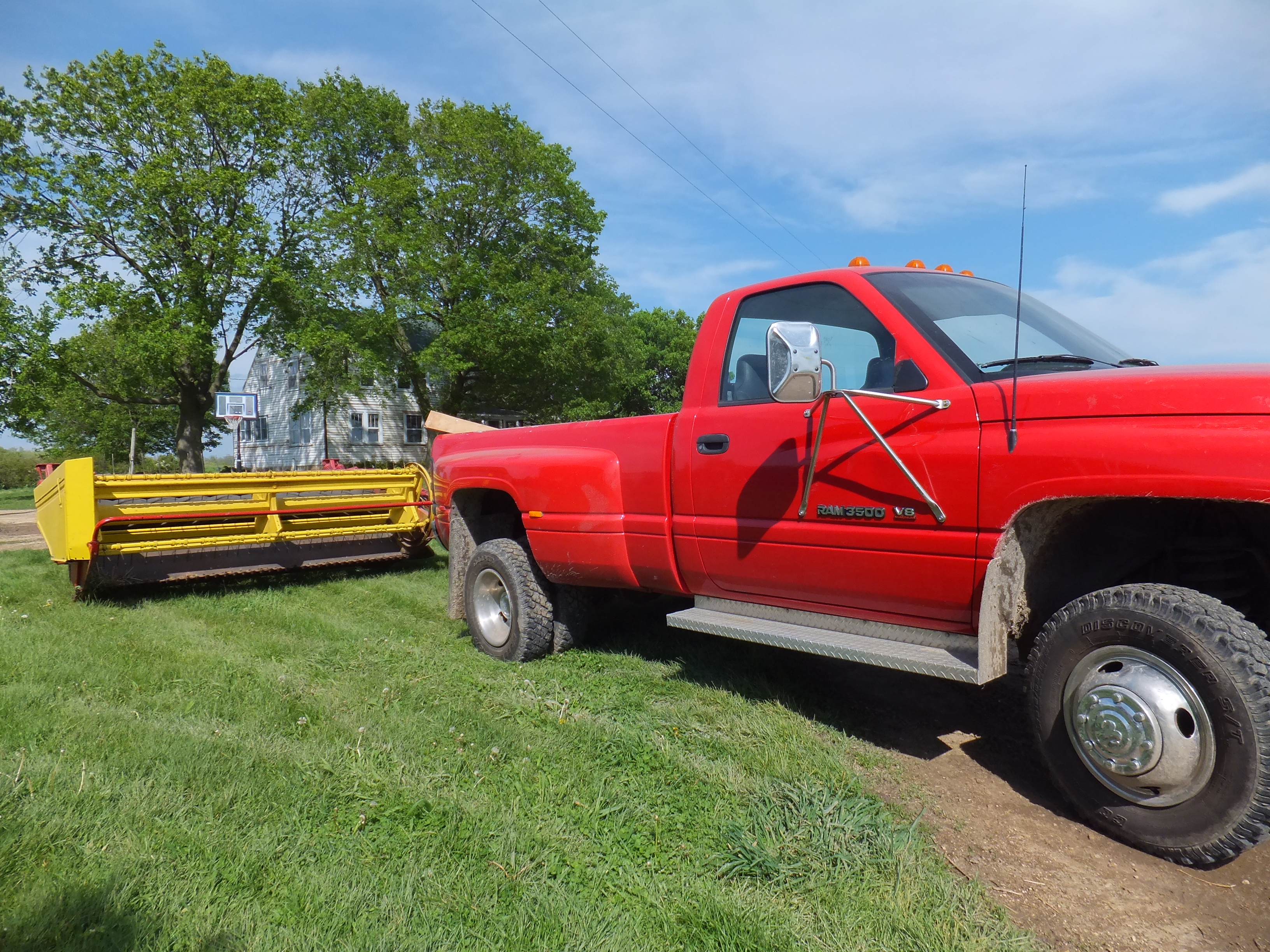
I made a couple of new purchases recently.  The truck is a 98 Dodge with 4-wheel drive.  I bought it specifically for hauling my animals to the butcher.  It does have a cassette player though, so I found my old cassette tapes and have been rerocking the 90’s.

The haybine is a New Holland 488, made in the 80’s.  A friend found it for me on Craig’s List.  It’s in great shape.

I paid $8000 for the truck and $2400 for the haybine.  The truck gets terrible mileage, less than ten miles per gallon when pulling the stock trailer.

Sixty miles round-trip to the butcher with about one load per week equals 3,000 miles, and maybe another 1,000 miles picking up supplies, means I may only drive it 4,000 miles per year.  If I get eight miles per gallon, I’ll use 500 gallons of gas.  At $4 per gallon I’ll spend $2000 annually on gas.

As much as I think grazing animals are part of the solution to global-warming, using this much fuel to get my animals to the butcher leads me to believe I’m not part of the solution.  But alas, I’m part of a system.

I would love to keep all my animals in one herd, schedule a kill date at my butcher, then sort all the animals I want to cull and walk them to the butcher once per year.  This isn’t the world I live in, though.


Grazing Winter Rye II: All Business

April 8, 2012

Five days after turning the cattle into half the winter rye field.  They ate it down to nothing.  And I have a round bale of hay available at all times.  But they want the green stuff.

When I turned them into the field five days ago, they did some running around, feeling their oats.  This time they were all business.  They knew what rye was, and they wanted it.

I love turning cattle into a new field of luscious forage.  Imagine tucking into a really good meal, and you won’t run out of food, and you won’t lose your appetite for about four hours.  I imagine this is how the cattle feel.  Nice.

Happy Easter!


Grazing Winter Rye

April 5, 2012

I planted winter rye after corn silage harvest last fall.  I spreaded the bedding pack manure from one hoop building evenly over the field, disced the field lightly, and planted a bushel of rye per acre with my drill.

It came up nicely and gave me a few days of grazing last fall.  The real beauty of winter rye is that it stays green all winter.  When the snow isn’t too deep, it’s nice to find a sea of green in a dead and dormant winter landscape.

Winter rye also takes off growing in the spring faster than anything.  It has an alleopathic effect, meaning it’s competitive with other plants.  A quick glance in the field found no weeds.

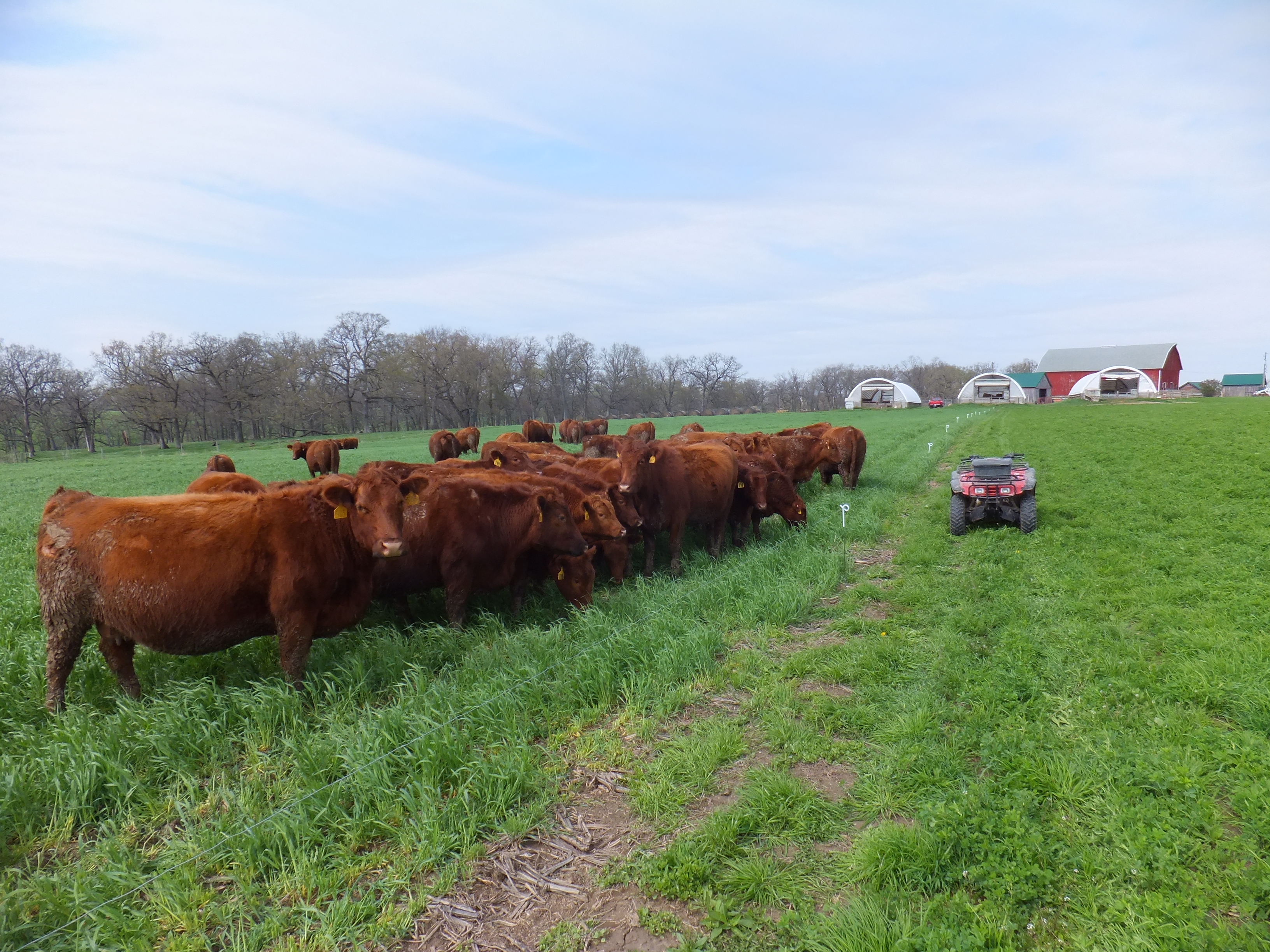
In the photo above you can see the cattle in the rye, kept in  with a single electric wire.  The field with the ATV is alfalfa/grass.  The dead area is where I concentrated the driving of machinery, keeping the compacted/damaged area in one place, rather than scattered throughout the fields.

In the photo below you can see the saying is true, “grass is greener etc,” even when it’s not.  I’m amazed at cows’ body knowledge.  They will reach under an electric fence, mere inches from being shocked, and rarely get shocked.